Once upon a time there was a violin maker who had two quarrelsome sons, and their names were John and Rudolf. When the boys came of age, their father put them to work in his shop, but John and Rudolf found it difficult to get along with one another, and they quarreled even more bitterly after the old man died.
One day a guitarist came into the shop and asked John and Rudolf if they would make him a special instrument. The brothers set aside their differences long enough to work together, and the result was a guitar that looked and sounded like no other. The guitarist was so pleased that he told all of his friends, and soon John and Rudolf had many new customers, and enough money that they continued to get along for a while.
But the pleasant times didn't last forever. Before long, John wanted to do things differently from Rudolf, and Rudolf wanted to do things differently from John, and each convinced himself that the idea for the splendid guitar was his own and not the other's. (In truth, it belonged to neither.) The brothers began to quarrel again, and then to bicker, and then to fight, and soon John left the shop and sought his fortune elsewhere.
Store that away for later.
From Teres to Redpoint to Galibier
Five years ago, a German manufacturer named Thomas Scheu decided to sell turntable kits to the do-it-yourself audio community, and he described his offerings in a series of posts on various Internet venues, including the popular Analog Addicts mailing list. Among those whose attention he caught were two Coloradoans, Chris Brady and Thom Mackris. Scheu's designs seemed good and the prices were actually quite reasonable, but Chris and Thom began to think out loud about pushing the design concepts even further. After some conversations between themselves and with a few other interested audiophiles, they decided to make their own turntables from scratch. A large and heavy turntable with a modular design and, consequently, fluid upgrade path took shape, but there was one problem: Tooling up to make only a few high-quality platters and bearings and motor pulleys and suchlike was prohibitively expensive. The only way to economize was by an economy of scale. It was early January 2000, and Brady and Mackris had attracted 11 other people to their cause, but virtually all of them had careers in other fields, and none wanted to become audio manufacturers. So they made a proposal to the other kit-builders on the Internet: If enough people were willing to kick in, they could all form a co-op and have their turntable parts made relatively cheaply. By the end of that month a total of 52 people had signed on, and the newly christened Teres project was born. By all accounts, those 52 hobbyists had a great time listening to and experimenting with their new turntables: Engineering lessons were learned, new music was discovered, and friendships were forged. But in spring 2001, Chris Brady, whose machinist brother had been contracted to make many of the Teres turntable parts, announced to the group that he was turning Teres into a commercial venture. Thom Mackris was impressed with neither Chris's business plan nor his "buyout" offer—a single turntable plinth that Chris's brother, Bryce Brady, had recently made—and he responded by joining forces with fellow project member Peter Clark to form a different commercial firm, called Redpoint Audio. (Mackris and Clark are both rock-climbing enthusiasts: hence the name.) In particular, Thom Mackris's partnership with Peter Clark centered around their ideas regarding platter design and construction, which had evolved somewhat since the Teres project began. They also decided to forgo the Teres turntable's rather complex motor-control circuitry, donated to the project by designer Manfred Huber, in favor of a comparatively simple voltage regulator.
Finally—or as finally as can be in such a context—Thom Mackris and Peter Clark parted company, as friends, in spring 2003. Peter carried on with Redpoint Audio, and Thom formed his own company, called Galibier. The two companies' products appear at least superficially similar to one another, in some respects remarkably so.
Galibier Quattro Supreme turntable
A popular TV show called Pimp My Ride asks the evergreen question Why do some men build extreme cars and trucks? They might as well wonder Why do some men build extreme turntables? I've looked at the phenomenon from every direction, and so far the most common answer seems to be: for the challenge. The fact that two of the Teres project's founders have an interest in mountaineering may be germane. It's also worth noting that one other founder didn't even own any records when Teres was getting underway: His love of turntable design would appear to have been more or less simply a love of turntable design—not that there's anything wrong with that. (For his part, Thom Mackris really does enjoy music, and has long maintained a good LP collection.)
 Some men have a natural tendency to make things that are impressive, and that often goes hand in hand with making things big. And the Teres turntable and all its progeny, none of which is sprung or suspended in any sense, are nothing if not massive. In the minds of many audio designers, that tendency may pay dividends in terms of reproducing music. They would point to the imperturbability of a massive player, and the idea that it's less susceptible to unwanted vibrations than something less chunky. But an idea is all it is, and people who come at it from the opposite direction would suggest that everything under the sun resonates, regardless of its mass, and that chunkier objects are in fact worse because they tend to release stored energy much more slowly (footnote 1). Your choice.
Somewhat less controversial are the benefits of a massive record platter. In that instance, the storage of certain kinds of energy—centripetal and rotational, I suppose—is regarded as a boon, because it helps to keep the record spinning at a steady speed. Rock-steady, if you'll pardon the expression.
Speaking of which, the Teres tribe all had another speed-stability trick up their sleeves: DC motors driven by rechargeable batteries. I'm with them all the way on that, having spent time with Pink Triangle's sadly discontinued Pink Link kit for the Linn LP12 turntable, which does essentially the same thing (footnote 2). Although early DC motors had speed-stability issues, with or without control servos, that's less true of their more modern counterparts, and Mackris and Clark are among the designers who believe that the combination of a massive and well-machined record platter with a low-speed, low-torque DC motor offers the best combination of steady speed, immunity to groove drag (ie, changes in record speed effected by especially heavily modulated portions of the record groove), and freedom from motor noise.
Are they on the right track? I had a chance to find out in July, when Thom Mackris sent me a sample of his best Galibier model, the Quattro Supreme ($5000). Add to that Galibier's composite platter option ($1250) and their Anvil record weight ($350)—the most accurately named audio product that I'm aware of—and you have a $6600 turntable, ready for action with the tonearm and cartridge of your choice.
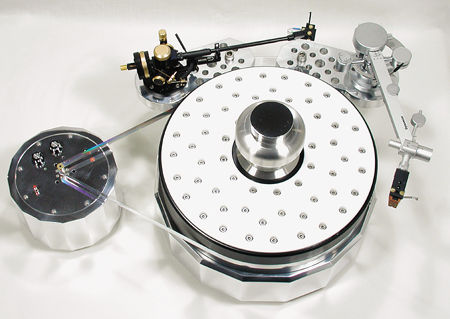
The Quattro Supreme begins life as 75-lb billet of aluminum alloy (yes, it could have been a Hardy fly reel), which is milled into a flat and mostly round platform not quite 4" thick and just larger in diameter than the platter itself. One portion of the platform is outsized and squared off, and this is intended to support one or two arm mounts, about which I'll have more to say later. The underside of the Quattro Supreme plinth is machined into a maze of concentric channels, mapped in accordance with the structure's computer-modeled resonant modes and filled with lead shot and oil. (The basic Quattro model, which sells for $3500 with standard platter and without Anvil, lacks these lead-filled channels.) It's a remarkable sight, rather like the inside of an automatic transmission (or perhaps a pachinko table). The outside of the plinth looks impressive, too: It's milled into a series of flat sides, then polished to a high gloss.
Some men have a natural tendency to make things that are impressive, and that often goes hand in hand with making things big. And the Teres turntable and all its progeny, none of which is sprung or suspended in any sense, are nothing if not massive. In the minds of many audio designers, that tendency may pay dividends in terms of reproducing music. They would point to the imperturbability of a massive player, and the idea that it's less susceptible to unwanted vibrations than something less chunky. But an idea is all it is, and people who come at it from the opposite direction would suggest that everything under the sun resonates, regardless of its mass, and that chunkier objects are in fact worse because they tend to release stored energy much more slowly (footnote 1). Your choice.
Somewhat less controversial are the benefits of a massive record platter. In that instance, the storage of certain kinds of energy—centripetal and rotational, I suppose—is regarded as a boon, because it helps to keep the record spinning at a steady speed. Rock-steady, if you'll pardon the expression.
Speaking of which, the Teres tribe all had another speed-stability trick up their sleeves: DC motors driven by rechargeable batteries. I'm with them all the way on that, having spent time with Pink Triangle's sadly discontinued Pink Link kit for the Linn LP12 turntable, which does essentially the same thing (footnote 2). Although early DC motors had speed-stability issues, with or without control servos, that's less true of their more modern counterparts, and Mackris and Clark are among the designers who believe that the combination of a massive and well-machined record platter with a low-speed, low-torque DC motor offers the best combination of steady speed, immunity to groove drag (ie, changes in record speed effected by especially heavily modulated portions of the record groove), and freedom from motor noise.
Are they on the right track? I had a chance to find out in July, when Thom Mackris sent me a sample of his best Galibier model, the Quattro Supreme ($5000). Add to that Galibier's composite platter option ($1250) and their Anvil record weight ($350)—the most accurately named audio product that I'm aware of—and you have a $6600 turntable, ready for action with the tonearm and cartridge of your choice.
The Quattro Supreme begins life as 75-lb billet of aluminum alloy (yes, it could have been a Hardy fly reel), which is milled into a flat and mostly round platform not quite 4" thick and just larger in diameter than the platter itself. One portion of the platform is outsized and squared off, and this is intended to support one or two arm mounts, about which I'll have more to say later. The underside of the Quattro Supreme plinth is machined into a maze of concentric channels, mapped in accordance with the structure's computer-modeled resonant modes and filled with lead shot and oil. (The basic Quattro model, which sells for $3500 with standard platter and without Anvil, lacks these lead-filled channels.) It's a remarkable sight, rather like the inside of an automatic transmission (or perhaps a pachinko table). The outside of the plinth looks impressive, too: It's milled into a series of flat sides, then polished to a high gloss.
Footnote 1: The electrical analog of mass is not resistance, as many assume, but either inductance or capacitance, depending on how you look at it. Unfortunately, energy cannot be dissipated by inductance or capacitance alone, only by resistance.—John Atkinson
Footnote 2: After writing about it for Listener a number of years ago and sending back the review sample, I ordered my own Pink Link. Unfortunately, I had to return the kit for a refund because of a manufacturing defect in my sample's motor pulley. That very sample proved to be the last one Pink Triangle ever sent to the States.—Art Dudley
Five years ago, a German manufacturer named Thomas Scheu decided to sell turntable kits to the do-it-yourself audio community, and he described his offerings in a series of posts on various Internet venues, including the popular Analog Addicts mailing list. Among those whose attention he caught were two Coloradoans, Chris Brady and Thom Mackris. Scheu's designs seemed good and the prices were actually quite reasonable, but Chris and Thom began to think out loud about pushing the design concepts even further. After some conversations between themselves and with a few other interested audiophiles, they decided to make their own turntables from scratch. A large and heavy turntable with a modular design and, consequently, fluid upgrade path took shape, but there was one problem: Tooling up to make only a few high-quality platters and bearings and motor pulleys and suchlike was prohibitively expensive. The only way to economize was by an economy of scale. It was early January 2000, and Brady and Mackris had attracted 11 other people to their cause, but virtually all of them had careers in other fields, and none wanted to become audio manufacturers. So they made a proposal to the other kit-builders on the Internet: If enough people were willing to kick in, they could all form a co-op and have their turntable parts made relatively cheaply. By the end of that month a total of 52 people had signed on, and the newly christened Teres project was born. By all accounts, those 52 hobbyists had a great time listening to and experimenting with their new turntables: Engineering lessons were learned, new music was discovered, and friendships were forged. But in spring 2001, Chris Brady, whose machinist brother had been contracted to make many of the Teres turntable parts, announced to the group that he was turning Teres into a commercial venture. Thom Mackris was impressed with neither Chris's business plan nor his "buyout" offer—a single turntable plinth that Chris's brother, Bryce Brady, had recently made—and he responded by joining forces with fellow project member Peter Clark to form a different commercial firm, called Redpoint Audio. (Mackris and Clark are both rock-climbing enthusiasts: hence the name.) In particular, Thom Mackris's partnership with Peter Clark centered around their ideas regarding platter design and construction, which had evolved somewhat since the Teres project began. They also decided to forgo the Teres turntable's rather complex motor-control circuitry, donated to the project by designer Manfred Huber, in favor of a comparatively simple voltage regulator.
A popular TV show called Pimp My Ride asks the evergreen question Why do some men build extreme cars and trucks? They might as well wonder Why do some men build extreme turntables? I've looked at the phenomenon from every direction, and so far the most common answer seems to be: for the challenge. The fact that two of the Teres project's founders have an interest in mountaineering may be germane. It's also worth noting that one other founder didn't even own any records when Teres was getting underway: His love of turntable design would appear to have been more or less simply a love of turntable design—not that there's anything wrong with that. (For his part, Thom Mackris really does enjoy music, and has long maintained a good LP collection.)
Some men have a natural tendency to make things that are impressive, and that often goes hand in hand with making things big. And the Teres turntable and all its progeny, none of which is sprung or suspended in any sense, are nothing if not massive. In the minds of many audio designers, that tendency may pay dividends in terms of reproducing music. They would point to the imperturbability of a massive player, and the idea that it's less susceptible to unwanted vibrations than something less chunky. But an idea is all it is, and people who come at it from the opposite direction would suggest that everything under the sun resonates, regardless of its mass, and that chunkier objects are in fact worse because they tend to release stored energy much more slowly (footnote 1). Your choice.
Somewhat less controversial are the benefits of a massive record platter. In that instance, the storage of certain kinds of energy—centripetal and rotational, I suppose—is regarded as a boon, because it helps to keep the record spinning at a steady speed. Rock-steady, if you'll pardon the expression.
Speaking of which, the Teres tribe all had another speed-stability trick up their sleeves: DC motors driven by rechargeable batteries. I'm with them all the way on that, having spent time with Pink Triangle's sadly discontinued Pink Link kit for the Linn LP12 turntable, which does essentially the same thing (footnote 2). Although early DC motors had speed-stability issues, with or without control servos, that's less true of their more modern counterparts, and Mackris and Clark are among the designers who believe that the combination of a massive and well-machined record platter with a low-speed, low-torque DC motor offers the best combination of steady speed, immunity to groove drag (ie, changes in record speed effected by especially heavily modulated portions of the record groove), and freedom from motor noise.
Footnote 1: The electrical analog of mass is not resistance, as many assume, but either inductance or capacitance, depending on how you look at it. Unfortunately, energy cannot be dissipated by inductance or capacitance alone, only by resistance.—John Atkinson