| Columns Retired Columns & Blogs |

Harmonic Technology & Analysis Plus interconnects & speaker cables
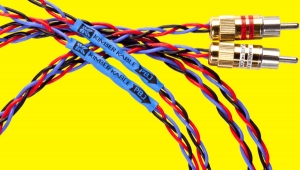
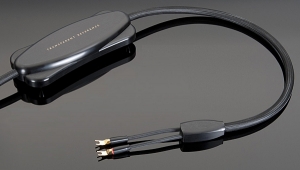
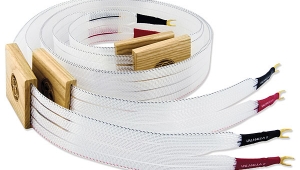
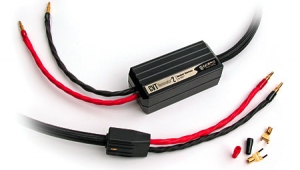
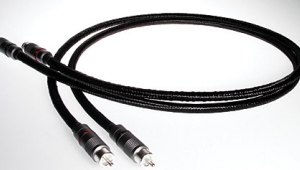
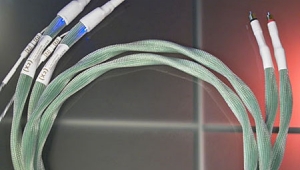
The dCS Verdi/Purcell/Elgar system's ultra-high resolution and superb focus, and its ability to drive an amplifier directly, provided a good opportunity to compare my current reference cables, Harmonic Technology's Magic Woofer ($2000/8' set) and Pro-Silway II interconnects ($399/m pair, $240/add'l. meter) with Analysis Plus's far less expensive Solo Crystal Oval 8 speaker cable ($969/8' set) and Solo Crystal Oval 8 interconnect ($399/m, longer lengths available).
Using a variety of SACDs, I spent an entire evening comparing Harmonic Tech's Pro-Silway II/Magic and Analysis Plus Solo Crystal Oval 8. The large differences proved to me that what you hear depends greatly on your associated cables, and that anyone who claims otherwise simply hasn't listened. Both brands of cables were prepped on the Audiodharma Cable Cooker.
For transient clarity, linearity, low-frequency nimbleness, high-frequency extension, and overall cleanness, the Analysis Plus was extremely impressive. It was neat and tidy, left no loose ends, and was free of glare, grain, or other annoying artifacts. The fast attacks of vocal sibilants and cymbals were handled with impressive clarity and ease. The bass was very tight, extended, well-controlled, and correctly sized.
Switching to the Harmonic Technology cable resulted in greater delicacy and transparency; an increased ability to experience and "feel" instrumental textures; and more, and more tactile, bass. The music seemed less "under wraps," though it's very possible that that sensation was the result of cable "enhancements." However, there was somewhat less bass control; rhythmic flow was somewhat impeded, and transients, while crisper and more detailed, were also slightly edgier and less finely drawn. But the net effect of the more tactile bass and the crisper transients was an overall sound of greater warmth and apparent detail.
While I respected the Analysis Plus's cleaner, more reserved take on the music, I preferred listening through the Harmonic Technology cable. At more than twice the price, Harmonic Tech's Magic Woofer should offer performance that's better, or at least more satisfying.
However, the importance of these differences, is very system-dependent. If you're running solid-state gear that tends toward the bright and edgy, if the music suffers from a bit of added hash and glare, and/or your speakers have some HF peaks, and/or your bass is a bit soft and amorphous, I'd bet that the Analysis Plus Solo Crystal speaker cable would work wonders in cleaning things up and restoring focus and control.
When I ran the dCS system through my tubed Hovland HP-100 preamp, the sonic tables began to turn toward the Analysis Plus, leaving me with the sinking feeling that cables are spices: before you add any, you'd better know your ingredients, and how you want your dish to taste.—Michael Fremer
NEXT: System Context »
 | |||||||||||

|
|
| |||||||||
- Log in or register to post comments













| Loudspeakers Amplification Digital Sources | |
Analog Sources Accessories Featured | |
Music Columns Retired Columns | |
Show Reports | |
Features Latest News Community | |
Resources Subscriptions |
 © 2024 Stereophile
AVTech Media Americas Inc., USA
All rights reserved