| Columns Retired Columns & Blogs |

Classé cdp-202 CD/DVD player
When, at the beginning of this century, the market profile of the high-end Mark Levinson brand took a dip due to the parent company's reorganization, one of the companies that took advantage of the opportunity was Classé Audio. Founded in 1980 by engineer Dave Reich (now with Theta Digital) and run by engineer-entrepreneur Mike Viglas since the mid-1980s, the Canadian electronics manufacturer's Omega line of high-end amplifiers and preamps had universally impressed Stereophile's scribes, and its Omega SACD player (reviewed by Jonathan Scull in November 2001) was the first such product to come from a North American company.
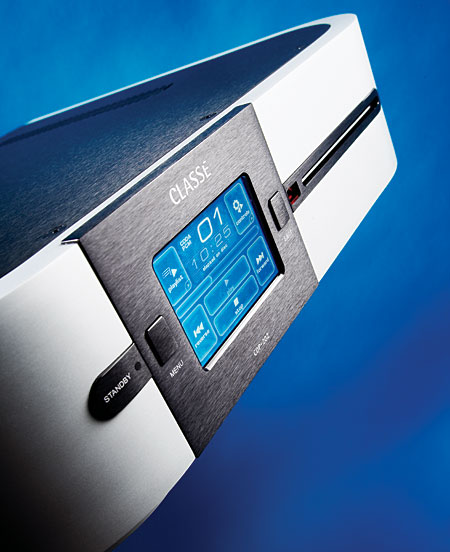
In 2001, Classé became part of the B&W Group. The first fruit of the new ownership was the Delta series of electronics, which feature a unique front panel that curves around to form the side panels and is apparently machined from solid aluminum. (It is actually formed by bending a vertical U-shaped extrusion, which, if you think about it, must be very difficult to do without the top and bottom webs buckling.) The cdp-202 ($6500) represents Classé's attempt to bring to market a true reference CD player, with better audio circuitry than the older but similar-looking cdp-102.
The cdp-202
While the press release announcing the April 2006 release of the cdp-202 describes it as a "CD player," it will actually play all current disc formats other than SACD. I asked Mike Viglas about the decision to omit SACD when I visited Classé in Montreal in fall 2005, and he explained that this allowed a far wider choice of transport mechanisms. If SACD playback was to be included to make the cdp-202 a true universal player, there were only a handful of suppliers of suitable hardware, which might limit Classé's future ability to manufacture the product. By omitting SACD capability, Classé could use a DVD-ROM mechanism, which has a standard form factor. Their choice was a TEAC transport, which Classé claims has superior disc-handling abilities and reliability. Discs are loaded via a front-panel slot that's discreetly outlined with blue light when no disc is present.
When I unpacked the cdp-202, the first thing that struck me was its apparent absence of control buttons. There are three discreet black buttons, labeled Standby, Menu, and Eject, but none of the usual transport and navigation buttons. The mystery was solved when I powered up the player. To the left of the disc-loading slot is an LCD display that illuminates to show the player's and disc's statuses. When the player is first plugged into the wall, white letters on a black ground state that the player is initializing, followed by the screen going dark and an LED in the Standby button glowing blue to indicate that the cdp-202 is standing by. When the player is taken out of standby, a white Classé logo fades in against a blue background. The logo is then replaced by the image of a disc with the words "PLEASE WAIT," followed by "INSERT A DISC." Then, when a disc is inserted, either the usual transport and track info buttons appear on the screen (CD) or the screen displays the disc's main menu (DVD). The LCD is actually a touchscreen with which you can play CDs or navigate DVD menus (a remote control is also supplied).
The Menu button allows the user to customize the player's operation regarding disc programming, display brightness, video operation, trigger operation, and whether the digital output jacks put out PCM from CD, converted PCM from DVD-Video discs, or raw data from DVDs to feed an external surround-sound processor or A/V receiver for Dolby or DTS decoding, and the volume and muting levels of the cdp-202's analog outputs. (The player can be set to bypass its volume control, which is how I used it in my auditioning.) The Menu button will also allow the player's operating firmware to be updated, with a file downloaded from Classé's website.
Technology
Beneath its acoustically damped, black-anodized top panel, the cdp-202's circuitry is carried on four surface-mount printed circuit boards: a main board running the full width of the interior that carries the digital audio output and control circuits and the power supply; a daughterboard each for the video and analog audio outputs; and another small board for the video decoding, this based on a Cirrus CS98200 DVD Processor chip, which manages the DVD-Audio, Dolby Digital, DTS, MP3, and AAC audio signal handling, as well as the video D/A conversion.
The CD data output from the transport or the decoded data from the Cirrus DVD decoder are routed to a Xilinx Complex Programmable Logic Device (CPLD) on the multilayer audio board, which upsamples digital audio data to 24-bit words with a sample rate of 192kHz and reclocks the data with a local crystal oscillator before feeding it to the D/A converters. These, two Burr-Brown PCM1792s, include the 8x-oversampling digital filters; one stereo DAC chip each is used for the left and right channels of the digital audio, these operated in dual-differential mode and true balanced operation maintained through to the analog output jacks. The single-ended Left and Right analog outputs are derived from a separate signal path using their own PCM1792 DAC chip. All the analog audio processing is realized with high-quality, FET-input, Burr-Brown OPA627 op-amps.
Sonics
The last Classé product I auditioned in my system was the CDP-10 CD player ($2000), which I reviewed back in the September 2003 Stereophile. Though I found its low frequencies a little lacking in weight and definition in absolute terms, that was outweighed for me by its grain-free highs and well-resolved soundstaging and the fact that it offered HDCD decoding. By contrast, the cdp-202 doesn't decode HDCD discs, which is a shame considering the superb standard of recording the revitalized Reference Recordings is now achieving with such releases as its new disc of Keith Lockhart conducting the Utah Symphony in orchestral works by Bernstein and Rachmaninoff (RR-105). Nevertheless, this was the first CD I played in the Classé, and my initial impression of the cdp-202 was, as with the CDP-10, of a superbly grain-free treble.
A favorite orchestral recording these days is the New Zealand Symphony's SACD of Vaughan Williams works, conducted by James Judd. I have this on SACD (Naxos 6.110053), but for this review I picked up the DVD-A version (Naxos 5.110053). The Classé defaulted to the MLP-encoded DVD-A data and I selected track 2, the Norfolk Rhapsody, using the onscreen menu. (It is so convenient not to need an external display to navigate a DVD-A's menu.) Violins were silky smooth, and the overall sound had weighty lows and the feeling of a clean window opened onto the recorded stage.
Next up was a DVD-V of Robert Silverman performing Rachmaninoff's Piano Concerto 3 in Mexico City, recorded live without edits in the early 1990s for a TV broadcast (available from www.robert-silverman.com). Even though this has only a Dolby Digital soundtrack in the disc's Video zone and has a little more hiss, hum, and audience noise than you'd expect from a commercial release, the sound was rich and compelling over the cdp-202. And Bob's playing is muscular when required, lyrical always. Returning to the Naxos Vaughan Williams disc, the Classé recognized it when I slid it into the slot, and switched back to the Audio zone to allow me to resume playing where I had left off before playing the Silverman DVD-V. (Some older DVD-A players got confused about what zone they should be reading when presented with a mixture of DVD-Vs and DVD-As.) The Info button on the cdp-202's remote, incidentally, lets you see (on the player's LCD display) what you're listening to.
Enough video. I inserted the DualDisc of Bruce Springsteen's The Seeger Sessions (Columbia 82876 82867-2) into the cdp-202's slot—not without some trepidation, given the incompatibility some earlier slot-loading mechanisms had with DualDiscs, which are slightly thicker than CDs. Not to worry; the cdp-202 recognized the disc—except that I'd inserted it with the DVD side up. (Good grief, the print around the center hole of a dual-sided disc is tiny!) I selected PCM Stereo with the onscreen display and watched and listened to the "making of" documentary before flipping the disc to play the CD side. Again, the highs of this rather overcooked recording were smooth, and the bass was weighty. However, in level-matched comparisons with the Mark Levinson No.30.6 D/A processor, fed by the Classé's digital output, I did feel the cdp-202 didn't dig quite as deep or have quite as much leading-edge definition on this recording's double bass as the standalone DAC. But even this rather raucous disc still sounded sweeter in the treble.
One of the drawbacks of the DualDisc format is that the data integrity of the CD side has had to be compromised in order to make the disc thin enough to be bonded back to back with a DVD. Even with the Classé's superb error correction, I got occasional dropouts on the Seeger Sessions' CD side.
One of the few DVD-As that allows an in-the-clear, 24-bit/96kHz data output is Hi-Rez Music's reissue of the Ray Brown Trio's classic Soular Energy (HRM 2011). The cdp-202 played the 96kHz- and 192kHz-sampled sides of this two-sided DVD without problem, with a 96kHz datastream available at its digital output from both. Again, the Classé presented a combination of a sweeter high end and slightly less-extended low frequencies than the No.30.6.
Against the Ayre
My current reference for CD and DVD-Audio playback is the Ayre C-5xe universal player ($5000), which I bought following Wes Phillips' July 2005 review. For specific comparisons, I matched the outputs of the Classé and Ayre players to within 0.1dB at 1kHz, using the Levinson preamp's Input Offset Level function.
Starting with a reference track, the Mozart Flute Quartet movement on Editor's Choice (CD, STPH016-2), the Ayre and Classé players sounded extremely similar. Both had a less forward-sounding midrange than the Levinson DAC, both had sweet and smooth high frequencies, and both reproduced the acoustic of Santa Fe's St. Francis Auditorium in equal measure. But on extended listening, I began to suspect that the cdp-202 had just a little more top-octave energy than the C-5xe. But only a little.
I confirmed that impression first by playing "Cry Me a River," from the Soular Energy DVD, then the 24/96 transfer of Dusty Springfield's version of "The Look of Love," from the Casino Royale soundtrack (HDAD/DVD, Classic HDAD 2007). There was a slightly more wispy quality to Springfield's voice through the Canadian player; conversely, the Coloradoan player could be just as easily described as having slightly less top-octave air. It's a matter of swings and roundabouts. The Ayre perhaps very slightly emphasized the body of sounds, the Classé very slightly the leading edges. Which did I prefer? Whichever one I was listening to at the time.
I finished my comparisons by playing in both players CD-Rs of the master of my new Cantus recording, There Lies the Home, due to be released in September. I'd worked hard to preserve the sense of space on the recording, captured in June 2005 in Sioux Falls' delicious-sounding Washington Pavilion. Both players reproduced the sense of space surrounding the male voices and cello in Brian Arreola's "Break, Break, Break." However, the cdp-202, despite its somewhat more forward presentation, did slightly better at separating the musical threads of this rather densely scored work. And both excelled at contrasting Kelvin Chan's solo baritone against the piano backdrop in Sir Charles Stanford's Songs of the Sea suite.
Summing up
Putting aside its stunning looks—which you will either love or hate—the Classé cdp-202 offers a user-friendly interface and superb sound from all disc formats other than SACD. Whether or not that omission is an issue for you will depend on how much of your favorite music is available on that medium, or, conversely, how important it is for you to be able to get the best from both CDs and the increasing number of DVD-Videos of live music performances. And you gotta love its touchscreen display and control interface. Very nice, Classé. Very nice.
NEXT: Specifications »
 | |||||||||||

|
|
| |||||||||
- Log in or register to post comments















| Loudspeakers Amplification Digital Sources | |
Analog Sources Accessories Featured | |
Music Columns Retired Columns | |
Show Reports | |
Features Latest News Community | |
Resources Subscriptions |
 © 2024 Stereophile
AVTech Media Americas Inc., USA
All rights reserved