With hindsight, one of the sideways steps taken by the High End in the early 1990s was the splitting of CD players into separate transports and processors. There were good reasons for this development, not the least of which was the flowering of creativity it engendered in high-end audio engineers. Having open access to the digital audio data also made possible effective digital equalizers and room-correction processors, but in the rush to increase a system's component count, it was overlooked for too long that keeping everything in one box offered certain advantages. 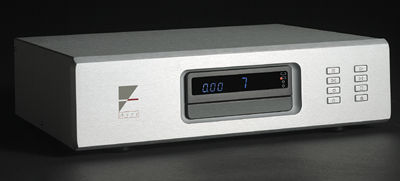 Yes, the highest-performing digital processors, such as the Weiss Medea (reviewed by Kal Rubinson in February), the dCS Elgar Plus (reviewed by Mikey Fremer in April), and my long-term reference, the Mark Levinson No.30.6 (reviewed by me in October and November 1999), still offer uncompromised CD sound. And yes, for those few of us with multiple data sources—DAT recorders, audio workstations, even a Nagra-D—using a standalone processor is mandatory. However, using an asynchronous interface that embeds the word clock in the data introduces further problems that need then to be solved. (See Malcolm Omar Hawksford's and Chris Dunn's 1992 AES paper, "Is the AES/EBU Interface Flawed?," reprinted as "Bits is Bits?" in the March 1996 Stereophile.) So, our views now sharpened by hindsight, these days Stereophile is paying more attention to one-box CD players.
Enter the CX-7
Yes, the highest-performing digital processors, such as the Weiss Medea (reviewed by Kal Rubinson in February), the dCS Elgar Plus (reviewed by Mikey Fremer in April), and my long-term reference, the Mark Levinson No.30.6 (reviewed by me in October and November 1999), still offer uncompromised CD sound. And yes, for those few of us with multiple data sources—DAT recorders, audio workstations, even a Nagra-D—using a standalone processor is mandatory. However, using an asynchronous interface that embeds the word clock in the data introduces further problems that need then to be solved. (See Malcolm Omar Hawksford's and Chris Dunn's 1992 AES paper, "Is the AES/EBU Interface Flawed?," reprinted as "Bits is Bits?" in the March 1996 Stereophile.) So, our views now sharpened by hindsight, these days Stereophile is paying more attention to one-box CD players.
Enter the CX-7
Although Ayre's top CD-playing machine is the DVD-based D-1X, which Paul Bolin reviewed in February, the CX-7 is considerably more affordable, at $2950. (The D-1X costs $6000 and up, depending on the video options chosen.) With its brushed-aluminum finish and blue display above the central disc drawer, the CX-7 looks very trim. The eight control buttons are to the right of the front panel, which gave rise to my only complaint: the Standby button on the bottom left of the array is adjacent to the drawer Open/Close button on the bottom right. Perhaps reviewers are more fumble-fingered than regular folks, but I kept putting the CX-7 into Standby when what I really wanted to do was eject a CD. As I was beginning my auditioning, Ayre sent me a replacement EEPROM for fixing a bug in the control circuitry (it is fair to note that I hadn't had a problem). Installing the v1.3 chip, which is mounted on the display and control board behind the front panel, gave me an opportunity to look under the hood. The CX-7's interior is dominated by two large blue-painted transformers and the transport, a CD-ROM mechanism sourced from TEAC and feeding what appear to be S/PDIF-encoded data to the printed circuit board that sits behind the output jacks. This double-sided board carries both surface-mount and traditional components, and the digital data are processed by an AKM receiver chip. This is capable of handling 24-bit words with sample rates of up to 96kHz, though in the CX-7, of course, it is dedicated to 16/44.1 data. The CX-7's AES/EBU-formatted digital output bypasses this chip, but is buffered and reclocked with a flip-flop and a pulse transformer and with the pcb traces surrounded by ground planes to minimize contamination of the analog circuitry.
The first stage of digital filtering is via the Burr-Brown DF1706 chip, a 24-bit device capable of operating at sample rates of up to 192kHz. Ayre appears to use this chip to upsample the data to 176.4kHz. The DF1706 also offers sharp or slow low-pass operation, which Ayre calls their Measure and Listen modes, these selectable via a rear-panel switch. Ayre's data sheet on the CX-7 says that a second filter "oversamples the data to 1.4112MHz." I assume this is the function of the large Field Programmable Gate Array (FPGA) chip adjacent to the DAC chip, this a single Burr-Brown PCM1738 compared with the D-1X's balanced array of PCM1704 chips. The well-regarded '1738 is a 24-bit part, its upper six bits converted with a conventional resistor-ladder topology, the lower 18 bits converted with a five-level sigma-delta architecture operating at 11.2896MHz. The PCM1738's analog outputs are in the form of current and appear to be fed directly to Analog Devices AD844 chips. This is a high-speed (2000V/µs!), low-settling-time bipolar op-amp optimized for current/voltage applications. Eight AD844s are used for the direct-coupled analog output stages. Although there are no coupling capacitors, no DC servo circuits are used; Ayre's Charles Hansen feels that this seat-of-the-pants approach optimizes low-frequency quality. Ayre also claims that the circuitry is "zero-feedback." Not only is there no loop voltage negative feedback, there are not even current feedback loops around the op-amps. When the player is powered up, two arrays of green LEDs, presumably used for biasing, lend the interior a festive appearance.
Yes, the highest-performing digital processors, such as the Weiss Medea (reviewed by Kal Rubinson in February), the dCS Elgar Plus (reviewed by Mikey Fremer in April), and my long-term reference, the Mark Levinson No.30.6 (reviewed by me in October and November 1999), still offer uncompromised CD sound. And yes, for those few of us with multiple data sources—DAT recorders, audio workstations, even a Nagra-D—using a standalone processor is mandatory. However, using an asynchronous interface that embeds the word clock in the data introduces further problems that need then to be solved. (See Malcolm Omar Hawksford's and Chris Dunn's 1992 AES paper, "Is the AES/EBU Interface Flawed?," reprinted as "Bits is Bits?" in the March 1996 Stereophile.) So, our views now sharpened by hindsight, these days Stereophile is paying more attention to one-box CD players. Although Ayre's top CD-playing machine is the DVD-based D-1X, which Paul Bolin reviewed in February, the CX-7 is considerably more affordable, at $2950. (The D-1X costs $6000 and up, depending on the video options chosen.) With its brushed-aluminum finish and blue display above the central disc drawer, the CX-7 looks very trim. The eight control buttons are to the right of the front panel, which gave rise to my only complaint: the Standby button on the bottom left of the array is adjacent to the drawer Open/Close button on the bottom right. Perhaps reviewers are more fumble-fingered than regular folks, but I kept putting the CX-7 into Standby when what I really wanted to do was eject a CD. As I was beginning my auditioning, Ayre sent me a replacement EEPROM for fixing a bug in the control circuitry (it is fair to note that I hadn't had a problem). Installing the v1.3 chip, which is mounted on the display and control board behind the front panel, gave me an opportunity to look under the hood. The CX-7's interior is dominated by two large blue-painted transformers and the transport, a CD-ROM mechanism sourced from TEAC and feeding what appear to be S/PDIF-encoded data to the printed circuit board that sits behind the output jacks. This double-sided board carries both surface-mount and traditional components, and the digital data are processed by an AKM receiver chip. This is capable of handling 24-bit words with sample rates of up to 96kHz, though in the CX-7, of course, it is dedicated to 16/44.1 data. The CX-7's AES/EBU-formatted digital output bypasses this chip, but is buffered and reclocked with a flip-flop and a pulse transformer and with the pcb traces surrounded by ground planes to minimize contamination of the analog circuitry.