Most people who now listen to tube amplifiers began with a transistor amp, and know from experience that a tube amp of a given measured power output sounds louder than its nominally identical transistorized equivalent. The unofficial consensus is that you need two to four times the transistor power to achieve the same loudness as you would using tubes. In other words, given the (subjectively) undistorted sound level a 25W (footnote 1) tube amplifier can provide, if you want the same loudness from solid-state technology you would have to replace it with at least a 50W transistor amp (footnote 2).  There have been many speculations about the reasons for these differences between measured and perceived performance. The oldest is probably the one that points out that tube amps tend to clip rather softly, whereas most transistor amps clip hard. So when you drive your tube amp into clipping, the occasional peaks will be compressed and rounded off—not chopped off, as would happen in a transistor amp, which is subjectively far more objectionable. Of more recent date are hypotheses that it is the different harmonic-distortion spectral contents of the two technologies that account for the perceived difference in loudness. There is probably some truth in all of these ideas, but in the last months of the past century I reserved a couple of days to examine an idea that had been triggered by the CD Touch, recorded by my friend and colleague Eelco Grimm for cable manufacturer Siltech. It turned out that there is a directly measurable explanation for the discrepancy. Edwin van der Klei of Siltech and Eelco Grimm are both audio purists, which is why they worked together on this project. Siltech wanted to celebrate their new G-3 cable (gold-dotted silver), which was used in the recording. Tube microphones were used, and the mike amp was Siltech's own tube preamp. During the mastering process, Eelco found that, even though the processing was being done in the digital domain, whatever processing he tried had a detrimental effect on the sound quality. He tried slight limiting to lift the average loudness to a more acceptable level, but even though this was done exclusively in the digital domain, it still degraded the sound. He tried level-shifting using Sonic Solutions, Meridian 518, and Wave Renaissance EQ. He even tried 1-bit level-shifting on the data files using a specially written program.
Everything degraded the sound. The many kinds of noise-shaped dither tried also led to the conclusion that "simplest is best." In the end, van der Klei and Grimm decided to use no processing and leave the recording as it was, and apply flat dither when truncating from the master's 20 bits to the CD's 16 bits. On Touch you hear percussion music performed by a single player. Percussion instruments by their nature are extremely dynamic. On practically all commercial CDs, compression is used to render this dynamic signal suitable for playback in a home environment, but the dynamics on Touch are left unsullied by compression. As a result, its average elevel is very low. Play Touch with your volume control at its normal setting and you'll hear almost nothing—but some peaks come within 0.5dB of clipping. [I listened to this CD and was astonished by the dynamic range captured by Eelco Grimm—and yes, it plays very quietly.—Ed.] Listening to this CD renewed my curiosity about the puzzling perceived dynamic performance of tube amplifiers, and I finally did what I should have done a long time ago: I hooked up my oscilloscope to one of the speaker outputs of my 300B amp and observed the screen while Touch was playing.
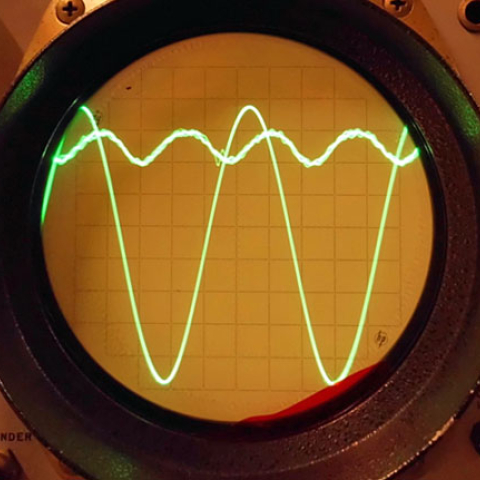
Holy Moses. I saw something like 30V peaks from an amp that, when driven with sinewaves and loaded with an 8 ohm resistor, never showed more than a 14V peak—more than twice the voltage technically supposed possible. You'd need a 50W transistor amp to realize the same peaks my 9W 300B launched without wincing at my speakers. However, I didn't know how to shoot a picture of such a moving target, and I don't own a digital 'scope. To record this behavior for history, I carried the amps to my car and drove to the magazine where Grimm works as a technical editor, and where they have an Audio Precision System Two. We loaded the amps with 8 ohms and fired a variety of pulse-like signals at them, but never arrived at more than 1.4 times the peak voltage observed with a steady-state sinewave near clipping. I was disappointed and puzzled. What was happening here? Back home, I decided not to give up yet. But to be able to do further research I had to have a digital oscilloscope with a memory and a printer output. I called Hewlett-Packard and learned that they were in the process of changing the brand name of their measuring equipment to Agilent (and to reserve the H-P name for computer peripherals). Of course they would lend me a 'scope; would a 500MHz, 1-gigasample/second model be enough?
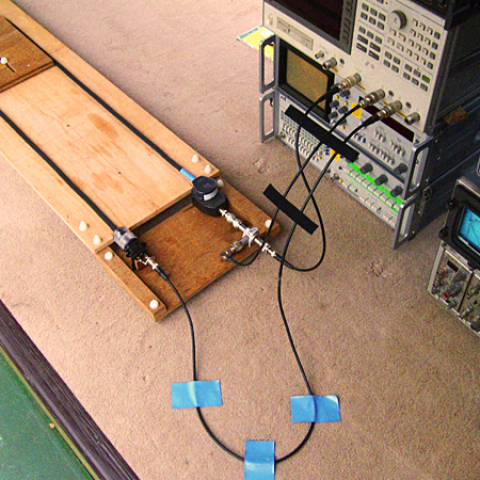
A few days later I picked up the HP54615B, plus an HP33120A function generator. It didn't take long to become familiar with all the buttons and menus, and after some trial runs I started measuring for real. The floor was soon littered with printouts; I'll share the most revealing with you.
There have been many speculations about the reasons for these differences between measured and perceived performance. The oldest is probably the one that points out that tube amps tend to clip rather softly, whereas most transistor amps clip hard. So when you drive your tube amp into clipping, the occasional peaks will be compressed and rounded off—not chopped off, as would happen in a transistor amp, which is subjectively far more objectionable. Of more recent date are hypotheses that it is the different harmonic-distortion spectral contents of the two technologies that account for the perceived difference in loudness. There is probably some truth in all of these ideas, but in the last months of the past century I reserved a couple of days to examine an idea that had been triggered by the CD Touch, recorded by my friend and colleague Eelco Grimm for cable manufacturer Siltech. It turned out that there is a directly measurable explanation for the discrepancy. Edwin van der Klei of Siltech and Eelco Grimm are both audio purists, which is why they worked together on this project. Siltech wanted to celebrate their new G-3 cable (gold-dotted silver), which was used in the recording. Tube microphones were used, and the mike amp was Siltech's own tube preamp. During the mastering process, Eelco found that, even though the processing was being done in the digital domain, whatever processing he tried had a detrimental effect on the sound quality. He tried slight limiting to lift the average loudness to a more acceptable level, but even though this was done exclusively in the digital domain, it still degraded the sound. He tried level-shifting using Sonic Solutions, Meridian 518, and Wave Renaissance EQ. He even tried 1-bit level-shifting on the data files using a specially written program.
Everything degraded the sound. The many kinds of noise-shaped dither tried also led to the conclusion that "simplest is best." In the end, van der Klei and Grimm decided to use no processing and leave the recording as it was, and apply flat dither when truncating from the master's 20 bits to the CD's 16 bits. On Touch you hear percussion music performed by a single player. Percussion instruments by their nature are extremely dynamic. On practically all commercial CDs, compression is used to render this dynamic signal suitable for playback in a home environment, but the dynamics on Touch are left unsullied by compression. As a result, its average elevel is very low. Play Touch with your volume control at its normal setting and you'll hear almost nothing—but some peaks come within 0.5dB of clipping. [I listened to this CD and was astonished by the dynamic range captured by Eelco Grimm—and yes, it plays very quietly.—Ed.] Listening to this CD renewed my curiosity about the puzzling perceived dynamic performance of tube amplifiers, and I finally did what I should have done a long time ago: I hooked up my oscilloscope to one of the speaker outputs of my 300B amp and observed the screen while Touch was playing.
Holy Moses. I saw something like 30V peaks from an amp that, when driven with sinewaves and loaded with an 8 ohm resistor, never showed more than a 14V peak—more than twice the voltage technically supposed possible. You'd need a 50W transistor amp to realize the same peaks my 9W 300B launched without wincing at my speakers. However, I didn't know how to shoot a picture of such a moving target, and I don't own a digital 'scope. To record this behavior for history, I carried the amps to my car and drove to the magazine where Grimm works as a technical editor, and where they have an Audio Precision System Two. We loaded the amps with 8 ohms and fired a variety of pulse-like signals at them, but never arrived at more than 1.4 times the peak voltage observed with a steady-state sinewave near clipping. I was disappointed and puzzled. What was happening here? Back home, I decided not to give up yet. But to be able to do further research I had to have a digital oscilloscope with a memory and a printer output. I called Hewlett-Packard and learned that they were in the process of changing the brand name of their measuring equipment to Agilent (and to reserve the H-P name for computer peripherals). Of course they would lend me a 'scope; would a 500MHz, 1-gigasample/second model be enough?
A few days later I picked up the HP54615B, plus an HP33120A function generator. It didn't take long to become familiar with all the buttons and menus, and after some trial runs I started measuring for real. The floor was soon littered with printouts; I'll share the most revealing with you.
Footnote 1: While 25W may be the filament power-consumption figure alone of many big American tube designs, in Europe it is quite a normal figure for the output power of a tube amp. European speakers are just more sensitive, as well as being faster and livelier to boot. I do my normal listening on either a homebred 300B single-ended amplifier outputting some 10W (the exact figure depends on your tolerance of THD); or a pair of 40-year-old modified Philips power amps delivering about 4Wpc (measured)—EL84 push-pull in triode mode, class-A, no overall feedback. And I'm not ashamed to confess that the Philipses are sometimes replaced by their baby brother with an output of 1.6Wpc. Footnote 2: This comparison assumes similar circuit topologies: both class-A, both push-pull. Otherwise, the volume difference will be greater. At the same measured power, class-A will sound louder than class-B, single-ended will sound louder than push-pull, etc.
There have been many speculations about the reasons for these differences between measured and perceived performance. The oldest is probably the one that points out that tube amps tend to clip rather softly, whereas most transistor amps clip hard. So when you drive your tube amp into clipping, the occasional peaks will be compressed and rounded off—not chopped off, as would happen in a transistor amp, which is subjectively far more objectionable. Of more recent date are hypotheses that it is the different harmonic-distortion spectral contents of the two technologies that account for the perceived difference in loudness. There is probably some truth in all of these ideas, but in the last months of the past century I reserved a couple of days to examine an idea that had been triggered by the CD Touch, recorded by my friend and colleague Eelco Grimm for cable manufacturer Siltech. It turned out that there is a directly measurable explanation for the discrepancy. Edwin van der Klei of Siltech and Eelco Grimm are both audio purists, which is why they worked together on this project. Siltech wanted to celebrate their new G-3 cable (gold-dotted silver), which was used in the recording. Tube microphones were used, and the mike amp was Siltech's own tube preamp. During the mastering process, Eelco found that, even though the processing was being done in the digital domain, whatever processing he tried had a detrimental effect on the sound quality. He tried slight limiting to lift the average loudness to a more acceptable level, but even though this was done exclusively in the digital domain, it still degraded the sound. He tried level-shifting using Sonic Solutions, Meridian 518, and Wave Renaissance EQ. He even tried 1-bit level-shifting on the data files using a specially written program. Footnote 1: While 25W may be the filament power-consumption figure alone of many big American tube designs, in Europe it is quite a normal figure for the output power of a tube amp. European speakers are just more sensitive, as well as being faster and livelier to boot. I do my normal listening on either a homebred 300B single-ended amplifier outputting some 10W (the exact figure depends on your tolerance of THD); or a pair of 40-year-old modified Philips power amps delivering about 4Wpc (measured)—EL84 push-pull in triode mode, class-A, no overall feedback. And I'm not ashamed to confess that the Philipses are sometimes replaced by their baby brother with an output of 1.6Wpc. Footnote 2: This comparison assumes similar circuit topologies: both class-A, both push-pull. Otherwise, the volume difference will be greater. At the same measured power, class-A will sound louder than class-B, single-ended will sound louder than push-pull, etc.