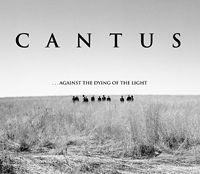
Part 1: Wes Phillips on the CD's genesis To find the true genesis of ...Against the Dying of the Light, the new recording from Minnesotan-based male-voice choir Cantus available from this website's secure "Recordings" page, you'd have to journey back to the beginning of 2001. In January or February, the group had begun to grapple with the development of a new program. Cantus' discs are distillations of the programs they perform on tour, and for several years now, one of the ways the ensemble had distinguished itself from other men's choruses was in the way their concerts expanded on a theme or themes—"almost taking the audience on a journey with us," as bass Erick Lichte puts it.  Coming on the heels of their last program, an exploration of folksong from around the world that resulted in their last recording, Let Your Voice Be Heard (January 2002, Vol.25 No.1), the group felt the need to perform more ambitious material, lest they be dismissed as an upscale 'N Sync. Musically and conceptually, it was time to get serious. It occurred to Erick Lichte that, when sequenced correctly, some of the new material the group had recently mastered actually told a story. The stoicism of Sibelius' "Hymnus" ("Lazy heirs benefit from his effort / at last expended; remembering they praise / his hands, now destroyed by cold death, / and his heart, now broken") fed directly into the despair of "O Vos Omnes" ("O ye people who pass by / behold and see / if there is any sorrow like unto mine") by Pablo Casals, a composer better known as a virtuoso cellist. Lamentations like Josquin's "Absalon, fili mi" ("Absalon, my son, that I could have died for you, my son. / Life holds no pleasure, let me descend to hell, weeping.") were milestones on the path to the acceptance of "De Profundis" ("If thou, Lord, should mark iniquities / O Lord, who shall stand? / My soul hopes in the Lord. / For with the Lord there is mercy, / And with Him is plenteous redemption."). Armed now with the awareness that their concert could illustrate a musical and poetic progression from grief and sorrow to consolation and joy, the group began assembling the new program. They regularly received standing ovations when they performed Kenneth Jennings' settings of two Dylan Thomas poems, "Do Not Go Gentle Into That Good Night" ("Old age should burn and rave at close of day; / Rage, rage against the dying of the light.") and "And Death Shall Have No Dominion" ("Though they go mad they shall be sane, / Though they sink through the sea they shall rise again; / Though lovers be lost love shall not; / And death shall have no dominion."). Taking their cue from the defiance of "And Death Shall Have No Dominion," the group sought emotional release in the rapture of Randall Thompson's "Alleluia" and the triumphant beatitude of Debussy's "Invocation" ("Rise up, voice of my soul, with the dawn, with the night / Throw yourself forth like the flame / Spread yourself like the noise / Float on the wing of clouds"). The final stage of the journey fell into place with Samuel Barber's soaringly transcendent setting of Gerard Manley Hopkins' "Heaven-Haven (A Nun Takes the Veil)":
 I have desired to go
Where springs not fail,
To fields where flies no sharp and sided hail
And a few lilies blow.And I have asked to be
Where no storms come,
Where the green swell is in the havens dumb,
And out of the swing of the sea. Cantus had found its final piece about the final peace. "God Protect Us from War"—Kanteletar II: Then, on September 11 2001, everything changed. "We were rehearsing at Westminster Presbyterian Church in downtown Minneapolis," tenor Michael Hanawalt recalled. "The events in New York, Northern Virginia, and Pennsylvania had unfolded during the morning and we had serious reservations about whether or not we should have our scheduled rehearsal. Erick and I discussed canceling, but, in the end, we decided that, at the very least, we should all meet. We all walked into the rehearsal room and we just sat there. Nobody spoke. Then, after about 15 minutes, we began to talk about what was happening and what we could do. Finally we decided that this is what we do—what we do is sing, so we decided to go on with the rehearsal. "Westminster staged an interfaith service that evening and they asked us to participate, so we sang Pablo Casals' 'O Vos Omnes.' Performing that night helped us get through that day—we felt that, by singing, we were doing what we were best at. We weren't firemen or construction workers or rescue workers and we weren't there, but we were contributing."
The group had scheduled its next tour for October, but the program concerned them. They had wanted to challenge themselves and their audiences, but to confront concertgoers with such difficult questions and such dark reflections at such a time was not, to Cantus' way of thinking, to be undertaken without soul-searching. "We weren't certain this was what people wanted to hear," said Lichte. "But we immediately felt the audiences connecting with those pieces—under different circumstances, I don't know if people would have had the same tolerance or understanding of the material. These works rank among the most serious classical music in our repertory, and we were concerned it might prove too intense and too personal. But that's not what audiences seemed to take from it.
Coming on the heels of their last program, an exploration of folksong from around the world that resulted in their last recording, Let Your Voice Be Heard (January 2002, Vol.25 No.1), the group felt the need to perform more ambitious material, lest they be dismissed as an upscale 'N Sync. Musically and conceptually, it was time to get serious. It occurred to Erick Lichte that, when sequenced correctly, some of the new material the group had recently mastered actually told a story. The stoicism of Sibelius' "Hymnus" ("Lazy heirs benefit from his effort / at last expended; remembering they praise / his hands, now destroyed by cold death, / and his heart, now broken") fed directly into the despair of "O Vos Omnes" ("O ye people who pass by / behold and see / if there is any sorrow like unto mine") by Pablo Casals, a composer better known as a virtuoso cellist. Lamentations like Josquin's "Absalon, fili mi" ("Absalon, my son, that I could have died for you, my son. / Life holds no pleasure, let me descend to hell, weeping.") were milestones on the path to the acceptance of "De Profundis" ("If thou, Lord, should mark iniquities / O Lord, who shall stand? / My soul hopes in the Lord. / For with the Lord there is mercy, / And with Him is plenteous redemption."). Armed now with the awareness that their concert could illustrate a musical and poetic progression from grief and sorrow to consolation and joy, the group began assembling the new program. They regularly received standing ovations when they performed Kenneth Jennings' settings of two Dylan Thomas poems, "Do Not Go Gentle Into That Good Night" ("Old age should burn and rave at close of day; / Rage, rage against the dying of the light.") and "And Death Shall Have No Dominion" ("Though they go mad they shall be sane, / Though they sink through the sea they shall rise again; / Though lovers be lost love shall not; / And death shall have no dominion."). Taking their cue from the defiance of "And Death Shall Have No Dominion," the group sought emotional release in the rapture of Randall Thompson's "Alleluia" and the triumphant beatitude of Debussy's "Invocation" ("Rise up, voice of my soul, with the dawn, with the night / Throw yourself forth like the flame / Spread yourself like the noise / Float on the wing of clouds"). The final stage of the journey fell into place with Samuel Barber's soaringly transcendent setting of Gerard Manley Hopkins' "Heaven-Haven (A Nun Takes the Veil)": I have desired to goWhere springs not fail,
To fields where flies no sharp and sided hail
And a few lilies blow.And I have asked to be
Where no storms come,
Where the green swell is in the havens dumb,
And out of the swing of the sea. Cantus had found its final piece about the final peace. "God Protect Us from War"—Kanteletar II: Then, on September 11 2001, everything changed. "We were rehearsing at Westminster Presbyterian Church in downtown Minneapolis," tenor Michael Hanawalt recalled. "The events in New York, Northern Virginia, and Pennsylvania had unfolded during the morning and we had serious reservations about whether or not we should have our scheduled rehearsal. Erick and I discussed canceling, but, in the end, we decided that, at the very least, we should all meet. We all walked into the rehearsal room and we just sat there. Nobody spoke. Then, after about 15 minutes, we began to talk about what was happening and what we could do. Finally we decided that this is what we do—what we do is sing, so we decided to go on with the rehearsal. "Westminster staged an interfaith service that evening and they asked us to participate, so we sang Pablo Casals' 'O Vos Omnes.' Performing that night helped us get through that day—we felt that, by singing, we were doing what we were best at. We weren't firemen or construction workers or rescue workers and we weren't there, but we were contributing."