"Where do you want 'em?" Doug'n'David (of Stereophile's shipping and receiving, not your favorite morning drive-time talk radio co-hosts) had just wrestled over 500 lbs of cocooned Wilson WITT loudspeakers onto the floor of my garage. Like the Thiel CS7s I had parted with just a few weeks earlier, the WITTs came packed in solid, heavy wooden crates. The pained expressions on Doug'n'David's faces indicated that it was time for me to start reviewing minimonitors! The unpacking went more smoothly than I expected, but this is clearly a pair of loudspeakers that demand to be delivered, uncrated, and set up by a dealer.
 Indeed, Mark Goldman and Troy Kosovich of Wilson Audio Specialties were due to visit in just a few days to perform that setup. In preparation, I ran-in the loudspeakers, with pink noise for about 30 hours. After their visit I gave the WITTs an additional weekend of break-in before settling down to serious listening.
Design
Indeed, Mark Goldman and Troy Kosovich of Wilson Audio Specialties were due to visit in just a few days to perform that setup. In preparation, I ran-in the loudspeakers, with pink noise for about 30 hours. After their visit I gave the WITTs an additional weekend of break-in before settling down to serious listening.
Design
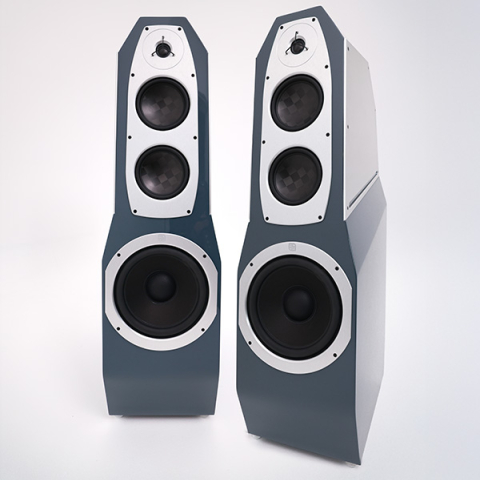
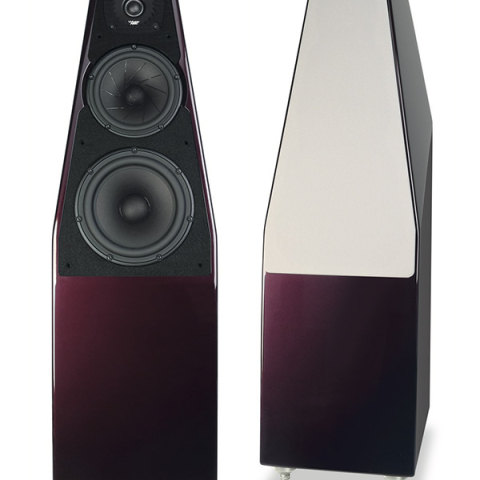
Although it comes via the bargain basement of Wilson Audio, the WITT (for Wilson Integrated Transducer Technology) is still far more expensive than the flagship designs of many other companies. For $8888/pair you expect first-rate build quality, and you certainly get it. That 200-lb unpacked weight is not misleading; these babies are solid—the old knuckle-rap test produced little besides sore knuckles. Although the cabinet looks—and feels—as if it was hewn out of solid granite, it's actually built of a combination of MDF and the same phenolic material first used by Wilson in Stereophile's 1995 Product of the Year, the X-1/Grand SLAMM. In the WITT, phenolic is used more sparingly: in the critical areas of baffle, sides, and bottom. Internally, partition baffles are used both for increased rigidity and to break up internal standing waves. The woofer and tweeter in the WITT are made by Focal. Dave Wilson has long been partial to Focal tweeters (other versions are used in both the WATT and the X-1). The WITT's inverted titanium-dome tweeter is similar to that in the WATT/Puppy 5 in that it's driven by a voice-coil slightly smaller than the dome itself. (This is unlike a conventional dome tweeter, which is driven from its perimeter by a voice-coil the same diameter as the dome.) But there's an added twist: the dome is coated with titanium dioxide, which is employed for damping. Focal calls the titanium/titanium dioxide material "Tioxid."
The WITT's SEAS-made midrange unit resembles the woofer/midrange driver used in the earlier versions of the WATT (though not the new WATT 5). According to Wilson, however, the WITT's midrange is a new, superior version of that mid-'80s unit. Though, unlike the modular X-1 and WATT/Puppy, the WITT is a single-cabinet design, the midrange is mounted in its own separate sub-enclosure. While the woofer is reflex-loaded (ported), the midrange loading is "aperiodic," or pressure-release; the necessary damped vents may be seen at the back of the upper cabinet.
The internal wiring uses a variety of types and gauges of high-quality cables, and the crossover network is fully potted—as with all Wilson loudspeakers—to eliminate movement of the components due to vibration.
The WITT looks like a cross between the WATT/Puppy and an X-1, with stronger hints of the latter. The polished side pieces (Wilson calls them "side blades") are made of the phenolic material mentioned above. The front baffle is acoustically damped with a thin layer of acoustic foam to minimize diffraction problems, and the grille consists of the same open-cell foam used throughout the Wilson line. The grille is frameless and about as acoustically transparent as any I know of; I did all of my listening with the grilles in place.
The look of the WITT is definitely industrial. I found the glossy sides, combined with the flat finish on the rest of the cabinet, very attractive, though as with the X-1, I expect mixed opinions on that score. It won't exactly clash with Early American, but in such company it will look like something from a time-warp.
Setup
When Mark Goldman and Troy Kosovich arrived, their time was limited. They immediately set about dialing-in the WITTs. Wes Phillips went into Wilson Audio's setup procedures extensively in his recent review of the WATT/Puppy 5 (Stereophile, November 1995, Vol.18 No.11), but it's worth a brief review here. The object is to minimize the influence of the room on the sound of the loudspeaker (footnote 1). This is done by carefully mapping out "zones of [relative] neutrality" for the left and right loudspeakers, then finding the most neutral position for each loudspeaker within these zones.
When you're done, you'll likely find (as did Wes and I) that the loudspeakers are farther apart, and closer to the wall behind them, than you're accustomed to. Certainly, when Mark and Troy were done, the loudspeakers seemed waaaaaaay far apart to me. In reality, they were separated by only about 11', with my listening chair just slightly farther away than that. The toe-in was just short of aimed straight at the listening seat.
System
The system used with the WITTs consisted of the Denon DP-S1 transport, Mark Levinson No.36 D/A converter (the two linked by a Kimber AGDL coaxial digital cable), and a Jeff Rowland Design Group Consummate preamplifier. Amplification and cables were as noted below. The listening was conducted in my (approximately) 26' by 18' by 11' listening room, discreetly (though not obtrusively) treated with Tube Traps and damping panels from ASC, and Diffusors from RPG. Performance
My reaction to the WITTs' soundstage was the same as WP's with the WATT/Puppy 5s. Huge! It wasn't surprising that it stretched from wall to wall; the speakers were spaced nearly that far apart—or so it seemed. And dynamic? Mark Goldman's preferred listening levels were a bit more, shall I say, unrestrained than mine. I only thought I played things loud—early on, Mark ran out of volume capability with my Rowland preamplifier (it's internally set for 6dB of gain, and I wasn't particularly anxious to pull it out and tear into it to change that).
A Denon PRA-S1 was pressed into service; it had enough gain for King Kong. So did the WITTs—your ears will give out before they do when it comes to sheer output capability. All loudspeakers have a level at which they start to sound congested; with the WITTs, that level appears to be far higher than any sane individual would require. I'm not sure we ever reached it.
While the WITT's bass was powerful and punchy, Mark noted that the deepest bass in my room was less extended than he has heard from the loudspeakers elsewhere. Even at those high levels, I never feared for the integrity of my house, as I sometimes do in the Home Theater room with a pair of 18" Snell subs doing the dinosaur dip.
Of course, most of the fun came after the Wilson folks left. That's when the reviewer gets to rearrange everything. Actually, I didn't move a thing right away, preferring to first listen thoroughly to the WITTs as Mark and Troy had set them up.
Footnote 1: One line in WP's review raised my eyebrows. He said the "point of the [Wilson setup] exercise is to remove the room from the equation." I presume that this came from someone at Wilson, but it certainly overstates their goal. We can minimize adverse effects from the room, but we cannot, ever, "remove the room from the equation." Nor would we want to. Even the best loudspeakers sound terrible outdoors! What we want, of course, is to approach the quality of that unattainable, "perfect" room.
Indeed, Mark Goldman and Troy Kosovich of Wilson Audio Specialties were due to visit in just a few days to perform that setup. In preparation, I ran-in the loudspeakers, with pink noise for about 30 hours. After their visit I gave the WITTs an additional weekend of break-in before settling down to serious listening.
Design
Although it comes via the bargain basement of Wilson Audio, the WITT (for Wilson Integrated Transducer Technology) is still far more expensive than the flagship designs of many other companies. For $8888/pair you expect first-rate build quality, and you certainly get it. That 200-lb unpacked weight is not misleading; these babies are solid—the old knuckle-rap test produced little besides sore knuckles. Although the cabinet looks—and feels—as if it was hewn out of solid granite, it's actually built of a combination of MDF and the same phenolic material first used by Wilson in Stereophile's 1995 Product of the Year, the X-1/Grand SLAMM. In the WITT, phenolic is used more sparingly: in the critical areas of baffle, sides, and bottom. Internally, partition baffles are used both for increased rigidity and to break up internal standing waves. The woofer and tweeter in the WITT are made by Focal. Dave Wilson has long been partial to Focal tweeters (other versions are used in both the WATT and the X-1). The WITT's inverted titanium-dome tweeter is similar to that in the WATT/Puppy 5 in that it's driven by a voice-coil slightly smaller than the dome itself. (This is unlike a conventional dome tweeter, which is driven from its perimeter by a voice-coil the same diameter as the dome.) But there's an added twist: the dome is coated with titanium dioxide, which is employed for damping. Focal calls the titanium/titanium dioxide material "Tioxid."
When Mark Goldman and Troy Kosovich arrived, their time was limited. They immediately set about dialing-in the WITTs. Wes Phillips went into Wilson Audio's setup procedures extensively in his recent review of the WATT/Puppy 5 (Stereophile, November 1995, Vol.18 No.11), but it's worth a brief review here. The object is to minimize the influence of the room on the sound of the loudspeaker (footnote 1). This is done by carefully mapping out "zones of [relative] neutrality" for the left and right loudspeakers, then finding the most neutral position for each loudspeaker within these zones.
The system used with the WITTs consisted of the Denon DP-S1 transport, Mark Levinson No.36 D/A converter (the two linked by a Kimber AGDL coaxial digital cable), and a Jeff Rowland Design Group Consummate preamplifier. Amplification and cables were as noted below. The listening was conducted in my (approximately) 26' by 18' by 11' listening room, discreetly (though not obtrusively) treated with Tube Traps and damping panels from ASC, and Diffusors from RPG. Performance
My reaction to the WITTs' soundstage was the same as WP's with the WATT/Puppy 5s. Huge! It wasn't surprising that it stretched from wall to wall; the speakers were spaced nearly that far apart—or so it seemed. And dynamic? Mark Goldman's preferred listening levels were a bit more, shall I say, unrestrained than mine. I only thought I played things loud—early on, Mark ran out of volume capability with my Rowland preamplifier (it's internally set for 6dB of gain, and I wasn't particularly anxious to pull it out and tear into it to change that).
Footnote 1: One line in WP's review raised my eyebrows. He said the "point of the [Wilson setup] exercise is to remove the room from the equation." I presume that this came from someone at Wilson, but it certainly overstates their goal. We can minimize adverse effects from the room, but we cannot, ever, "remove the room from the equation." Nor would we want to. Even the best loudspeakers sound terrible outdoors! What we want, of course, is to approach the quality of that unattainable, "perfect" room.