After reviewing a long series of minimonitors, I am now working on what may well be an equally varied selection of large floorstanding loudspeakers. This trend began with my review of the Sonus Faber Cremona Elipsa in the December 2007 issue, and continues this month with the Series 2 version of the KEF Reference 207, until recently the flagship model from this English manufacturer (footnote 1). I reviewed the original Reference 207 in February 2003, and was very impressed by what I heard.
 "Midrange to die for!" I concluded in that review, deciding that the big, beautiful-looking KEF was a speaker I could live with for a long time, though I did note that my ultimate preference back then would have been for the slightly less expensive Wilson Audio Sophia or Revel Ultima Studio, due to a residual hardness in the 207's mid-treble. "On recordings that themselves sound hard," I wrote, "such as the DVD-A of Yes's Magnification (Rhino R9 78250), the KEF was unforgiving," though I did hold open the possibility that the speaker was merely revealing problems with the recordings.
There the matter lay until I saw a new version of the 207 on silent display at the 2007 Consumer Electronics Show. Other than the deletion of the small pod on top that had housed a supertweeter, it looked identical to the original. But when I spoke with Dr. Andrew Watson, head of KEF's engineering team, it emerged that the coaxial two-way Uni-Q unit, which covers the range from the lower midrange up, had been completely redesigned. Such was the improvement, he explained, that the supertweeter was no longer needed to cover the range above 15kHz. The price was planned to be $20,000/pair, compared with the original version's $15,000/pair. Considering the decline in value of the US dollar against the pound sterling in the intervening years, the increase doesn't seem inappropriate.
I finally got to hear the new Reference 207/2 at Home Entertainment 2007 last May. Driven by Chord digital source and amplification components, it produced an enormous, full-range sweep of sound that, even at high levels in the fairly small hotel suite, was not even slightly fatiguing. I asked for a pair for review.
"Midrange to die for!" I concluded in that review, deciding that the big, beautiful-looking KEF was a speaker I could live with for a long time, though I did note that my ultimate preference back then would have been for the slightly less expensive Wilson Audio Sophia or Revel Ultima Studio, due to a residual hardness in the 207's mid-treble. "On recordings that themselves sound hard," I wrote, "such as the DVD-A of Yes's Magnification (Rhino R9 78250), the KEF was unforgiving," though I did hold open the possibility that the speaker was merely revealing problems with the recordings.
There the matter lay until I saw a new version of the 207 on silent display at the 2007 Consumer Electronics Show. Other than the deletion of the small pod on top that had housed a supertweeter, it looked identical to the original. But when I spoke with Dr. Andrew Watson, head of KEF's engineering team, it emerged that the coaxial two-way Uni-Q unit, which covers the range from the lower midrange up, had been completely redesigned. Such was the improvement, he explained, that the supertweeter was no longer needed to cover the range above 15kHz. The price was planned to be $20,000/pair, compared with the original version's $15,000/pair. Considering the decline in value of the US dollar against the pound sterling in the intervening years, the increase doesn't seem inappropriate.
I finally got to hear the new Reference 207/2 at Home Entertainment 2007 last May. Driven by Chord digital source and amplification components, it produced an enormous, full-range sweep of sound that, even at high levels in the fairly small hotel suite, was not even slightly fatiguing. I asked for a pair for review.
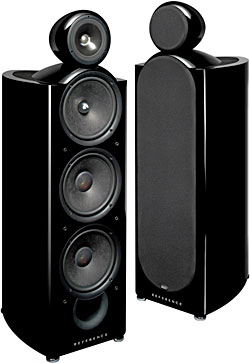 The Reference 207/2
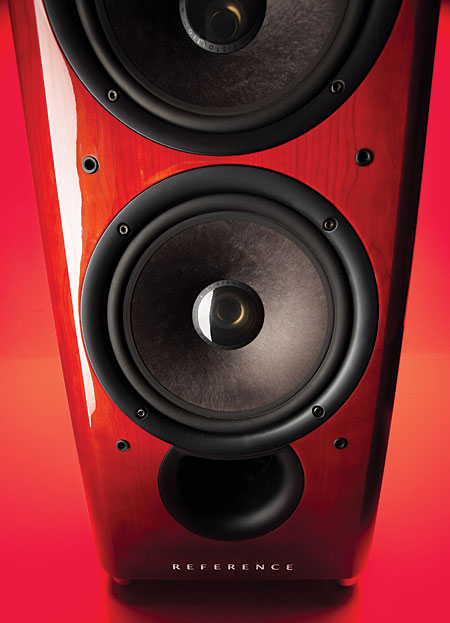
Other than the absence of the supertweeter pod, the 207/2 looks identical to its predecessor. A gloss-finished, cast-aluminum pod that carries the new Uni-Q drive-unit is mounted atop a wood-veneered cabinet with an elliptical plan section and complex internal bracing to minimize cabinet resonances. This handsome speaker manages to conceal its considerable bulk. As before, a 10" pulp-cone lower-midrange driver, mounted in its own subenclosure, covers the one and a half octaves where instruments and voices have their fundamental energy (120–350Hz). It hands over below 120Hz to a pair of 10" fiber-reinforced paper-cone woofers, these individually reflex-loaded with two large, flared ports each more than 4" in diameter. One port is at the base of the front baffle; the other is on top, firing upward behind the Uni-Q pod. (With a radiating diameter so much smaller than the wavelengths of the sound it produces, the port is omnidirectional—it doesn't matter which way it points.) The lower-midrange unit has a stationary, chromium-plated phase plug on the end of its pole-piece; the woofers have conventional dustcaps. All three lower-frequency units use a pair of shorting Faraday rings on their voice-coil formers to reduce magnetically induced distortion; the woofers use a long coil mounted in a short gap to give constant drive force regardless of cone position, while the lower-midrange unit, with its reduced need for large cone excursions, has a short-coil/long-gap motor. KEF introduced the Uni-Q driver in 1987. A tweeter powered by a powerful neodymium magnet is mounted on the front of the midrange unit's pole-piece, the polypropylene copolymer midrange cone forming a waveguide for the high frequencies. The acoustic centers of the two individual drive-units can thus be time-aligned, and the dual driver's dispersion remains constant with frequency in both the vertical and horizontal planes. However, reflections of the tweeter's output from the termination of the midrange cone can adversely affect its response. I understand that the new Uni-Q drive-unit results from work by Mark Dodd, GPAcoustics' head of research. Dodd found that the way to minimize the production of these reflections was to arrange the shapes of the tweeter dome and midrange cone so that the edge of the propagating high-frequency wavefront is always at right angles to the cone profile at the point of contact with the cone (footnote 2). "As long as this perpendicularity is maintained, the wavefront will continue to propagate without generating unwanted reflections, and thus produce a clean, undisturbed tweeter output," reported Paul Messenger in his "Industry Update" item on Dodd's work in the February 2007 Stereophile (pp.23–25). The new 1" titanium-dome tweeter in the 207/2 uses a vented pole-piece and is said to operate pistonically to a much higher frequency than in the original 207, eliminating the need for a separate supertweeter.
As in the 207, the 207/2's crossover features symmetrical 24dB/octave slopes, and electrical connection is via three pairs of plastic-covered binding posts at the speaker's rear. Short heavy-gauge jumpers, terminated with a spade at one end and a 4mm plug at the other, are supplied; I used them for all my auditioning. Two shorting plugs are also supplied; these are used to fine-tune the speaker's bass and treble balances by plugging in none, one, two, or all three into three sockets above the binding posts. By removing the plug from the bass socket, the low-frequency level can be shelved down by a couple of dB, to compensate for boundary loading if the speakers must be used close to walls. I auditioned the 207/2s with the shorting plugs set for free-space operation; ie, maximum bass. Even so, the speakers didn't boom. The other two sockets/plugs allow the entire treble region to be adjusted up by 0.75dB, or down by 0.75dB or 1.5dB. I did most of my listening (and all the measuring) with the treble set to flat, which worked best with rock recordings, but found that raising the treble by 0.75dB added some air to the sound of naturally miked classical recordings. I used the speakers without their grilles, but found very little difference with them on.
Sonics
With speakers as physically large and imposing as the Reference 207/2s, placement possibilities are of necessity restricted. I started off with the 207/2s in the positions where the Sonus Faber Cremona Elipsas had worked best, but ended up with the big KEFs a little closer to the sidewalls, almost exactly where I'd placed the original 207s. This gave the best balance between bass extension and definition. (I used the speakers on their smooth-faced feet rather than spikes, to make adjustment easier.) The speaker's tweeter is a high 43" from the floor, but I found that vertical listening axis was not critical—the 207/2's balance with pink noise didn't appreciably change over a wide range of ear heights. (When I sit in my listening chair, my ears are 37" from the floor.) With the earlier version, I found that I had to sit more upright than usual to get the full measure of the extreme highs.
Footnote 1: Yes, KEF has been owned for the past 15 years by Hong Kong–based Gold Peak, but to the Chinese company's credit, they have retained the ethos and quality of the brand founded more than 45 years ago by the late Raymond Cooke.
Footnote 2: Mark Dodd, "Optimum Diaphragm and Waveguide Geometry for Coincident Source Drive Units," presented at the 121st Audio Engineering Society Convention in San Francisco, October 2006.
"Midrange to die for!" I concluded in that review, deciding that the big, beautiful-looking KEF was a speaker I could live with for a long time, though I did note that my ultimate preference back then would have been for the slightly less expensive Wilson Audio Sophia or Revel Ultima Studio, due to a residual hardness in the 207's mid-treble. "On recordings that themselves sound hard," I wrote, "such as the DVD-A of Yes's Magnification (Rhino R9 78250), the KEF was unforgiving," though I did hold open the possibility that the speaker was merely revealing problems with the recordings.
There the matter lay until I saw a new version of the 207 on silent display at the 2007 Consumer Electronics Show. Other than the deletion of the small pod on top that had housed a supertweeter, it looked identical to the original. But when I spoke with Dr. Andrew Watson, head of KEF's engineering team, it emerged that the coaxial two-way Uni-Q unit, which covers the range from the lower midrange up, had been completely redesigned. Such was the improvement, he explained, that the supertweeter was no longer needed to cover the range above 15kHz. The price was planned to be $20,000/pair, compared with the original version's $15,000/pair. Considering the decline in value of the US dollar against the pound sterling in the intervening years, the increase doesn't seem inappropriate.
The Reference 207/2
Other than the absence of the supertweeter pod, the 207/2 looks identical to its predecessor. A gloss-finished, cast-aluminum pod that carries the new Uni-Q drive-unit is mounted atop a wood-veneered cabinet with an elliptical plan section and complex internal bracing to minimize cabinet resonances. This handsome speaker manages to conceal its considerable bulk. As before, a 10" pulp-cone lower-midrange driver, mounted in its own subenclosure, covers the one and a half octaves where instruments and voices have their fundamental energy (120–350Hz). It hands over below 120Hz to a pair of 10" fiber-reinforced paper-cone woofers, these individually reflex-loaded with two large, flared ports each more than 4" in diameter. One port is at the base of the front baffle; the other is on top, firing upward behind the Uni-Q pod. (With a radiating diameter so much smaller than the wavelengths of the sound it produces, the port is omnidirectional—it doesn't matter which way it points.) The lower-midrange unit has a stationary, chromium-plated phase plug on the end of its pole-piece; the woofers have conventional dustcaps. All three lower-frequency units use a pair of shorting Faraday rings on their voice-coil formers to reduce magnetically induced distortion; the woofers use a long coil mounted in a short gap to give constant drive force regardless of cone position, while the lower-midrange unit, with its reduced need for large cone excursions, has a short-coil/long-gap motor. KEF introduced the Uni-Q driver in 1987. A tweeter powered by a powerful neodymium magnet is mounted on the front of the midrange unit's pole-piece, the polypropylene copolymer midrange cone forming a waveguide for the high frequencies. The acoustic centers of the two individual drive-units can thus be time-aligned, and the dual driver's dispersion remains constant with frequency in both the vertical and horizontal planes. However, reflections of the tweeter's output from the termination of the midrange cone can adversely affect its response. I understand that the new Uni-Q drive-unit results from work by Mark Dodd, GPAcoustics' head of research. Dodd found that the way to minimize the production of these reflections was to arrange the shapes of the tweeter dome and midrange cone so that the edge of the propagating high-frequency wavefront is always at right angles to the cone profile at the point of contact with the cone (footnote 2). "As long as this perpendicularity is maintained, the wavefront will continue to propagate without generating unwanted reflections, and thus produce a clean, undisturbed tweeter output," reported Paul Messenger in his "Industry Update" item on Dodd's work in the February 2007 Stereophile (pp.23–25). The new 1" titanium-dome tweeter in the 207/2 uses a vented pole-piece and is said to operate pistonically to a much higher frequency than in the original 207, eliminating the need for a separate supertweeter.
With speakers as physically large and imposing as the Reference 207/2s, placement possibilities are of necessity restricted. I started off with the 207/2s in the positions where the Sonus Faber Cremona Elipsas had worked best, but ended up with the big KEFs a little closer to the sidewalls, almost exactly where I'd placed the original 207s. This gave the best balance between bass extension and definition. (I used the speakers on their smooth-faced feet rather than spikes, to make adjustment easier.) The speaker's tweeter is a high 43" from the floor, but I found that vertical listening axis was not critical—the 207/2's balance with pink noise didn't appreciably change over a wide range of ear heights. (When I sit in my listening chair, my ears are 37" from the floor.) With the earlier version, I found that I had to sit more upright than usual to get the full measure of the extreme highs.
Footnote 1: Yes, KEF has been owned for the past 15 years by Hong Kong–based Gold Peak, but to the Chinese company's credit, they have retained the ethos and quality of the brand founded more than 45 years ago by the late Raymond Cooke.