Combine an electrostatic panel to reproduce music's midrange and treble with a moving-coil woofer for the bass foundation. For decades, this has seemed the ideal way of designing a loudspeaker: Each type of drive-unit is used in the frequency region for which its performance is optimized. The resulting hybrid should sing like an angel. 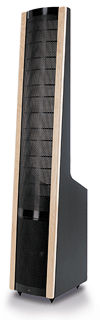 Yet such hybrids often turn out to be mules, in my experience, their sounds remaining resolutely earthbound. To integrate drivers with very diverse radiation patterns—the omnidirectional woofer and the bipolar panel—sets the speaker engineer a pretty problem, to say the least, while the choice of a crossover frequency that does the least damage to the music is also far from trivial. When I read Sam Tellig's enthusiastic prose (footnote 1) about MartinLogan's new baby, the Aerius, I was intrigued. Could the Kansas company have successfully blended thoroughbred electrostat and dynamic donkey to get the best of both breeds? Aerius
Like all MartinLogan designs, the Aerius features elegance in spades. The 55"-tall speaker occupies no more floorspace than a minimonitor on a stand. The 8" woofer is mounted in a sealed enclosure behind a downward continuation of the front stator. The enclosure is reinforced by two vertical triangular braces at the side-panel midpoints and is filled with synthetic fiber. Black-painted side panels rise from the woofer bin, tapering to the top of the speaker, while optional oak trim strips ($300) flank the panel.
The narrow, curved, electrostatic panel is sandwiched between black-painted, rigid perforated stators. The panel, coated with a very thin, transparent, conductive film to ensure even charge distribution over its surface, is divided into 14 horizontal sections, each between 2" and 3" high. Two clear plastic damping panels, each a few square inches in area and made from Lexan, are fixed to the rear stator. These are said to provide some response shaping by "pressure compensation." Electrical connection is via a pair of 5-way binding posts on the rear of the woofer enclosure; a second pair for individual drive of the two drive-units is a $200 option. The crossover circuitry is mounted on the inside of the woofer enclosure's rear panel. High- and low-pass slopes are specified at 12dB/octave, though some electrical response shaping appears to be employed. Air-cored coils and a mixture of plastic-film and electrolytic caps, along with a handful of resistors, are used. The internal wiring appears to be Monster. The crossover frequency is set at 500Hz—in the heart of the midrange. This is interesting; it allows nearly all musical fundamentals of bass, tenor, and alto instruments to be reproduced by the moving-coil unit, with the panel left free to handle their harmonics. Melody instruments—flutes, oboes, violins, the right-hand region of the piano, and the higher tessitura of the female voice—are reproduced exclusively by the electrostatic panel.
On the other hand, taking a relatively small panel down to 500Hz might be asking for too much excursion in its bottom octave, resulting in extra distortion products in the 1-3kHz region, where the ear is very sensitive. Note that the operative word here is "might," not "will." The proof will be in the listening.
Footnote 1: "Sam's Space," June 1993, Vol.16 No.6, pp.75-81.—JA
Yet such hybrids often turn out to be mules, in my experience, their sounds remaining resolutely earthbound. To integrate drivers with very diverse radiation patterns—the omnidirectional woofer and the bipolar panel—sets the speaker engineer a pretty problem, to say the least, while the choice of a crossover frequency that does the least damage to the music is also far from trivial. When I read Sam Tellig's enthusiastic prose (footnote 1) about MartinLogan's new baby, the Aerius, I was intrigued. Could the Kansas company have successfully blended thoroughbred electrostat and dynamic donkey to get the best of both breeds? Aerius Like all MartinLogan designs, the Aerius features elegance in spades. The 55"-tall speaker occupies no more floorspace than a minimonitor on a stand. The 8" woofer is mounted in a sealed enclosure behind a downward continuation of the front stator. The enclosure is reinforced by two vertical triangular braces at the side-panel midpoints and is filled with synthetic fiber. Black-painted side panels rise from the woofer bin, tapering to the top of the speaker, while optional oak trim strips ($300) flank the panel.
Footnote 1: "Sam's Space," June 1993, Vol.16 No.6, pp.75-81.—JA