Who knows not Circe,
The daughter of the Sun, whose charmed cup
Whoever tasted, lost his upright shape,
And downward fell into a groveling swine?
—John Milton, Comus Actually, maybe you know not Circe, so here's a refresher: When Odysseus landed on Aeaea, Circe placed an enchantment upon his crew, turning them into swine. Odysseus was unaffected because he was protected by an herb called Moly, a gift of Hermes, and he forced Circe to restore his crew's human forms. Odysseus then hung out with her for a year (fathering Telegonus, among other pastimes) before she dispatched him and his shipmates off to the underworld to consult Tiresias. Circe was the daughter of the sun god Helios and the ocean nymph Perse. As Aetes' sister and Medea's aunt, she figures prominently in Apollonius' Argonautica, cleansing Jason and Medea for their treacherous murder of Absyrtus. Tough broad—busy, too. What's the audio connection? No clues here—unless it's that this Circe, from Alón by Acarian Systems, also is capable of casting a spell. Certainly that seemed the case at HI-FI '98 last June, where the sound in the Acarian Systems/Cary room was the talk of the Show. Didn't see 'em change anyone into a swine, though—anybody who left the room a pig had probably walked in that way. Evolution is a change from an indefinite, incoherent homogeneity, to a definite coherent heterogeneity.
The Circe is a floorstanding three-way system with an external passive crossover. Designer Carl Marchisotto explains, "We use an external crossover to reduce degradation caused by the crossover components being vibrated or modulated by magnetic fields within the speaker. Obviously, inside the speaker is not the best place to mount a sensitive electronic device." The crossover contains three separate boards—one for each driver—and has a hard-wired harness of Alón's own Black Orpheus cable connecting it to the Circe's three sets of binding posts. It also has three pairs of posts, which accept the speaker wire from the amplifier. Marchisotto recommends triwiring the crossover to the amplifier, thus keeping the signal paths discrete all the way back to the amp.
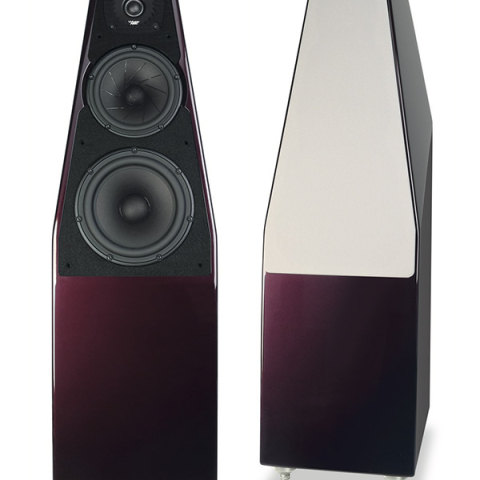
Reacting to complaints that triwiring a speaker can lead to cable costs higher than that of the speaker itself, Marchisotto developed his own speaker cable, Black Orpheus, and offers a 10' triwired harness for $500. The bass cable uses coaxial construction, with a solid inner core and a braided outer layer made of silver-plated copper, both metals oxygen-free. The midrange and HF cables are uni-axial, using silver-clad strands and OFC in the same bundle. The cable is roughly equivalent to 13 AWG. "We take some flak over our use of a very thin insulation," Marchisotto notes; "some people equate a thick cable with a good cable. But in audio we're not dealing with high voltages, and thick dielectrics load up the [inductance], which causes losses." Marchisotto is not exactly forthcoming concerning the crossover technology. "It's not a classical crossover. The slopes are sharper than a first-order but not as sharp as a second-order." "So what does that make it?" I asked. "A good crossover." Ah. The Circe itself is reasonably understated in a Vandersteen sort of way. The whole unit is clad in black fabric, with a cherrywood top cap. The sealed bass enclosure houses a 10" long-throw pulp-cone woofer. On top of this cabinet is a small slanted baffle that houses a 5.5" pulp-cone midrange unit and a 1" aluminum-alloy dome tweeter. The two upper-range drivers are set into the baffle, which is open to the rear, so that they perform as dipoles. Wooden dowels support the decorative top-plate above the baffle board and provide a framework for the speaker cloth.
All three drivers employ alnico magnets, which Marchisotto prefers for their "better fidelity, lower distortion, better low-level resolution, and more stable magnetic field, which translates into a more musical (more authentic, I think) harmonic structure. Alnico magnets also provide a more realistic sense of dynamics." The midrange and woofer cones are made of pulp-based materials: long-fiber wool is used for the woofer, while the midrange driver has a double treatment layering two different plastics over a pulp base. Marchisotto is adamant: "We prefer the low-level resolution and more natural sound of pulp-based drivers because we have found that alloy and higher-tech materials have colorations that cannot be totally compensated for in the crossover in the midrange. The HF driver is an aluminum-magnesium alloy. We don't mind using a metal dome for this frequency range because the resonance is above 25kHz, which is outside the range of hearing."
The daughter of the Sun, whose charmed cup
Whoever tasted, lost his upright shape,
And downward fell into a groveling swine?
—John Milton, Comus Actually, maybe you know not Circe, so here's a refresher: When Odysseus landed on Aeaea, Circe placed an enchantment upon his crew, turning them into swine. Odysseus was unaffected because he was protected by an herb called Moly, a gift of Hermes, and he forced Circe to restore his crew's human forms. Odysseus then hung out with her for a year (fathering Telegonus, among other pastimes) before she dispatched him and his shipmates off to the underworld to consult Tiresias. Circe was the daughter of the sun god Helios and the ocean nymph Perse. As Aetes' sister and Medea's aunt, she figures prominently in Apollonius' Argonautica, cleansing Jason and Medea for their treacherous murder of Absyrtus. Tough broad—busy, too.
What's the audio connection? No clues here—unless it's that this Circe, from Alón by Acarian Systems, also is capable of casting a spell. Certainly that seemed the case at HI-FI '98 last June, where the sound in the Acarian Systems/Cary room was the talk of the Show. Didn't see 'em change anyone into a swine, though—anybody who left the room a pig had probably walked in that way. Evolution is a change from an indefinite, incoherent homogeneity, to a definite coherent heterogeneity. The Circe is a floorstanding three-way system with an external passive crossover. Designer Carl Marchisotto explains, "We use an external crossover to reduce degradation caused by the crossover components being vibrated or modulated by magnetic fields within the speaker. Obviously, inside the speaker is not the best place to mount a sensitive electronic device." The crossover contains three separate boards—one for each driver—and has a hard-wired harness of Alón's own Black Orpheus cable connecting it to the Circe's three sets of binding posts. It also has three pairs of posts, which accept the speaker wire from the amplifier. Marchisotto recommends triwiring the crossover to the amplifier, thus keeping the signal paths discrete all the way back to the amp.