Unless you've been on active duty in the Middle East, you're aware that Mobile Fidelity Sound Lab is back in business. During Stereophile's Home Entertainment 2003 show in San Francisco last June, Kal Rubinson and I played hookey to visit MoFi mastering engineer Paul Stubblebine's recording studio, at 1340 Mission Street. As we sat spellbound, Paul played the original four-track, ½", 1-mil master tape of Stanislaw Skrowaczewski and the Minnesota Orchestra's legendary 1974 recording of Ravel's Boléro and Daphnis et Chloé (footnote 1). Stubblebine fed the four discrete channels from the specially modified ReVox reel-to-reel deck to a modern surround system. The master tape produced the cleanest, purest sound I had heard in a long time.
 That audio epiphany rejuvenated my interest in recorded music, and greatly boosted my enthusiasm for listening sessions at HE2003. Coleman Brice, MoFi's public relations specialist, promised KR and me SACD copies of that magical master tape when it became available. I couldn't wait.
Five months later, a small package arrived at my house, in it the finished SACD. I was in the middle of reviewing a loudspeaker I'd been entranced by at that same show—the Isophon Europa II loudspeaker. Because I'd actually heard the master tape of this new SACD, it seemed the perfect reference disc for testing the speaker.
Mathematics, Physics, Enthusiasm
That audio epiphany rejuvenated my interest in recorded music, and greatly boosted my enthusiasm for listening sessions at HE2003. Coleman Brice, MoFi's public relations specialist, promised KR and me SACD copies of that magical master tape when it became available. I couldn't wait.
Five months later, a small package arrived at my house, in it the finished SACD. I was in the middle of reviewing a loudspeaker I'd been entranced by at that same show—the Isophon Europa II loudspeaker. Because I'd actually heard the master tape of this new SACD, it seemed the perfect reference disc for testing the speaker.
Mathematics, Physics, Enthusiasm
The arrival of the Isophon Europa II seemed an ideal time to interview the speaker's designer, Roland Gauder, who visited me the day the loudspeakers were delivered. Gauder is tall, slim, and muscular, with a ready smile and clear, articulate English. He listened enthusiastically to the Europas in my listening room, and helped position the furniture to optimize the sound. He was bursting with eagerness to explain the Europa's unique design features: the acoustic bandpass filtering for the woofers, and the special configuration of the midrange drivers.
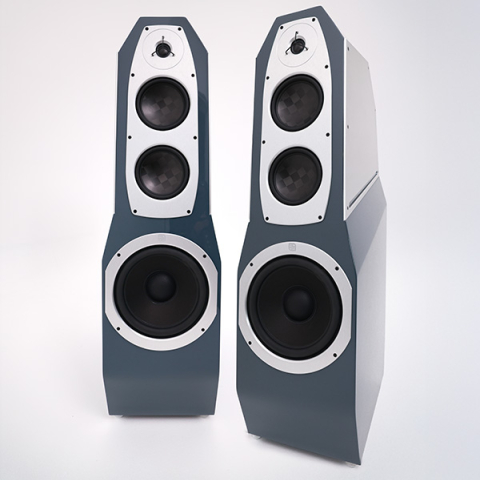
The Isophon Europa II is a tall, slim, floorstanding loudspeaker with beveled sides. It shares its aluminum veneer with a number of other high-end floorstanders, including the Krell LAT-1 and the Piega C-8 Limited. The Europa's tweeter and two of its three midrange drivers are set securely into a shiny chrome faceplate at the top of the column, with a 25.25" by 2" vertical slot running most of the front panel's length and covered by a grille. The third midrange driver is mounted in the side of the enclosure. The front midrange and HF drivers have no protective covers.
A bandpass woofer uses conventional drive-units, but instead of these radiating into the open air, they fire instead into an internal cavity, which is then vented to the outside world. Gauder decided to use this technology in the Europa because he was not satisfied with more conventional bass-reflex, or acoustic-suspension bass designs. Each of the two 9" woofers has a 2" long-throw voice-coil, a heavy paper cone, and its own separate sealed subcabinet to create acoustic (rather than electrical) bandpass loading. They fire into an internal chamber, with two ports opening into the long, large slot on the front baffle, to provide low air speed at high volumes. Foam placed in the vents provide additional filtering for frequencies above 80Hz.
Gauder developed a midrange-driver configuration that he calls the Acoustic Hologram Technology (AHT), to solve the problem of having a midrange driver that is both ultra-fast and has high dynamic range. The ideal midrange driver is light, with a small diameter and excursion. If a midrange is asked to output frequencies below 200Hz, it needs to develop relatively large excursions, which can produce audible distortions. Gauder uses three 4" drivers. Each midrange unit has a basket of diecast aluminum and a highly damped paper cone with low directivity, and is mounted in its own 3.7-liter subcabinet filled with sheep's wool. Two of the three midrange units—one mounted on the Europa's front, the other on the side of the enclosure—cover the 140-300Hz range. The third driver is mounted immediately beneath the tweeter, and covers the rest of midrange, crossing over at 3.4kHz.
The 1" soft-dome tweeter has a double magnet system and has been designed with a gradual rise in frequency response, from 12kHz to 20kHz, to account for the sound absorption of the air. The tweeter's response is delayed by a second-order passive network to achieve time alignment with the midrange drivers.
The Europa II is designed for triwiring, with three pairs of WBT jacks and separate crossovers for the woofers, midranges, and tweeters. The woofer crossover uses a large-gauge inductor and high-current capacitors. The speaker's quality of cabinet construction is very high: 1" MDF separated internally by wooden panels into six chambers to enhance stiffness and reduce internal resonances. The damped metal bottom plate has sockets for the supporting spikes.
Sound
Although each Europa II weighs 123 lbs, it was easy to maneuver them around the listening area in search of the optimal positions. I found they did best when placed 5' from the front wall and 5' from the sidewalls, about 7' away from my listening chair. This situated them near the short wall of my lightly damped, rectangular listening room (26' long by 13' wide by 12' high). The other end of the room opens into a 25' by 15' kitchen.
The Europas were oriented so that their side-firing midrange drivers faced each other, to lessen reflections from the sidewalls, as recommended by Isophon. The Europa is made in "handed" pairs that share a single serial number, followed by an R or an L to designate the channels served.
The Europa II is of average voltage sensitivity. I was able to drive it to loud sound levels with the Mark Levinson ML-2 monoblocks, which put out just under 40W RMS into the speaker's nominal impedance of 6 ohms. For the listening tests, I also used a Mark Levinson No.334 (200Wpc into 6 ohms) and a Krell FPB 600c (1kWpc into 6 ohms).
Footnote 1: The recording engineer was Marc Aubort. This four-track master was released on a Vox LP, and was later encoded with Sansui SQ matrix system for release on a quadraphonic LP.
That audio epiphany rejuvenated my interest in recorded music, and greatly boosted my enthusiasm for listening sessions at HE2003. Coleman Brice, MoFi's public relations specialist, promised KR and me SACD copies of that magical master tape when it became available. I couldn't wait.
Five months later, a small package arrived at my house, in it the finished SACD. I was in the middle of reviewing a loudspeaker I'd been entranced by at that same show—the Isophon Europa II loudspeaker. Because I'd actually heard the master tape of this new SACD, it seemed the perfect reference disc for testing the speaker.
Mathematics, Physics, Enthusiasm
The arrival of the Isophon Europa II seemed an ideal time to interview the speaker's designer, Roland Gauder, who visited me the day the loudspeakers were delivered. Gauder is tall, slim, and muscular, with a ready smile and clear, articulate English. He listened enthusiastically to the Europas in my listening room, and helped position the furniture to optimize the sound. He was bursting with eagerness to explain the Europa's unique design features: the acoustic bandpass filtering for the woofers, and the special configuration of the midrange drivers.
Although each Europa II weighs 123 lbs, it was easy to maneuver them around the listening area in search of the optimal positions. I found they did best when placed 5' from the front wall and 5' from the sidewalls, about 7' away from my listening chair. This situated them near the short wall of my lightly damped, rectangular listening room (26' long by 13' wide by 12' high). The other end of the room opens into a 25' by 15' kitchen.
Footnote 1: The recording engineer was Marc Aubort. This four-track master was released on a Vox LP, and was later encoded with Sansui SQ matrix system for release on a quadraphonic LP.