Film sequels are a mixed blessing. If an action movie holds my attention, I can't wait to see the sequel: same characters, same actors, new adventures. And if the first film was successful, studios are more than willing to oblige. So Jurassic Park begat The Lost World, which begat Jurassic Park III. But the results are often unsatisfying. 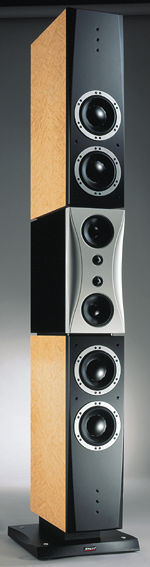 Which brings me to Dynaudio's Evidence Temptation speaker system. Ever since their flagship loudspeaker, the Evidence Master, left my listening room (see Stereophile, May 2000, Vol.23 No.5), I've been waiting for its sequel. Although it costs an astonishing $85,000/pair, the eight-driver, nearly 7'-tall Evidence Master is one of the best-sounding loudspeakers I've ever heard, surpassing all comparison loudspeakers in its lack of grain, total freedom from distortion and dynamic compression, topnotch focus for nearfield and farfield listening positions, and deep, wide, layered soundstage. It did all this without listener fatigue, without an overdone bass response, and without muddying the separate lines of complex musical textures. On the test bench, John Atkinson found the Evidence Master to have "superb measured performance" with an "astonishingly flat" farfield frequency response, "superbly well-controlled lateral dispersion," and a clean cumulative spectral-decay plot that was "free from resonant hash." He concluded that the Evidence Master "represents a serious attempt on the state of the loudspeaker art." To follow in the Evidence Master's footsteps, the Temptation would need to have high power handling, low coloration, precise bass response, damping of resonances, excellent transient response, large dynamic range, low distortion, and controlled vertical dispersion. To some extent—how much, I couldn't say—the Master's ability to meet all these criteria depended on hand assembly, time-consuming fine-tuning, and precision construction. I am told it takes over an hour just to CNC-machine each midrange/tweeter baffle, let alone the midrange housing, cabinet connecting tracks, and base. The labor-intensive manufacture limited Dynaudio to building only 75 pairs of Evidence Master loudspeakers per year. Their goal for the Temptation was to apply the technical experience gained from making the Master to a more economical design that could be produced in lots of 300 or 400 per year. Could Dynaudio transfer the Evidence Master's technological advances and musical magic to a less costly model? I didn't have to wait long for an answer—Dynaudio launched the $30,000/pair Temptation at the 2001 Consumer Electronics Show. When the opportunity to grab a review pair arose, I eagerly volunteered, hoping the Temptation would buck the trend and prove a satisfying sequel to the Master.
Design
Which brings me to Dynaudio's Evidence Temptation speaker system. Ever since their flagship loudspeaker, the Evidence Master, left my listening room (see Stereophile, May 2000, Vol.23 No.5), I've been waiting for its sequel. Although it costs an astonishing $85,000/pair, the eight-driver, nearly 7'-tall Evidence Master is one of the best-sounding loudspeakers I've ever heard, surpassing all comparison loudspeakers in its lack of grain, total freedom from distortion and dynamic compression, topnotch focus for nearfield and farfield listening positions, and deep, wide, layered soundstage. It did all this without listener fatigue, without an overdone bass response, and without muddying the separate lines of complex musical textures. On the test bench, John Atkinson found the Evidence Master to have "superb measured performance" with an "astonishingly flat" farfield frequency response, "superbly well-controlled lateral dispersion," and a clean cumulative spectral-decay plot that was "free from resonant hash." He concluded that the Evidence Master "represents a serious attempt on the state of the loudspeaker art." To follow in the Evidence Master's footsteps, the Temptation would need to have high power handling, low coloration, precise bass response, damping of resonances, excellent transient response, large dynamic range, low distortion, and controlled vertical dispersion. To some extent—how much, I couldn't say—the Master's ability to meet all these criteria depended on hand assembly, time-consuming fine-tuning, and precision construction. I am told it takes over an hour just to CNC-machine each midrange/tweeter baffle, let alone the midrange housing, cabinet connecting tracks, and base. The labor-intensive manufacture limited Dynaudio to building only 75 pairs of Evidence Master loudspeakers per year. Their goal for the Temptation was to apply the technical experience gained from making the Master to a more economical design that could be produced in lots of 300 or 400 per year. Could Dynaudio transfer the Evidence Master's technological advances and musical magic to a less costly model? I didn't have to wait long for an answer—Dynaudio launched the $30,000/pair Temptation at the 2001 Consumer Electronics Show. When the opportunity to grab a review pair arose, I eagerly volunteered, hoping the Temptation would buck the trend and prove a satisfying sequel to the Master.
Design
At first glance, the Evidence Temptation is a dead ringer for the Evidence Master. Both are tall, narrow columns that provide control of vertical dispersion with minimal floor reflections when listened to from 10' to 46' away. Except for the woofer, each Temptation uses the same drivers, in a symmetrical array: two 28mm soft-dome tweeters and two 6" polypropylene midrange drivers arranged in an MTTM configuration in a CNC-machined, 40mm-thick aluminum baffle, and surrounded by four woofers—two above, two below—in separate reflex-aligned woofer cabinets, each with a 4" rear port. All of this is supported by a massive 17.5"-square steel-plated base plinth equipped with adjustable feet and internal spike assemblies. The bottom woofer cabinet's rear panel features two finely machined, very substantial WBT gold-plated binding posts for speaker cables, complete with special spades. Both the Temptation's and Master's crossovers use polypropylene capacitors and large-gauge, multi-wire air-core inductors hand-wound to a tolerance of less than 1%. Resistors are zero-compression, low-inductance, low-capacitance, wire-wound types with high heat stability. All components are wired into double-thickness, multi-layered, fiberglass-reinforced printed circuit boards with thick copper traces. All internal cabling consists of high-purity, matched-crystal, oxygen-free, silver-coated copper. The drivers were developed during the six-year gestation of the Evidence Master. The 28mm soft-dome tweeter is protected with a titanium wire guard, has a 40mm aluminum-alloy front-panel mount, a pure aluminum-wire voice-coil with magnetic-fluid cooling, a vented pole piece, an aluminum-alloy rear chamber with high heat dissipation, and a high-sensitivity, 72mm neodymium magnet. The 6" midranges employ a one-piece molded polypropylene cone and a 38mm pure aluminum voice-coil. Each of the four woofers has a 6.8", one-piece, molded-polypropylene cone, a 75mm pure-aluminum wire voice-coil, and large amounts of neodymium magnet material for high sensitivity.
If the Master and Temptation look the same and use the same drivers, how did Dynaudio reduce the Temptation's price by $55,000/pair? First of all, the Temptation's cabinets are not modular, but are bonded together at the factory. They therefore don't need the Evidence Master's interlocking rail system and external van den Hul wiring. (This explains why the Temptations are shipped in two long flight cases rather than the eight cases that brought me the Evidence Masters.) Still, a few CNC-machined aluminum sections are common to both systems: the one-piece midrange-and-tweeter baffle and the adjustable floor spikes.
Which brings me to Dynaudio's Evidence Temptation speaker system. Ever since their flagship loudspeaker, the Evidence Master, left my listening room (see Stereophile, May 2000, Vol.23 No.5), I've been waiting for its sequel. Although it costs an astonishing $85,000/pair, the eight-driver, nearly 7'-tall Evidence Master is one of the best-sounding loudspeakers I've ever heard, surpassing all comparison loudspeakers in its lack of grain, total freedom from distortion and dynamic compression, topnotch focus for nearfield and farfield listening positions, and deep, wide, layered soundstage. It did all this without listener fatigue, without an overdone bass response, and without muddying the separate lines of complex musical textures. On the test bench, John Atkinson found the Evidence Master to have "superb measured performance" with an "astonishingly flat" farfield frequency response, "superbly well-controlled lateral dispersion," and a clean cumulative spectral-decay plot that was "free from resonant hash." He concluded that the Evidence Master "represents a serious attempt on the state of the loudspeaker art." To follow in the Evidence Master's footsteps, the Temptation would need to have high power handling, low coloration, precise bass response, damping of resonances, excellent transient response, large dynamic range, low distortion, and controlled vertical dispersion. To some extent—how much, I couldn't say—the Master's ability to meet all these criteria depended on hand assembly, time-consuming fine-tuning, and precision construction. I am told it takes over an hour just to CNC-machine each midrange/tweeter baffle, let alone the midrange housing, cabinet connecting tracks, and base. The labor-intensive manufacture limited Dynaudio to building only 75 pairs of Evidence Master loudspeakers per year. Their goal for the Temptation was to apply the technical experience gained from making the Master to a more economical design that could be produced in lots of 300 or 400 per year. Could Dynaudio transfer the Evidence Master's technological advances and musical magic to a less costly model? I didn't have to wait long for an answer—Dynaudio launched the $30,000/pair Temptation at the 2001 Consumer Electronics Show. When the opportunity to grab a review pair arose, I eagerly volunteered, hoping the Temptation would buck the trend and prove a satisfying sequel to the Master. At first glance, the Evidence Temptation is a dead ringer for the Evidence Master. Both are tall, narrow columns that provide control of vertical dispersion with minimal floor reflections when listened to from 10' to 46' away. Except for the woofer, each Temptation uses the same drivers, in a symmetrical array: two 28mm soft-dome tweeters and two 6" polypropylene midrange drivers arranged in an MTTM configuration in a CNC-machined, 40mm-thick aluminum baffle, and surrounded by four woofers—two above, two below—in separate reflex-aligned woofer cabinets, each with a 4" rear port. All of this is supported by a massive 17.5"-square steel-plated base plinth equipped with adjustable feet and internal spike assemblies. The bottom woofer cabinet's rear panel features two finely machined, very substantial WBT gold-plated binding posts for speaker cables, complete with special spades. Both the Temptation's and Master's crossovers use polypropylene capacitors and large-gauge, multi-wire air-core inductors hand-wound to a tolerance of less than 1%. Resistors are zero-compression, low-inductance, low-capacitance, wire-wound types with high heat stability. All components are wired into double-thickness, multi-layered, fiberglass-reinforced printed circuit boards with thick copper traces. All internal cabling consists of high-purity, matched-crystal, oxygen-free, silver-coated copper. The drivers were developed during the six-year gestation of the Evidence Master. The 28mm soft-dome tweeter is protected with a titanium wire guard, has a 40mm aluminum-alloy front-panel mount, a pure aluminum-wire voice-coil with magnetic-fluid cooling, a vented pole piece, an aluminum-alloy rear chamber with high heat dissipation, and a high-sensitivity, 72mm neodymium magnet. The 6" midranges employ a one-piece molded polypropylene cone and a 38mm pure aluminum voice-coil. Each of the four woofers has a 6.8", one-piece, molded-polypropylene cone, a 75mm pure-aluminum wire voice-coil, and large amounts of neodymium magnet material for high sensitivity.