Of the small number of times I have been totally swept away by listening to recorded music, a significant proportion have involved loudspeakers from Wilson Audio Specialties. It was my experience of their X-1/Grand SLAMM in the listening rooms of reviewer Martin Colloms, then-retailer Peter McGrath, designer Dan D'Agostino of Krell, and manufacturer Madrigal Audio Labs, that led me to name it my "Editor's Choice" for 1995 and join my vote with those of the Stereophile scribes to make it the magazine's "Loudspeaker of the Year." I wrote in my December 2001 "As We See It" about how a cross-country road trip had begun with a listen to the Cantus CD on the Wilson WAMMs in their designer's Utah listening room. And, as I wrote in my April column, auditioning Peter McGrath's 24-bit Nagra-D master tapes on Wilson MAXXes in the Halcro room was, for me, the highlight of the 2002 CES. 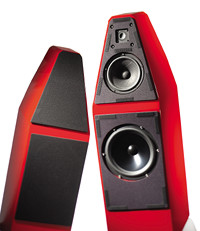 But yes, all three of these speaker systems are very expensive, ranging from $38,900/pair (the MAXX) through $70,000/pair (the X-1) to over a quarter-million bucks (the ultimate WAMM). As much as I appreciate and desire the attainments of speakers like these, my own music-making, like almost all Stereophile readers', has to be based in the real world of mortgages, car payments, and school and college fees. So when I laid eyes and ears on Wilson's Sophia, priced to sell at a relatively affordable $11,700/pair, at the 2001 CEDIA Expo last September, I began salivating about how they would work in my room and my budget. Sophisticated
In its general appearance, the Sophia looks like a single-box cousin of Wilson's WATT/Puppy (last reviewed in its System 5 incarnation in November 1995). And its 41"-high, floorstanding, three-way design concept reminds me of the now-discontinued WITT (reviewed in our January and July 1996 and January 1998 issues). But the Sophia is all new, from its handcrafted enclosure to its custom-built drive-units.
I usually begin my description of a speaker with its active parts: the drive-units and crossover. But having witnessed the labor-intensive craftsmanship that goes into each Wilson speaker, I'll start with the Sophia's intricate cabinet. This is mainly crafted from what Wilson terms "M" material. According to Vern Credille, the company's R&D director, this composite material consists of a matrix of cellulose fibers bound together with phenolic resin to form basic sheets. These are then laminated together to make the Sophia's enclosure panels. For the speaker's front baffle for the woofer section, and for the base, Wilson's even more rigid "X" material is used, which is a high-density, mineral-loaded, methacrylate-based composite. The Sophia's assembled enclosure is spray-coated with automotive paints and clear coats, and rubbed down between each application, to produce an immaculate, high-gloss finish. (If you live in Utah and can't get your car repainted to the original factory standard, it's because Wilson tempted away the state's best workers for its production line.) All this attention to detail is to ensure that the enclosure doesn't emit sound, thus providing an optimal environment for the components that do. Handling the highest frequencies is the same version of Focal's inverted-dome tweeter used in Wilson's home-theater speakers, its titanium diaphragm coated with dark-gray "tioxid." This crosses over to a 7" midrange unit sourced from ScanSpeak. The paper cone has a radiating diameter of approximately 5", and cone and dustcap are scored in a radiating pattern, the score marks filled with damping material. The long-throw woofer is a 10" aluminum-cone unit, reflex-loaded by a 3"-diameter aluminum port on the rear panel. The midrange unit is also reflex-loaded with a 1" port, again on the rear panel, presumably to increase its dynamic range at the bottom of its passband.
But yes, all three of these speaker systems are very expensive, ranging from $38,900/pair (the MAXX) through $70,000/pair (the X-1) to over a quarter-million bucks (the ultimate WAMM). As much as I appreciate and desire the attainments of speakers like these, my own music-making, like almost all Stereophile readers', has to be based in the real world of mortgages, car payments, and school and college fees. So when I laid eyes and ears on Wilson's Sophia, priced to sell at a relatively affordable $11,700/pair, at the 2001 CEDIA Expo last September, I began salivating about how they would work in my room and my budget. Sophisticated In its general appearance, the Sophia looks like a single-box cousin of Wilson's WATT/Puppy (last reviewed in its System 5 incarnation in November 1995). And its 41"-high, floorstanding, three-way design concept reminds me of the now-discontinued WITT (reviewed in our January and July 1996 and January 1998 issues). But the Sophia is all new, from its handcrafted enclosure to its custom-built drive-units.