Experienced reviewers know that shows are the wrong environments for critical audiophile listening. Convention centers—especially the one at Las Vegas—are huge, cavernous airplane hangers, not the intimate listening rooms reviewers thrive in. Extraneous sounds from subwoofer blasts and the constantly milling crowds leak in to sully the music. Booths set up by manufacturers on the show floor have very thin, flexible walls, and no bass treatment.
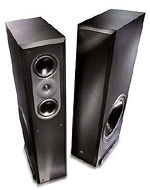 So the floor of the Las Vegas Convention center was the last place I expected to hear a pair of loudspeakers produce three-dimensional imaging. But there I was at the 1998 International Consumer Electronics Show, stopped in my tracks by transparent, open sonics from the prototypes of a new floorstanding, three-way, tower loudspeaker with a powered woofer—the Acoustic Research (AR) AR-1, then called the P315HO. My notes from that day: "Although the level of its internally powered woofer was set too high, this speaker had very transparent mids and highs, unusual imaging, and made vocalists sound unusually natural...be sure you get this product for review."
That night, over dinner, I mentioned the AR-1's transparency, relatively low price (then intended to be $1999/pair), and unusually high voltage sensitivity of 96dB/2.83V/m—a perfect match for single-ended triode amplifiers. That got Sam Tellig's immediate attention! Afraid of being scooped, I quickly requested the review assignment, filed a show report, and waited upon the arrival of review samples. These arrived and I started on the review.
At the 1999 Winter CES, this speaker again sounded clear and transparent. But AR had changed the midrange drivers, equalization for the internal amplifier, rear service panel, added a tweeter protector, increased the price from $1999 to $2495, and changed its name to "Hi-Res Series AR-1." having already finished the review, I hurriedly obtained the Show samples of the new speakers and filed this report.
Description
So the floor of the Las Vegas Convention center was the last place I expected to hear a pair of loudspeakers produce three-dimensional imaging. But there I was at the 1998 International Consumer Electronics Show, stopped in my tracks by transparent, open sonics from the prototypes of a new floorstanding, three-way, tower loudspeaker with a powered woofer—the Acoustic Research (AR) AR-1, then called the P315HO. My notes from that day: "Although the level of its internally powered woofer was set too high, this speaker had very transparent mids and highs, unusual imaging, and made vocalists sound unusually natural...be sure you get this product for review."
That night, over dinner, I mentioned the AR-1's transparency, relatively low price (then intended to be $1999/pair), and unusually high voltage sensitivity of 96dB/2.83V/m—a perfect match for single-ended triode amplifiers. That got Sam Tellig's immediate attention! Afraid of being scooped, I quickly requested the review assignment, filed a show report, and waited upon the arrival of review samples. These arrived and I started on the review.
At the 1999 Winter CES, this speaker again sounded clear and transparent. But AR had changed the midrange drivers, equalization for the internal amplifier, rear service panel, added a tweeter protector, increased the price from $1999 to $2495, and changed its name to "Hi-Res Series AR-1." having already finished the review, I hurriedly obtained the Show samples of the new speakers and filed this report.
Description
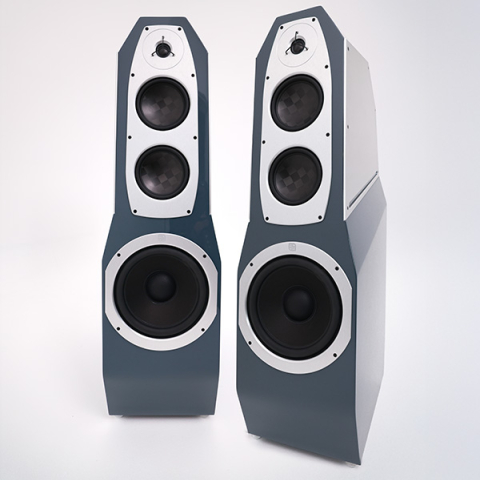
Over the past four decades, Acoustic Research has been the source of several important loudspeaker innovations: the 1954 AR-1 introduced the first acoustic-suspension woofer, the AR-3 added a soft-dome tweeter, and the AR9 improved timbral response by minimizing diffraction effects. Although AR had been located in the Boston area for most of its 44 years, it was recently sold by International Jensen to Recoton Corporation, and moved to Benicia, California. [As of 2005, the company is owned by Audiovox, of Hauppage, NY.—Ed.] The new AR-1 was designed by Mike Park, Acoustic Research's VP of engineering and lead design engineer. For this new design, Park drew on the company's previous design features: acoustic-suspension woofers and diffraction minimization. The AR-1 is a three-way loudspeaker with a 15" woofer driven by a 500W, Sunfire-designed amplifier. Its tower-style enclosure is constructed from ¾" particleboard with picture-frame internal bracing.
The tweeter is a 1", plasma-transferred, diamond-coated titanium dome. The manufacturer claims the diamond dust increases the stiffness of the titanium dome bu a factor of four, and raises the tweeter's breakup frequency from 18kHz to a less audible 23kHz. Surrounding the tweeter is an "energy-control contoured baffle," an integral waveguide for the tweeter made of foam of varying density, which controls the unit's dispersion. This foam ring was used, said Mike Park, to produce a smoother off-axis response pattern by eliminating the edge-cancellation effects of the speaker's narrow front baffle.
Above and below the tweeter are a pair of 5.25" midrange drivers in a D'Appolito configuration. Each of these has a monocoque concave cone—with no dust cap—made from a very stiff magnesium-aluminum alloy. A 1" copper voice-coil is wound on an aluminum former, this said to double the sound-propagation velocity through the cone material and to lower the second and third harmonic distortion compared to a paper midrange cone. Each midrange driver is housed in a specially formulated, compressed-pulp sub-enclosure to provide isolation from the woofer.
The 15" is mounted near the floor, on the cabinet's side—the speaker is supplied as asymmetrical pairs, with left- and right-hand versions. Like the other drivers, the woofer is magnetically shielded. It is driven by an internal, high-efficiency amplifier designed by Sunfire Corporation and licensed to AR that uses a tracking down-converter (TDC). This amplifier features continuously variable power-supply voltages slightly higher than and in sync with the audio signal. Sunfire claims that the design allows its TDC amplifier to approach 85% power-conversion efficiency compared to the 20–30% of conventional designs. This amplifier can thus be a small, lightweight, cool-running, low-cost unit. Its built-in limiter IPC (intelligent parameter control) circuit provides an excursion limiter, a dynamic compressor, a thermal rollback limiter, active low-frequency equalization, infrasonic filtering, and automatic, signal-sensing amplifier turn on/off.
The woofer is solidly, ruggedly constructed. It employs a 4-lb magnet, a vented pole-piece to improve voice-coil cooling, a half-roll foam surround, a and a two-layer, long-throw, copper voice-coil, 4" in diameter and wound on an aluminum former to provide high heat dissipation. Its rib-reinforced cone is made from a formulated paper material chemically treated with a clear polymer "Hydra-Plas" resonance-damping compound to reduce distortion and cone breakup. To further increase cone stiffness, the dustcap is inverted. The latest AR-1 includes equalization circuitry to allow the bass-level control to act as a narrow-Q parametric equalizer around 30Hz.
The AR-1 has an unusually high voltage sensitivity of 96dB/2.83V/1m—hence its "HO" (high output) suffix. Amplifiers of very low power—such as single-ended triodes (SETs)—should be able to easily drive the AR-1.
So the floor of the Las Vegas Convention center was the last place I expected to hear a pair of loudspeakers produce three-dimensional imaging. But there I was at the 1998 International Consumer Electronics Show, stopped in my tracks by transparent, open sonics from the prototypes of a new floorstanding, three-way, tower loudspeaker with a powered woofer—the Acoustic Research (AR) AR-1, then called the P315HO. My notes from that day: "Although the level of its internally powered woofer was set too high, this speaker had very transparent mids and highs, unusual imaging, and made vocalists sound unusually natural...be sure you get this product for review."
That night, over dinner, I mentioned the AR-1's transparency, relatively low price (then intended to be $1999/pair), and unusually high voltage sensitivity of 96dB/2.83V/m—a perfect match for single-ended triode amplifiers. That got Sam Tellig's immediate attention! Afraid of being scooped, I quickly requested the review assignment, filed a show report, and waited upon the arrival of review samples. These arrived and I started on the review.
At the 1999 Winter CES, this speaker again sounded clear and transparent. But AR had changed the midrange drivers, equalization for the internal amplifier, rear service panel, added a tweeter protector, increased the price from $1999 to $2495, and changed its name to "Hi-Res Series AR-1." having already finished the review, I hurriedly obtained the Show samples of the new speakers and filed this report.
Over the past four decades, Acoustic Research has been the source of several important loudspeaker innovations: the 1954 AR-1 introduced the first acoustic-suspension woofer, the AR-3 added a soft-dome tweeter, and the AR9 improved timbral response by minimizing diffraction effects. Although AR had been located in the Boston area for most of its 44 years, it was recently sold by International Jensen to Recoton Corporation, and moved to Benicia, California. [As of 2005, the company is owned by Audiovox, of Hauppage, NY.—Ed.] The new AR-1 was designed by Mike Park, Acoustic Research's VP of engineering and lead design engineer. For this new design, Park drew on the company's previous design features: acoustic-suspension woofers and diffraction minimization. The AR-1 is a three-way loudspeaker with a 15" woofer driven by a 500W, Sunfire-designed amplifier. Its tower-style enclosure is constructed from ¾" particleboard with picture-frame internal bracing.