Judging absolute sound quality under the unfamiliar circumstances of an audio show is always fraught with difficulty. If a system sounds bad, there are so many possible reasons for it to do so that pointing a finger of blame at the components is possibly unfair. Conversely, when a room sounds good at a show, it is probable that the components being used deserve some recognition. Such was the case at Home Entertainment 2002 in New York last May, when Dynaudio's Confidence C4 made its debut. 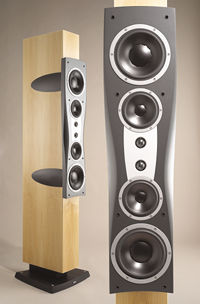 Driven by a Naim CD player and Naim amplification in a fairly large room, the loudspeaker impressed me with its lack of coloration, the range of its dynamics, and the broad sweep of its soundstaging. Accordingly, I asked for review samples to be sent, to finish up the mini-survey of expensive, floorstanding speakers I've been publishing in recent issues. (This survey began with the Wilson Audio Sophia ($11,700/pair) in July 2002, and proceeded to cover the mbl 111b ($17,000/pair) in August of that year, the Mission Pilastro ($35,000/pair) in December, the Canton Karat Reference 2 DC ($10,000/pair) in January 2003, and the KEF Reference 207 ($15,000/pair) in February, punctuated by auditions of the more realistically priced Thiel CS1.6 ($1990/pair) and RBH 641-SE ($1499/pair) last September and October, respectively.)) Trickle-down...
...was the term I used to describe the new Dynaudio speaker on this issue's cover, to the puzzlement of some staffers. This was because, despite its $16,000/pair price, the C4 has much in common with its cost-no-object cousins in Dynaudio's Evidence line: the $85,000/pair Master and the $30,000/pair Temptation, reviewed by Larry Greenhill in May 2000 and December 2001, respectively. Like the Evidences, the C4 is a tall, narrow floorstander with twin tweeters flanked first by twin midrange units, then by twin woofers. In combination with the first-order crossover slopes, this vertically symmetrical array of drive-units narrows the vertical radiation pattern, resulting in a claimed 75% reduction in the energy reflected from the ceiling and floor. Referred to by the manufacturer as Dynaudio Directivity Control (DDC) and reminiscent of the similar arrays used by John Dunlavy in his designs for Duntech and DAL, this will make the speaker's sound less dependent than usual on individual room acoustics.
Usually, having spaced tweeters covering identical frequency ranges will result in some top-octave vertical lobing as the drivers' outputs interfere away from the central axis. However, in the DDC array, the upper tweeter is used only between 3kHz and 8kHz, to narrow the vertical dispersion in the region where the radiating diameter would otherwise be smaller than the wavelengths of sound being emitted, reducing the presence-region "flare" in the speaker's reverberant soundfield. The Confidence C4's tweeter is the new Esotar2 unit, which is also used in the Danish company's 25th-anniversary Special 25 loudspeaker, which so impressed John Marks in our January issue (p.55). A ferrofluid-cooled, 28mm, fabric-dome type, the Esotar2 uses a powerful neodymium magnet and aluminum voice-coil wire. Both the 6" midrange drivers and the 8" woofers feature molded plastic cones loaded with mineral powder (magnesium silicate), and again use low-mass aluminum wiring. Each of the woofers is reflex-loaded with a 2.75"-diameter port with flared inner and outer openings on the rear of the enclosure. The first-order crossover network uses what Dynaudio refers to as "zero-compression" resistors and capacitors with low dielectric loss and is mounted on a glass-fiber-reinforced printed circuit board in a separate internal chamber. Electrical connection is via a single pair of gold WBT binding posts.
Driven by a Naim CD player and Naim amplification in a fairly large room, the loudspeaker impressed me with its lack of coloration, the range of its dynamics, and the broad sweep of its soundstaging. Accordingly, I asked for review samples to be sent, to finish up the mini-survey of expensive, floorstanding speakers I've been publishing in recent issues. (This survey began with the Wilson Audio Sophia ($11,700/pair) in July 2002, and proceeded to cover the mbl 111b ($17,000/pair) in August of that year, the Mission Pilastro ($35,000/pair) in December, the Canton Karat Reference 2 DC ($10,000/pair) in January 2003, and the KEF Reference 207 ($15,000/pair) in February, punctuated by auditions of the more realistically priced Thiel CS1.6 ($1990/pair) and RBH 641-SE ($1499/pair) last September and October, respectively.)) Trickle-down... ...was the term I used to describe the new Dynaudio speaker on this issue's cover, to the puzzlement of some staffers. This was because, despite its $16,000/pair price, the C4 has much in common with its cost-no-object cousins in Dynaudio's Evidence line: the $85,000/pair Master and the $30,000/pair Temptation, reviewed by Larry Greenhill in May 2000 and December 2001, respectively. Like the Evidences, the C4 is a tall, narrow floorstander with twin tweeters flanked first by twin midrange units, then by twin woofers. In combination with the first-order crossover slopes, this vertically symmetrical array of drive-units narrows the vertical radiation pattern, resulting in a claimed 75% reduction in the energy reflected from the ceiling and floor. Referred to by the manufacturer as Dynaudio Directivity Control (DDC) and reminiscent of the similar arrays used by John Dunlavy in his designs for Duntech and DAL, this will make the speaker's sound less dependent than usual on individual room acoustics.