Interest in super-efficient, horn-loaded, compression-driver loudspeakers has grown in the past few years, fueled in part by a renewed fascination among many hobbyists with low-powered, single-ended triode tube amplifiers. But staring down the maws of two Tubby the Tubas is not every audiophile's idea of a good time—even when the resulting sound is spectacularly fast, coherent, and extended.  I've sat before arrays of unadorned horns and marveled at their rapid-fire transients and super-clean high-frequency extension, and—as designers have made great progress integrating cone woofers to create coherent full-range, real-world-sized systems—the idea of actually owning one becomes more attractive. But the thought of staring down those monstrous throats stops me every time. That's why, when I saw and heard Odeon's Tosca speaker at the Frankfurt HiFi show a few years ago, I asked Axiss Distribution, the US importer of the German product, if I might review it. The Tosca's mid/HF horn was integrated with a conventional-looking baffle also containing a reflex-loaded cone woofer. For all intents and purposes, it looked like a normal loudspeaker, but what it was doing with a CD of Sonny Rollins' Way Out West was anything but. The sound made me horny (footnote 1). Odeon's founder, Axel Gersdorf, began designing loudspeakers in the late 1970s. In 1987 he founded ARS to design and engineer OEM products for home and professional applications. Between 1990 and 1993 he developed the spherical multiplex horn system used in Odeon speakers, the third generation of which was completed in 2000 and premiered at the 2001 high-end audio show in Frankfurt. Gersdorf says his design is "fast, phase-coherent, efficient, exhibit[ing] a smooth frequency response [delivering] that 'you are there live experience.' "
Two Years Later
I've sat before arrays of unadorned horns and marveled at their rapid-fire transients and super-clean high-frequency extension, and—as designers have made great progress integrating cone woofers to create coherent full-range, real-world-sized systems—the idea of actually owning one becomes more attractive. But the thought of staring down those monstrous throats stops me every time. That's why, when I saw and heard Odeon's Tosca speaker at the Frankfurt HiFi show a few years ago, I asked Axiss Distribution, the US importer of the German product, if I might review it. The Tosca's mid/HF horn was integrated with a conventional-looking baffle also containing a reflex-loaded cone woofer. For all intents and purposes, it looked like a normal loudspeaker, but what it was doing with a CD of Sonny Rollins' Way Out West was anything but. The sound made me horny (footnote 1). Odeon's founder, Axel Gersdorf, began designing loudspeakers in the late 1970s. In 1987 he founded ARS to design and engineer OEM products for home and professional applications. Between 1990 and 1993 he developed the spherical multiplex horn system used in Odeon speakers, the third generation of which was completed in 2000 and premiered at the 2001 high-end audio show in Frankfurt. Gersdorf says his design is "fast, phase-coherent, efficient, exhibit[ing] a smooth frequency response [delivering] that 'you are there live experience.' "
Two Years Later
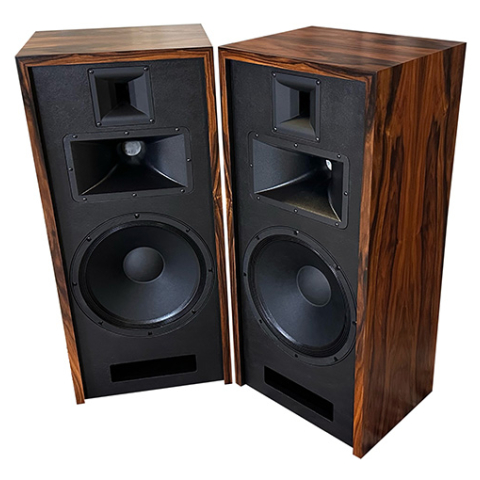
It took two years, but finally, Art Manzano of Axiss called to tell me he'd have a pair of the $9500 Odeon La Traviatas for me to review (my samples, in gorgeous burled wood finish, cost $12,500/pair). In addition to the 1" compression driver with horn, the Traviata features a 16kHz-and-above ring-radiator supertweeter nested into the top of the horn's flare, and an 8" floor-ported woofer that hands the signal off at 1.8kHz via a "dynamic phase/time domain" crossover. Speed is of the essence for a cone woofer to have any chance of keeping up with a compression horn tweeter, so Odeon uses one that's said to be stiff and of low mass and short excursion, driven by an air-cooled voice-coil wound with rectangular wire. Most Odeon horns are machined from blocks of a multilayered wood laminate. Unlike the Tosca, which leaves the layers of wood exposed, the Traviata's horn is finished in a piano-black lacquer. I assumed the horn's construction was the same, but according to a description furnished by the designer, "The construction of the loudspeaker is a combination of the solid wood spherical horn..." Either something got lost in translation, or this horn is machined from a solid block of wood rather than from a laminate. I suspect it's a translator's error. Asymmetrically designed to break up standing waves, the almost-4'-tall tapered cabinet is supported by three spikes: one screws into the bottom edge of the front baffle, the other two are attached to the rear of a floor support. Finished in black lacquer, the support can be affixed to the speaker's bottom in one of two positions, allowing for either More Bass or Less Bass, depending on how much of the port the support covers. This constitutes Odeon's Tuneable Port System, or TPS. I got the smoothest bass and most effective woofer/horn integration in my room with the TPS set to More Bass. Nominal impedance is 8 ohms, specified sensitivity 93dB—high, but not that high.
Setup
Upending the Traviatas to attach the base plate, which holds two of the spikes and sets the TPS, I noted that the cabinet is constructed not from the usual medium-density fiberboard (MDF) but from plywood. Most speaker designs use MDF because it's dense and does a good job of damping cabinet resonances. The mitered edges of the back and side panels on one speaker didn't mate snugly, leaving a visible gap on the inside seam. The frames of both woofer grilles, which are supposed to friction-fit into recesses in the front baffles, were warped and wouldn't lie flat in the recesses. Worse, as soon as the woofers produced bass, both grilles popped out onto the floor. I hate when that happens. Though the Traviata's exterior fit'n'finish was superb and the speaker looked gorgeous overall, I found the level of craftsmanship disappointing for a $9500-$12,500 pair of loudspeakers. The Traviatas sounded best where most speakers do in my room—approximately 2' from the front wall, 30" from the side walls, and 9' apart—but pointed almost straight ahead, instead of being toed-in so the tweeter axes cross just behind the listening position.
Footnote 1: This reminds me of a famous audiophile joke best told with hand gestures: Paul Klipsch spies Amar Bose across a street. Klipsch puts his hands up to his mouth to form a horn and yells, "Hello, Amar!" Amar hears and sees him, turns his back to Paul, puts his open hands together about 6" away and slightly offset from his mouth, and yells, "Hello, Paul!"
I've sat before arrays of unadorned horns and marveled at their rapid-fire transients and super-clean high-frequency extension, and—as designers have made great progress integrating cone woofers to create coherent full-range, real-world-sized systems—the idea of actually owning one becomes more attractive. But the thought of staring down those monstrous throats stops me every time. That's why, when I saw and heard Odeon's Tosca speaker at the Frankfurt HiFi show a few years ago, I asked Axiss Distribution, the US importer of the German product, if I might review it. The Tosca's mid/HF horn was integrated with a conventional-looking baffle also containing a reflex-loaded cone woofer. For all intents and purposes, it looked like a normal loudspeaker, but what it was doing with a CD of Sonny Rollins' Way Out West was anything but. The sound made me horny (footnote 1). Odeon's founder, Axel Gersdorf, began designing loudspeakers in the late 1970s. In 1987 he founded ARS to design and engineer OEM products for home and professional applications. Between 1990 and 1993 he developed the spherical multiplex horn system used in Odeon speakers, the third generation of which was completed in 2000 and premiered at the 2001 high-end audio show in Frankfurt. Gersdorf says his design is "fast, phase-coherent, efficient, exhibit[ing] a smooth frequency response [delivering] that 'you are there live experience.' " It took two years, but finally, Art Manzano of Axiss called to tell me he'd have a pair of the $9500 Odeon La Traviatas for me to review (my samples, in gorgeous burled wood finish, cost $12,500/pair). In addition to the 1" compression driver with horn, the Traviata features a 16kHz-and-above ring-radiator supertweeter nested into the top of the horn's flare, and an 8" floor-ported woofer that hands the signal off at 1.8kHz via a "dynamic phase/time domain" crossover. Speed is of the essence for a cone woofer to have any chance of keeping up with a compression horn tweeter, so Odeon uses one that's said to be stiff and of low mass and short excursion, driven by an air-cooled voice-coil wound with rectangular wire. Most Odeon horns are machined from blocks of a multilayered wood laminate. Unlike the Tosca, which leaves the layers of wood exposed, the Traviata's horn is finished in a piano-black lacquer. I assumed the horn's construction was the same, but according to a description furnished by the designer, "The construction of the loudspeaker is a combination of the solid wood spherical horn..." Either something got lost in translation, or this horn is machined from a solid block of wood rather than from a laminate. I suspect it's a translator's error. Asymmetrically designed to break up standing waves, the almost-4'-tall tapered cabinet is supported by three spikes: one screws into the bottom edge of the front baffle, the other two are attached to the rear of a floor support. Finished in black lacquer, the support can be affixed to the speaker's bottom in one of two positions, allowing for either More Bass or Less Bass, depending on how much of the port the support covers. This constitutes Odeon's Tuneable Port System, or TPS. I got the smoothest bass and most effective woofer/horn integration in my room with the TPS set to More Bass. Nominal impedance is 8 ohms, specified sensitivity 93dB—high, but not that high.
Upending the Traviatas to attach the base plate, which holds two of the spikes and sets the TPS, I noted that the cabinet is constructed not from the usual medium-density fiberboard (MDF) but from plywood. Most speaker designs use MDF because it's dense and does a good job of damping cabinet resonances. The mitered edges of the back and side panels on one speaker didn't mate snugly, leaving a visible gap on the inside seam. The frames of both woofer grilles, which are supposed to friction-fit into recesses in the front baffles, were warped and wouldn't lie flat in the recesses. Worse, as soon as the woofers produced bass, both grilles popped out onto the floor. I hate when that happens. Though the Traviata's exterior fit'n'finish was superb and the speaker looked gorgeous overall, I found the level of craftsmanship disappointing for a $9500-$12,500 pair of loudspeakers. The Traviatas sounded best where most speakers do in my room—approximately 2' from the front wall, 30" from the side walls, and 9' apart—but pointed almost straight ahead, instead of being toed-in so the tweeter axes cross just behind the listening position.
Footnote 1: This reminds me of a famous audiophile joke best told with hand gestures: Paul Klipsch spies Amar Bose across a street. Klipsch puts his hands up to his mouth to form a horn and yells, "Hello, Amar!" Amar hears and sees him, turns his back to Paul, puts his open hands together about 6" away and slightly offset from his mouth, and yells, "Hello, Paul!"