I know from conversations with other reviewers that this sort of thing happens all the time: Something new comes along—a product from a company we've never heard of, a technology we've never encountered before, whatever—and when we're impressed, we end up wondering if the thing is really as good as we think. We're insecure, just like you (footnote 1).
 So it was with the Concerto 3 ($3495/pair) from Sonist Loudspeakers, a newish company based in southern California. I gladly accepted designer Randy Bankert's invitation to review his largest model—my reputation for enjoying combinations of low-power amps and high-sensitivity loudspeakers had once again preceded me, happily enough—and within hours of setting up the review pair, I was struck by how clearly the Concerto 3 was surpassing my expectations, given its reasonable price, its ostensibly less-than-exotic design brief, and the utter lack of any word on the street that might have helped me know what to think. (Just kidding. Sort of.)
Was it for real?
Description
So it was with the Concerto 3 ($3495/pair) from Sonist Loudspeakers, a newish company based in southern California. I gladly accepted designer Randy Bankert's invitation to review his largest model—my reputation for enjoying combinations of low-power amps and high-sensitivity loudspeakers had once again preceded me, happily enough—and within hours of setting up the review pair, I was struck by how clearly the Concerto 3 was surpassing my expectations, given its reasonable price, its ostensibly less-than-exotic design brief, and the utter lack of any word on the street that might have helped me know what to think. (Just kidding. Sort of.)
Was it for real?
Description
By all outward appearances, the Sonist Concerto 3 is unextraordinary—an impression that endures even after a look inside it. Apart from its mildly tapering width from front to back, the Concerto 3's enclosure is a simple rectangular box. It doesn't appear to be a bass-reflex design, although its cabinet is vented through a 9" slot very near the floor. (We'll see what, if any, port-related impedance changes are uncovered by John Atkinson's measurements.)
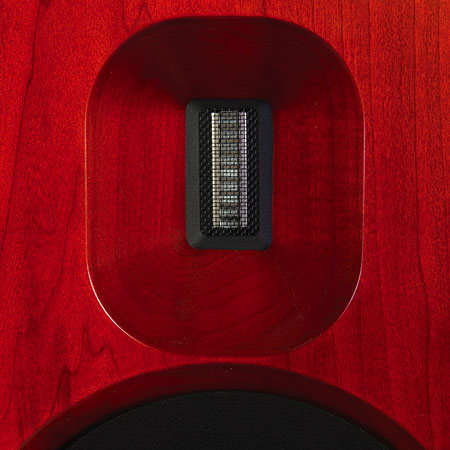
That's not to say the enclosure lacks sophistication. While mostly constructed of 0.75"-thick Medite—again, nothing up its sleeve—the Concerto 3 sports a front baffle machined from 1.75"-thick poplar, which the designer suggests is less resonant than other solid woods or plywoods. Perhaps more to the point, I know from experience that poplar is easier to work than other hardwoods, a quality that apparently allowed Sonist to shape their baffle with a loading horn for the tweeter. The Concerto 3's woofer is also set back into a recessed flare of sorts, but certainly not enough to increase its gain by means of a horn effect.
Those drivers are well chosen. The woofer is an 8" paper cone with a shallow flare, a moderately sized dustcap, and an impregnated fabric surround. The 2.6" tweeter is the increasingly popular Fountek JP3.0 ribbon, which sports a low-mass (11mg) element of corrugated aluminum and a strong neodymium magnet. Electrically sensitive though ribbons can be, one doesn't always think of them as especially easy to drive. The Fountek and others get around that with a built-in transformer to raise their impedance to a level more friendly to single-ended-triode (SET) tube amplifiers: in this case, 7 ohms. While we're on the subject, Sonist claims for the Concerto 3 a nominal impedance of 8 ohms, a minimum impedance of 6 ohms, and an overall electrical sensitivity of 95dB.
That last number may also be a function of Sonist's decidedly minimalist approach to crossovers. The Concerto 3 contains only two filter elements (in addition to the resistive qualities provided by the drivers themselves, of course): a Goertz Alpha-Core foil inductor for the first-order low-pass filter, and an Auricap polypropylene capacitor for the first-order high-pass filter. Other notable bits include Auric hookup wire and Cardas solder and binding posts, the latter supplied as two separate pairs, for biwiring and biamping. Flexible Cardas links are also provided for slope-browed single-wire enthusiasts such as I.
Still, and notwithstanding the absence of an exotic loading scheme or some such, I imagine the bulk of the Concerto 3's price is tied up in its cabinet, which apparently was the subject of much thought and care. A pair of H-braces, machined from Medite, help stiffen and deaden the sidewalls. Most interior surfaces are damped with sheets of something called Black Hole 5, which sounds like the fifth in a series of Ron Jeremy films but is actually a popular sound-absorbent polymer. Outside, the portions of the cabinet made from Medite are finished with a black, Nextel-like textured paint, while the poplar front baffle sports a nice reddish-brown stain and lacquer. Capping it all off is a nicely made round grille for the woofer, held in place with small magnets. On second thought: Capping it all off is a carton of very decent quality and purpose-made packing materials. Sonist may be small, but they're professional.
Workmanship was acceptably good for the price. The hand-wired crossover was neatly soldered, though no apparent effort was made to dress the wires. (In the Concerto 3, the binding posts are near the bottom of the cabinet, the crossover nearer the top.) A few of the threaded inserts for the woofer-mounting screws were slightly off-kilter, and those foam damping sheets weren't always squared with their enclosure walls—little things that keep this unapologetic VW from sharing top-shelf space with our hobby's depressingly over-abundant Lamborghinis. But at the end of the day, the Sonist got the job done, and at least one non-audiophile visitor to my home commented on the cabinet's good looks—especially the smooth, well-finished front baffles.
Installation and setup
I installed the Sonist Concerto 3s in my usual listening room: 19' L by 12' W by 8' H, with drywall construction, two exterior walls, a hardwood floor, and approximately 46 square feet of window area. Listening impressions and my AudioControl Industrial SA3050 spectrum analyzer agreed that the best combination of low-frequency power and overall response smoothness was had with the speakers placed some 60" from the (short) wall behind them and 27" from the sidewalls (all dimensions taken to the approximate centers of the cabinets).
Footnote 1: My wife just read that paragraph over my shoulder and offered the observation that this is "a penis thing." That in itself may explain a great deal, not all of it about men.
So it was with the Concerto 3 ($3495/pair) from Sonist Loudspeakers, a newish company based in southern California. I gladly accepted designer Randy Bankert's invitation to review his largest model—my reputation for enjoying combinations of low-power amps and high-sensitivity loudspeakers had once again preceded me, happily enough—and within hours of setting up the review pair, I was struck by how clearly the Concerto 3 was surpassing my expectations, given its reasonable price, its ostensibly less-than-exotic design brief, and the utter lack of any word on the street that might have helped me know what to think. (Just kidding. Sort of.)
Was it for real?
Description
By all outward appearances, the Sonist Concerto 3 is unextraordinary—an impression that endures even after a look inside it. Apart from its mildly tapering width from front to back, the Concerto 3's enclosure is a simple rectangular box. It doesn't appear to be a bass-reflex design, although its cabinet is vented through a 9" slot very near the floor. (We'll see what, if any, port-related impedance changes are uncovered by John Atkinson's measurements.)
I installed the Sonist Concerto 3s in my usual listening room: 19' L by 12' W by 8' H, with drywall construction, two exterior walls, a hardwood floor, and approximately 46 square feet of window area. Listening impressions and my AudioControl Industrial SA3050 spectrum analyzer agreed that the best combination of low-frequency power and overall response smoothness was had with the speakers placed some 60" from the (short) wall behind them and 27" from the sidewalls (all dimensions taken to the approximate centers of the cabinets).
Footnote 1: My wife just read that paragraph over my shoulder and offered the observation that this is "a penis thing." That in itself may explain a great deal, not all of it about men.