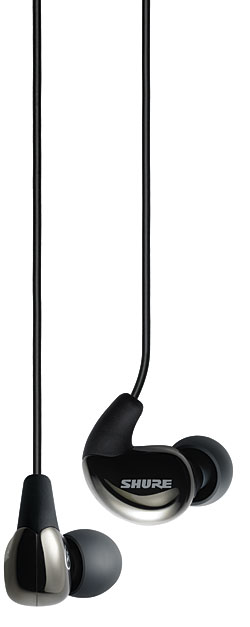
I first saw the Shure SE530 at the 2006 Consumer Electronics Show, when it was dubbed the E500. The '500 shared the current product's three-armature driver technology and in-ear, sound-isolating, sleeve fitting scheme, but that early prototype seemed almost crude in comparison with the SE530.
 During the year or so it took Shure to bring the SE530 to market, it went through some changes, including its model designation. Shure added modular cables (different lengths are available), as well as a standard in-line volume attenuator and a Push To Hear (PTH) module ($50) that "allows you to activate the VoicePort microphone and adjust levels of external sound for clarity—ideal for brief conversations without removing your earphones."
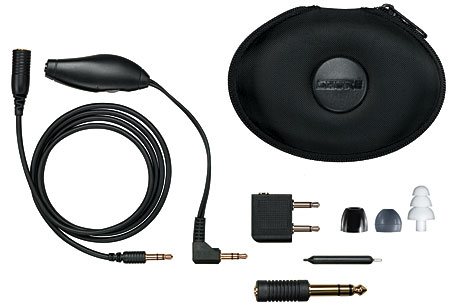
During that same time, Shure developed a new isolating sleeve (called black foam because it's made of, you guessed it, black foam) with a more durable lining. The company also began offering its sleeves in a greater variety of sizes; research had indicated that the biggest impediment to achieving good sound with in-ear 'phones was that there was far greater variety of size and shape in peoples' ear canals than previously suspected. (Shure's manager of Personal Audio Products, Matt Engstrom, refers to one of the new sizes as the "John Atkinson jumbo" model.) The SE530 comes with three types of sleeves, in eight sizes. It also comes with three handy extras: an "airplane attenuator" to make the low-capacitance 'phones mate better with high-output sources, such as airline entertainment systems; a two-prong converter that lets you use your headphones on older airline entertainment systems; and a handy little pod to carry your headphones and accessories in. It all comes in a handsome aluminum case, which may take a bit of the sting out of the SE530's price of $449.
The ear is the only true writer
During the year or so it took Shure to bring the SE530 to market, it went through some changes, including its model designation. Shure added modular cables (different lengths are available), as well as a standard in-line volume attenuator and a Push To Hear (PTH) module ($50) that "allows you to activate the VoicePort microphone and adjust levels of external sound for clarity—ideal for brief conversations without removing your earphones."
During that same time, Shure developed a new isolating sleeve (called black foam because it's made of, you guessed it, black foam) with a more durable lining. The company also began offering its sleeves in a greater variety of sizes; research had indicated that the biggest impediment to achieving good sound with in-ear 'phones was that there was far greater variety of size and shape in peoples' ear canals than previously suspected. (Shure's manager of Personal Audio Products, Matt Engstrom, refers to one of the new sizes as the "John Atkinson jumbo" model.) The SE530 comes with three types of sleeves, in eight sizes. It also comes with three handy extras: an "airplane attenuator" to make the low-capacitance 'phones mate better with high-output sources, such as airline entertainment systems; a two-prong converter that lets you use your headphones on older airline entertainment systems; and a handy little pod to carry your headphones and accessories in. It all comes in a handsome aluminum case, which may take a bit of the sting out of the SE530's price of $449.
The ear is the only true writer
When I say that the SE530 went through a lot of changes before the version I reviewed, I don't just mean on the inside. The original E500 shared the compact body of the E3c, which JA reviewed in May 2004, and the E4, which Jim Austin reviewed in April 2007. The SE530 has a much larger ABS plastic housing.
"That's because the two low-frequency drivers are vented and share a common port, which enhances the dynamics and texture of the bottom end," said Matt Engstrom. "There's an acoustic reaction to that space—you do get more bass, but the real reason we double the drivers and port them into that chamber is what it does for the tonal balance of the low end." The two LF drivers share a common "spout," or acoustic channel, which has a passive damper that enhances the drivers' natural rolloff to the HF driver.
The HF/full-range driver has a miniaturized high-pass filter in the 550–700Hz range that is actually built into the flex cable that surrounds it. The result of the damped bass rolloff and superior high-pass filter, according to Engstrom, is "less cross-pollination—and superior handoff—from low to high, which I feel is one of the major steps forward from the E5 'phones."
Shure claims 119dB sensitivity and a 1kHz impedance of 36 ohms, which would make the SE530s reasonably easy to drive.
The ear does not sound
At the risk of repeating a point both JAs have made explicit, getting the proper fit between your ear canals and the Shure monitors is the key to making them sing. The new sleeves and sizes go a long way toward solving this problem, but you still have to carefully insert the 'phones and dress the cables or you'll lose bass response—and possibly the 'phones. I found that the SE530s tended to fall out of my ears if I didn't follow Engstrom's instructions to dress the cable to the front and around the upper edge of my pinnae (well, the auricular sulcus, if you want to get specific), which also puts the junction between the two channels behind my head. Even then, I found that vigorous motion—running, bending abruptly, twisting—could dislodge the SE530s. Steady motion—striding, using an elliptical trainer, bicycling (not recommended)—posed no problems. Your fit may lead to different results. Once you do get a good fit, the SE530s offer a very high degree of noise reduction—not quite on a par with that of a custom ear mold or Etymotic's triple-flanged tips, but better than what I've experienced with most noise-reducing headphones—and with far greater sound fidelity than any noise-reducing headphone I've tried. (Shure offers a triple-flanged tip similar to the ones Etymotic uses, but it was not a good fit for my ear canals.)
One last usage note: The Shure SE530 is, hands down, the best in-ear 'phone I've ever paired with a personal portable. My iPod Video drove it easily, even giving me tons of deep, fast bass—something it can't properly do with my longtime reference Etymotic ER-4S and more recently acquired Ultimate Ears UE-10 Pros, because of their lower impedances. Don't get me wrong—adding a headphone amp delivered even better sound—but the unamplified sound of the Shure was better than that of any other high-aspiration in-ear headphone I've heard to date.
And if you use any generation of the iPod Shuffle, that, plus the short modular cable, translates into the best-sounding, least-hassle version of a gym music rig I've ever encountered.
We only consult the ear because the heart is wanting
In Carla Bley's "Dreams So Real," from her Dinner Music (CD, WATT6), Steve Gadd's kick drum had impact and slam, indicating superb extension and speed. Cornell Dupree's crystalline electric guitar had sparkle and shimmer that just continued into the stratosphere. Best of all, I could hear deep into the mix, experiencing Bley's use of the sustain pedal as a cloud of suspended calm, growing and swelling within the studio as she stacked chord upon chord under the other musicians' leaps into the silence. Best of all, I heard this as a continuum, not as bands of lows, mids, and highs. The music was seamless.
 On Bryan Lee's Katrina Was Her Name (CD, Justin Time JUST 226), the boogie slop-shuffle of "29 Ways" was almost physical. John Perkins' superb time-keeping was accentuated by some of the kickingest tom-tom work I've ever heard. When that man drops a T-bomb on the chorus, the Shures really slammed it home. Add Bruce Katz's B-3 wheeze and a horn section featuring Doug James and Gordon Beadle, and you're talking about a full-body experience of a recording.
After grooving to "29 Ways" on the SE530s, I decided to check it out on my big rig, featuring the Vandersteen Quatro Wood loudspeakers ($10,700/pair). The sound was even more physical, of course—and there was more soundstage depth, which is an area where headphones simply can't compete with speakers—but there was also a loss of focus, which I missed. I wouldn't trade one listening experience for the other; one enhances another.
Simone Dinnerstein's airy, crystalline performance of Bach's Goldberg Variations (CD, Telarc CD-80692) was another whole-body experience. I was completely captivated by Variation 14, in which her control of dynamics presented a third fugue line as convincingly as I have ever perceived it. It's bold, brash, and somehow completely respectful. Through the Shures, I didn't so much hear it as inhabit it. Great art does that; great headphones don't hurt.
In one ear and out the top of my head
On Bryan Lee's Katrina Was Her Name (CD, Justin Time JUST 226), the boogie slop-shuffle of "29 Ways" was almost physical. John Perkins' superb time-keeping was accentuated by some of the kickingest tom-tom work I've ever heard. When that man drops a T-bomb on the chorus, the Shures really slammed it home. Add Bruce Katz's B-3 wheeze and a horn section featuring Doug James and Gordon Beadle, and you're talking about a full-body experience of a recording.
After grooving to "29 Ways" on the SE530s, I decided to check it out on my big rig, featuring the Vandersteen Quatro Wood loudspeakers ($10,700/pair). The sound was even more physical, of course—and there was more soundstage depth, which is an area where headphones simply can't compete with speakers—but there was also a loss of focus, which I missed. I wouldn't trade one listening experience for the other; one enhances another.
Simone Dinnerstein's airy, crystalline performance of Bach's Goldberg Variations (CD, Telarc CD-80692) was another whole-body experience. I was completely captivated by Variation 14, in which her control of dynamics presented a third fugue line as convincingly as I have ever perceived it. It's bold, brash, and somehow completely respectful. Through the Shures, I didn't so much hear it as inhabit it. Great art does that; great headphones don't hurt.
In one ear and out the top of my head
So how did the SE530s compare to my references, the Etymotic ER-4S and the Ultimate Ears UE-10 Pro? With headphones, comparisons are even harder than with other components, essentially because of factors you can't completely control, such as compensating for impedance differences and insertion depths. For example, I felt the UE-10s had a bit more deep-bass impact than the SE530s, but less bloom and body—but how much of that was caused by the closer proximity of the UE-10s' acoustic channels to my eardrums, and how much by the Shures' combination of crossover and port? Either way, the UE-10s seemed to go deeper, but the Shures surely better integrated that bass into the rest of the spectrum. Similarly, the Etymotics had a more tipped-up top end, which gave them a more revealing (or, if you prefer, ruthless) quality, whereas the Shures, while not lacking for extension or clarity, balanced their extension better with their midrange.
And let's not forget that, sans headphone amp, the Shures trumped both sets of 'phones in control and dynamics across the spectrum.
Give every man thy ear
Does that make the Shure SE530s my favorite in-ear headphones? If I had to choose just one set of 'phones that would work in all of the circumstances in which I use them, yeah, they would be—if only because their impedance makes them work so well with unamplified portable media players. The SE530s are sonically well balanced, having both extended bass and a smooth, soaring top end, and at $449, they fall between the $299 Etymotics and the $1000 Ultimate Ears. I really like the Etymotics' superior noise isolation, and the UE-10 Pros driven by a good headphone amp are my refuge of choice for intercontinental air travel. Yet for everyday use, day in and day out, I tend to grab the Shure SE530s and just go.
Reliability and versatility are hard to argue with.
During the year or so it took Shure to bring the SE530 to market, it went through some changes, including its model designation. Shure added modular cables (different lengths are available), as well as a standard in-line volume attenuator and a Push To Hear (PTH) module ($50) that "allows you to activate the VoicePort microphone and adjust levels of external sound for clarity—ideal for brief conversations without removing your earphones."
During that same time, Shure developed a new isolating sleeve (called black foam because it's made of, you guessed it, black foam) with a more durable lining. The company also began offering its sleeves in a greater variety of sizes; research had indicated that the biggest impediment to achieving good sound with in-ear 'phones was that there was far greater variety of size and shape in peoples' ear canals than previously suspected. (Shure's manager of Personal Audio Products, Matt Engstrom, refers to one of the new sizes as the "John Atkinson jumbo" model.) The SE530 comes with three types of sleeves, in eight sizes. It also comes with three handy extras: an "airplane attenuator" to make the low-capacitance 'phones mate better with high-output sources, such as airline entertainment systems; a two-prong converter that lets you use your headphones on older airline entertainment systems; and a handy little pod to carry your headphones and accessories in. It all comes in a handsome aluminum case, which may take a bit of the sting out of the SE530's price of $449.
The ear is the only true writer
When I say that the SE530 went through a lot of changes before the version I reviewed, I don't just mean on the inside. The original E500 shared the compact body of the E3c, which JA reviewed in May 2004, and the E4, which Jim Austin reviewed in April 2007. The SE530 has a much larger ABS plastic housing.
At the risk of repeating a point both JAs have made explicit, getting the proper fit between your ear canals and the Shure monitors is the key to making them sing. The new sleeves and sizes go a long way toward solving this problem, but you still have to carefully insert the 'phones and dress the cables or you'll lose bass response—and possibly the 'phones. I found that the SE530s tended to fall out of my ears if I didn't follow Engstrom's instructions to dress the cable to the front and around the upper edge of my pinnae (well, the auricular sulcus, if you want to get specific), which also puts the junction between the two channels behind my head. Even then, I found that vigorous motion—running, bending abruptly, twisting—could dislodge the SE530s. Steady motion—striding, using an elliptical trainer, bicycling (not recommended)—posed no problems. Your fit may lead to different results. Once you do get a good fit, the SE530s offer a very high degree of noise reduction—not quite on a par with that of a custom ear mold or Etymotic's triple-flanged tips, but better than what I've experienced with most noise-reducing headphones—and with far greater sound fidelity than any noise-reducing headphone I've tried. (Shure offers a triple-flanged tip similar to the ones Etymotic uses, but it was not a good fit for my ear canals.)
In Carla Bley's "Dreams So Real," from her Dinner Music (CD, WATT6), Steve Gadd's kick drum had impact and slam, indicating superb extension and speed. Cornell Dupree's crystalline electric guitar had sparkle and shimmer that just continued into the stratosphere. Best of all, I could hear deep into the mix, experiencing Bley's use of the sustain pedal as a cloud of suspended calm, growing and swelling within the studio as she stacked chord upon chord under the other musicians' leaps into the silence. Best of all, I heard this as a continuum, not as bands of lows, mids, and highs. The music was seamless.
On Bryan Lee's Katrina Was Her Name (CD, Justin Time JUST 226), the boogie slop-shuffle of "29 Ways" was almost physical. John Perkins' superb time-keeping was accentuated by some of the kickingest tom-tom work I've ever heard. When that man drops a T-bomb on the chorus, the Shures really slammed it home. Add Bruce Katz's B-3 wheeze and a horn section featuring Doug James and Gordon Beadle, and you're talking about a full-body experience of a recording.
After grooving to "29 Ways" on the SE530s, I decided to check it out on my big rig, featuring the Vandersteen Quatro Wood loudspeakers ($10,700/pair). The sound was even more physical, of course—and there was more soundstage depth, which is an area where headphones simply can't compete with speakers—but there was also a loss of focus, which I missed. I wouldn't trade one listening experience for the other; one enhances another.
Simone Dinnerstein's airy, crystalline performance of Bach's Goldberg Variations (CD, Telarc CD-80692) was another whole-body experience. I was completely captivated by Variation 14, in which her control of dynamics presented a third fugue line as convincingly as I have ever perceived it. It's bold, brash, and somehow completely respectful. Through the Shures, I didn't so much hear it as inhabit it. Great art does that; great headphones don't hurt.
So how did the SE530s compare to my references, the Etymotic ER-4S and the Ultimate Ears UE-10 Pro? With headphones, comparisons are even harder than with other components, essentially because of factors you can't completely control, such as compensating for impedance differences and insertion depths. For example, I felt the UE-10s had a bit more deep-bass impact than the SE530s, but less bloom and body—but how much of that was caused by the closer proximity of the UE-10s' acoustic channels to my eardrums, and how much by the Shures' combination of crossover and port? Either way, the UE-10s seemed to go deeper, but the Shures surely better integrated that bass into the rest of the spectrum. Similarly, the Etymotics had a more tipped-up top end, which gave them a more revealing (or, if you prefer, ruthless) quality, whereas the Shures, while not lacking for extension or clarity, balanced their extension better with their midrange.
Does that make the Shure SE530s my favorite in-ear headphones? If I had to choose just one set of 'phones that would work in all of the circumstances in which I use them, yeah, they would be—if only because their impedance makes them work so well with unamplified portable media players. The SE530s are sonically well balanced, having both extended bass and a smooth, soaring top end, and at $449, they fall between the $299 Etymotics and the $1000 Ultimate Ears. I really like the Etymotics' superior noise isolation, and the UE-10 Pros driven by a good headphone amp are my refuge of choice for intercontinental air travel. Yet for everyday use, day in and day out, I tend to grab the Shure SE530s and just go.