| Columns Retired Columns & Blogs |

Phiaton Moderna MS 400 headphones
I once spoke to a blacksmith (named Smith, actually) about the wonderfully patterned bowie knives he made of Damascus steel. Struck by the contrast between the massive brutality of the knives themselves and the delicate beauty of the steel from which they were wrought, I asked Smith why he worked in Damascus, expecting him to extol its legendary temper or its aggressive cutting edge. After all, he was a pretty macho guy with a physique like, well, the village blacksmith's (Google it, young 'uns). He thought for a minute before responding, quietly, "Beauty is its own reward."
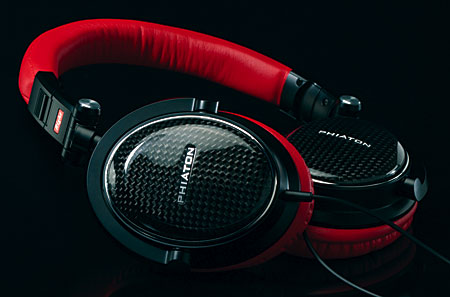
I thought about Smith the smith when John Atkinson delivered the Phiaton Moderna MS 400 headphones for review. Make no mistake—the MS 400s ($249), crafted from black carbon fiber and polymer and clad in Ferrari Rosso Corso crimson leather, are beautiful. They've turned heads every time I've taken them out in public. I'm used to attracting stares when I take out my travel rig on flights—custom-molded in-ear monitors and headphone amplifiers aren't the usual fare, despite the proliferation of pricy noise-canceling headphones. What I'm not used to is being tapped on the shoulder and asked, "What are those? Where can I get some?"
The answers are simple: They're circumaural (ie, they fit around the ear) headphones with a closed back and extremely comfortable padded leather everywhere they touch skin, and you can buy them direct from www.phiaton.com. But here's the $64,000 question (Google it, young 'uns): Is their beauty more than skin deep?
It is beauty that catches your attention
Phiaton's parent company is Cresyn Company, Ltd., a large South Korean electronics manufacturer specializing in MP3 players, microphones, and headphones of all sorts. The MS 400 is part of Phiaton's Moderna series, which also includes the MS 300 headphones and MS 600 iPod dock.
The MS 400's headband is adjustable, padded in leather-enclosed foam, and reinforced with springy steel. It terminates in two gimbals (U-shaped ear-up brackets) connected by swiveling hinges, which means the cups can swivel 180°, DJ style, and fold up into the headband so that the Phiatons can compactly fit into their carrying case (supplied). The ear cups themselves are made of carbon fiber coated with a polymer that, Phiaton claims, increases the carbon fiber's vibration-damping properties. Inside each cup is a 40mm polymer diaphragm. Each cup has its own cable, and they join in a Y about a foot out. That cable terminates in a 3.5mm miniplug, which comes with a snug-fitting converter for ¼" plugs. The MS 400 is specified as being a 32 ohm load.
Love of beauty is taste
Long ago, when dinosaurs and humans played tag on the savannah, closed-back headphones were the only choice. In 1967, Sennheiser introduced its HD-414 open-backed 'phones, padded in bright yellow, and everyone followed suit with open-backed designs of their own. More recently, our choices have proliferated, with the flourishing of earbuds, in-ear monitors, and even noise-canceling designs. Which is best?
It depends on the user and his or her priorities. At home, my favorites tend to be open-backed designs like the Sennheiser HD650 and AKG K701. On the road, my favorite is Ultimate Ears' UE-11 in-ear model—but, to my ears, the Ultimates need a headphone amp, which takes 'em off the table for many listeners. Others just don't like sticking things in their ears.
For travel use, some listeners object to open-back designs because a) they place a diaphragm 12" away from a seatmate's ear, and b) environmental noise leaks in. Hence the increasing popularity of noise-canceling headphones—but there's a problem there, too: I have yet to hear an NC 'phone that didn't create a timbre shift when its noise-canceling circuits were engaged.
Given those considerations, a closed-back headset makes a lot of sense, since there's no back spatter, and the sealed chamber reduces the intrusion of external noise. There still ain't no such thing as a free lunch, though: Just about every closed-back design I've heard has had its own coloration—possibly the ear cup resonating from the diaphragm's motion. The MS 400's use of carbon fiber, I reasoned, might be a good solution to that problem.
But I'm a tad confused about carbon fiber's resonance-taming properties. As an early admirer of Black Diamond Racing's equipment platforms and just about everything manufactured by Wilson Benesch, I just "knew" that carbon fiber was dead, dead, dead. Once, however, while visiting the shop of luthier William R. Cumpiano, I noticed a classical guitar made of carbon fiber. "Gee," I said, "isn't that an odd choice, given how nonresonant that material is?"
His eyes widened in wonder. "Nonresonant? Listen to this!" He picked it up and strummed a chord that seemed to last forever. I would bet that soundboard is still vibrating. Cumpiano, who wrote the book on building guitars (Guitarmaking: Tradition and Technology, Rosewood Press, 1987), likes working with wood, but he believes that great guitars can be made with carbon fiber—just not necessarily by him.
So there you have it: Experts agree that carbon fiber is ideal for its resonant properties—they just don't agree on what those properties are.
Beauty is a light in the heart
The MS 400s are comfortable. They don't sit as lightly on the head, as do the Sennheiser HD650s or AKG K701s, but their ample padding helps a lot. There's enough range in the adjustable headband to easily accommodate heads both large (mine, for instance) and petite (my wife's). Between the tight seal afforded by the ear-cup pads and the closed back, my ears got hot during long listening sessions—a minor cavil. On the other hand, the tightness of that seal and the closed back also meant that small amounts of sound leaked in both directions.
NEXT: Page 2 »
 | |||||||||||

|
|
| |||||||||
- Log in or register to post comments

























| Loudspeakers Amplification Digital Sources | |
Analog Sources Accessories Featured | |
Music Columns Retired Columns | |
Show Reports | |
Features Latest News Community | |
Resources Subscriptions |
 © 2024 Stereophile
AVTech Media Americas Inc., USA
All rights reserved