"I have something I think might interest you," said Elite AudioVideo Distribution's Scot Markwell. "Kevin Halverson has some, shall we say, different ideas about universal players."
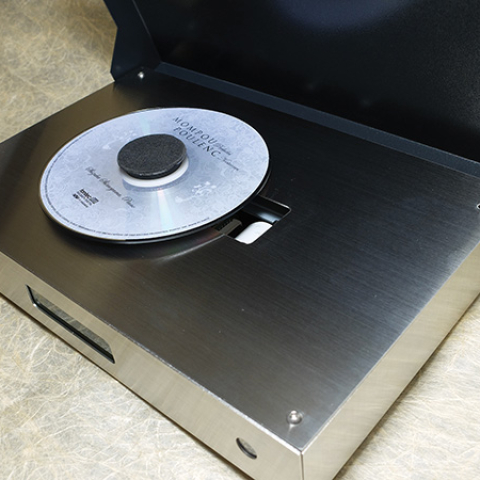
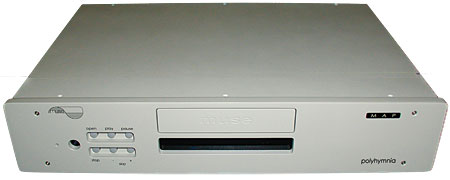 We walked into Elite's dark demo room at last year's Consumer Electronics Show and Markwell stepped aside with a flourish, gesturing toward a quasi–industrial-looking, powder-coated box: the Polyhymnia universal disc player, from Halverson's Muse Electronics.
"Ta-daa!" Yes, he said it.
I must not have looked impressed. "Oh, I forgot," he said. "It's only fancy on the inside." And—as he quickly demonstrated—in performance.
Markwell cued up an SACD and pressed Play. It was like that hackneyed scene when the prim librarian takes off her glasses, shakes out her coiled hair, and stares into the camera. She is drop-dead gorgeous, after all.
Hubba, as they say, hubba.
Love passed, the muse appeared
We walked into Elite's dark demo room at last year's Consumer Electronics Show and Markwell stepped aside with a flourish, gesturing toward a quasi–industrial-looking, powder-coated box: the Polyhymnia universal disc player, from Halverson's Muse Electronics.
"Ta-daa!" Yes, he said it.
I must not have looked impressed. "Oh, I forgot," he said. "It's only fancy on the inside." And—as he quickly demonstrated—in performance.
Markwell cued up an SACD and pressed Play. It was like that hackneyed scene when the prim librarian takes off her glasses, shakes out her coiled hair, and stares into the camera. She is drop-dead gorgeous, after all.
Hubba, as they say, hubba.
Love passed, the muse appeared
Polyhymnia is the Greek muse of sacred song and lyric poetry, and the inventor of the lyre and harmony. Her name literally means "(singing) many songs," so it's an appropriate name for a universal disc player. The Muse Polyhymnia (as opposed to the muse Polyhymnia) is one of Muse's Modular Audio-Video Platform (MAP) components, which means that its four bays allow the end-user to add the features he or she might require. The Polyhymnia sings "Red Book" CDs, DVDs -Audio and -Video, SACDs, and MP3-encoded discs in two channels, with multichannel playback available as a separate $750 module. My review sample, which Scot Markwell called "standard" in that it included the Ultra Performance analog output module and RCA and XLR stereo outputs, also included the optional multichannel output module (RCA), and an A/V output module (S/PDIF, S-video, composite video, component video). The fourth bay was empty, although a variety of choices, including an attenuator module, can be included. Price of the standard stereo model: $6400.
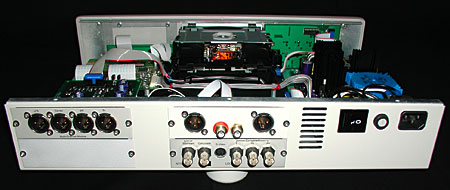 I said that the Polyhymnia's glamour resides within, but that's not to say it doesn't have its own kind of lab-gear butchness. A powder-coated case may not be as sexy as an anodized one, but the Polyhymnia is built like a brick and screams dependability. Think subdued Harley-Davidson: no chrome, lots of grunt.
The Polyhymnia is the sixth generation of Kevin Halverson's take on DVD. In fact, when Classic Records decided to take advantage of DVD's 24-bit/96kHz spec back in the format's infancy, it was Halverson who brought the news to Stereophile in Santa Fe: "Don't you get it? For the first time, audiophiles can actually own studio-quality masters!"
DSD and PCM are both handled by native conversion, using a passive reconstruction filter (a high-order Bessel topology) and, Halverson says, "a highly differential instrumentation-amplifier signal path. We find that this topology has the advantage of reduced spectral contamination and a low and spectrally flat noise floor."
The Polyhymnia's front panel looks almost bare. There's an IR window, two rows of three control buttons each, a disc tray, and a small illuminated display. Although a video display isn't required for day-to-day use, some functions are a lot easier to access if one is present—and a display is essential for setup.
The Polyhymnia is accompanied by the largest, heaviest, most solidly constructed remote control I've ever encountered. It weighs about as much as a red-clay brick and seems as durable—an important consideration, as users will be overwhelmed almost daily by the urge to hurl it against something solid.
Why? Because the Remote-2 has 64 buttons, all exactly the same size, many of them labeled cryptically in light gray letters on a slightly lighter gray background. I also found the buttons fiddly—or maybe it's the IR window. All I know is that the Polyhymnia ignored an awful lot of my commands. (Markwell tells me a much simpler remote for the Polyhymnia, called the Remote-1, which is easier to navigate, is now available as a $375 option. Seeing is believing.)
One additional note: The owner's manual states that "The Polyhymnia should never be connected to a mains source (power outlet) other than the normal domestic service. After market 'power conditioners' of the active variety (regeneration devices) can damage your Polyhymnia and should never be used." Now you know.
Fool, said my muse to me
I said that the Polyhymnia's glamour resides within, but that's not to say it doesn't have its own kind of lab-gear butchness. A powder-coated case may not be as sexy as an anodized one, but the Polyhymnia is built like a brick and screams dependability. Think subdued Harley-Davidson: no chrome, lots of grunt.
The Polyhymnia is the sixth generation of Kevin Halverson's take on DVD. In fact, when Classic Records decided to take advantage of DVD's 24-bit/96kHz spec back in the format's infancy, it was Halverson who brought the news to Stereophile in Santa Fe: "Don't you get it? For the first time, audiophiles can actually own studio-quality masters!"
DSD and PCM are both handled by native conversion, using a passive reconstruction filter (a high-order Bessel topology) and, Halverson says, "a highly differential instrumentation-amplifier signal path. We find that this topology has the advantage of reduced spectral contamination and a low and spectrally flat noise floor."
The Polyhymnia's front panel looks almost bare. There's an IR window, two rows of three control buttons each, a disc tray, and a small illuminated display. Although a video display isn't required for day-to-day use, some functions are a lot easier to access if one is present—and a display is essential for setup.
The Polyhymnia is accompanied by the largest, heaviest, most solidly constructed remote control I've ever encountered. It weighs about as much as a red-clay brick and seems as durable—an important consideration, as users will be overwhelmed almost daily by the urge to hurl it against something solid.
Why? Because the Remote-2 has 64 buttons, all exactly the same size, many of them labeled cryptically in light gray letters on a slightly lighter gray background. I also found the buttons fiddly—or maybe it's the IR window. All I know is that the Polyhymnia ignored an awful lot of my commands. (Markwell tells me a much simpler remote for the Polyhymnia, called the Remote-1, which is easier to navigate, is now available as a $375 option. Seeing is believing.)
One additional note: The owner's manual states that "The Polyhymnia should never be connected to a mains source (power outlet) other than the normal domestic service. After market 'power conditioners' of the active variety (regeneration devices) can damage your Polyhymnia and should never be used." Now you know.
Fool, said my muse to me
Before setting up the Muse Polyhymnia, eat a substantial breakfast, preferably accompanied by enough caffeine to wake you thoroughly without giving you the jitters—those remote buttons are small and require a firm and accurate touch. Hook up your video display and be prepared for a trial by menu. You'll need to tell the Polyhymnia how to handle digital audio output (including Dolby Digital, DTS, linear PCM, MPEG, and video). If you're integrating the player into an A/V system, you'll need to establish the aspect ratio and assign S-video or component pathways. There are submenus for DVD playback mode (DVD-V or DVD-A) and DSD playback (two-channel, multichannel, or CD layer). There's a DTS downmix submenu, as well as an option to constrain the dynamic range of your discs (some people actually want this, believe it or not). There's more, but you get the idea. Of course, one reason you have so many options is that the Polyhymnia can do so many things. I just set it up to play two-channel CD, SACD, and DVD-A. Then the video display went bye-bye. It turned out to be true that you don't need a display to play discs—unless you change your mind about whether you're listening to DVD-A only. If you want to hear the soundtrack on an occasional DVD-V, you'll need to fetch the monitor again and leave it there so you can switch the Polyhymnia back to DVD-A afterwards.
Livelier liquor than the muse
The Polyhymnia's On/Off switch is on its rear panel. For daily use, the player is left on; it lapses into Standby mode after about an hour of inactivity. And you might as well leave it on, because it sounds better after it's been on for a few hours. I offer no explanation for this, but I observed it every time I shifted the Polyhymnia from one system to another.
We walked into Elite's dark demo room at last year's Consumer Electronics Show and Markwell stepped aside with a flourish, gesturing toward a quasi–industrial-looking, powder-coated box: the Polyhymnia universal disc player, from Halverson's Muse Electronics.
"Ta-daa!" Yes, he said it.
I must not have looked impressed. "Oh, I forgot," he said. "It's only fancy on the inside." And—as he quickly demonstrated—in performance.
Polyhymnia is the Greek muse of sacred song and lyric poetry, and the inventor of the lyre and harmony. Her name literally means "(singing) many songs," so it's an appropriate name for a universal disc player. The Muse Polyhymnia (as opposed to the muse Polyhymnia) is one of Muse's Modular Audio-Video Platform (MAP) components, which means that its four bays allow the end-user to add the features he or she might require. The Polyhymnia sings "Red Book" CDs, DVDs -Audio and -Video, SACDs, and MP3-encoded discs in two channels, with multichannel playback available as a separate $750 module. My review sample, which Scot Markwell called "standard" in that it included the Ultra Performance analog output module and RCA and XLR stereo outputs, also included the optional multichannel output module (RCA), and an A/V output module (S/PDIF, S-video, composite video, component video). The fourth bay was empty, although a variety of choices, including an attenuator module, can be included. Price of the standard stereo model: $6400.
I said that the Polyhymnia's glamour resides within, but that's not to say it doesn't have its own kind of lab-gear butchness. A powder-coated case may not be as sexy as an anodized one, but the Polyhymnia is built like a brick and screams dependability. Think subdued Harley-Davidson: no chrome, lots of grunt.
The Polyhymnia is the sixth generation of Kevin Halverson's take on DVD. In fact, when Classic Records decided to take advantage of DVD's 24-bit/96kHz spec back in the format's infancy, it was Halverson who brought the news to Stereophile in Santa Fe: "Don't you get it? For the first time, audiophiles can actually own studio-quality masters!"
DSD and PCM are both handled by native conversion, using a passive reconstruction filter (a high-order Bessel topology) and, Halverson says, "a highly differential instrumentation-amplifier signal path. We find that this topology has the advantage of reduced spectral contamination and a low and spectrally flat noise floor."
Before setting up the Muse Polyhymnia, eat a substantial breakfast, preferably accompanied by enough caffeine to wake you thoroughly without giving you the jitters—those remote buttons are small and require a firm and accurate touch. Hook up your video display and be prepared for a trial by menu. You'll need to tell the Polyhymnia how to handle digital audio output (including Dolby Digital, DTS, linear PCM, MPEG, and video). If you're integrating the player into an A/V system, you'll need to establish the aspect ratio and assign S-video or component pathways. There are submenus for DVD playback mode (DVD-V or DVD-A) and DSD playback (two-channel, multichannel, or CD layer). There's a DTS downmix submenu, as well as an option to constrain the dynamic range of your discs (some people actually want this, believe it or not). There's more, but you get the idea. Of course, one reason you have so many options is that the Polyhymnia can do so many things. I just set it up to play two-channel CD, SACD, and DVD-A. Then the video display went bye-bye. It turned out to be true that you don't need a display to play discs—unless you change your mind about whether you're listening to DVD-A only. If you want to hear the soundtrack on an occasional DVD-V, you'll need to fetch the monitor again and leave it there so you can switch the Polyhymnia back to DVD-A afterwards.
The Polyhymnia's On/Off switch is on its rear panel. For daily use, the player is left on; it lapses into Standby mode after about an hour of inactivity. And you might as well leave it on, because it sounds better after it's been on for a few hours. I offer no explanation for this, but I observed it every time I shifted the Polyhymnia from one system to another.