It was 20 years ago today that Sgt. Michaelson taught the band to play. I was living in London when Antony Michaelson launched Musical Fidelity in an attempt to make a major statement in the area of affordable, high-quality, high-value electronics. Other Brits at the time were doing the same—companies such as Creek, A&R Cambridge (now Arcam), and DNM began to compete for the destitute audiophile's dollar.  I was living in London back then, and being paid in US dollars during the pound sterling's historical high. This meant I was chronically broke, and thus fascinated by the work being done by all of these cost-conscious companies. Since then, Musical Fidelity has broadened and upgraded its product line continuously, and lately our own Mikey Fremer has been spending a lot of time with the company's more upmarket digital and electronics gear. So when I discovered that the company had launched a dual-mono, 110Wpc, integrated amplifier for a quite affordable $1500, I thought it would be a good time to take a slight break from reviewing inexpensive speakers.
Being for the benefit of Mr. Consumer
I was living in London back then, and being paid in US dollars during the pound sterling's historical high. This meant I was chronically broke, and thus fascinated by the work being done by all of these cost-conscious companies. Since then, Musical Fidelity has broadened and upgraded its product line continuously, and lately our own Mikey Fremer has been spending a lot of time with the company's more upmarket digital and electronics gear. So when I discovered that the company had launched a dual-mono, 110Wpc, integrated amplifier for a quite affordable $1500, I thought it would be a good time to take a slight break from reviewing inexpensive speakers.
Being for the benefit of Mr. Consumer
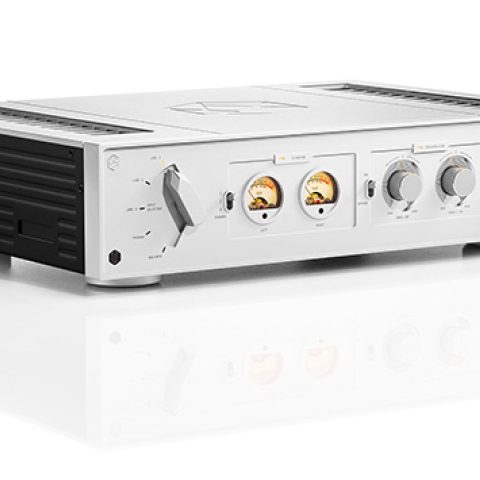
Antony Michaelson is not shy about his philosophy of product design. He favors intelligent design and strict cost efficiencies, both of which translate into value for money for his customers. He strongly believes in using, whenever possible, low-feedback, dual-mono circuits. He's also a fanatic experimenter with circuit-board layout, always in pursuit of the best sound. He is not, however, a believer in expensive "name" electronic parts, as he feels they do not justify their cost. The A3.2 is a fully dual-mono integrated amplifier, with separate transformer windings for the preamp stage in an attempt to achieve better inter-stage isolation. The A3.2's power supply features a choke-regulator transformer to minimize power-supply ripple and noise. The preamp section sports five line-level inputs as well as a phono stage, which can be switched between moving-magnet and moving-coil operation with a back-panel button. Rounding out the A3.2 are separate preamp output jacks and a full-function remote control. Although I'm not usually turned on by such stuff, I thought the physical appearance of the faceplate, the rugged construction, the cool blue selector lights, and the slinkiest volume control I've ever twiddled, all combined to create an ergonomic and visual statement that reminded me more of Hovland, Krell, and Jeff Rowland Design Group than of affordable gear.
It's getting better all the time
Immediately on cranking it up, I was struck by how the A3.2's overall character reminded me of expensive tube electronics. There was an overall musical rightness, a sense of liquidity and delicacy, an organic quality to the textures of well-recorded acoustic music. The A3.2 exhibited a laid-back, back-of-the-hall perspective that in no way seemed dark, sluggish, or veiled with any of the recordings I demoed. The amp had a coherent dimensional and musical character, but never seemed to euphonically color any type of music. Most important, I always heard a level of detail and transparency that suggested the performance of far more expensive gear. Small-group jazz shone on the A3.2 via both vinyl and CD sources. Duke Ellington's piano on "The Mooche," from Duke Ellington and Louis Armstrong (LP, Roulette/Classic SR52074), sounded natural, warm, and vibrant, but with sufficient bite and transient attack on higher-frequency right-hand passages. The rich midrange, combined with the revealing yet delicate and relaxed high-frequency reproduction, rendered the bite of Armstrong's trumpet but with a golden, burnished hue. Barney Bigard's clarinet was woody and lyrical without a trace of dulling, sweetening, or veiling. Percussion also fared very well with the A3.2. On the Modern Jazz Quartet's Concorde (LP/CD, Prestige/JVCXRCD LP7002), Milt Jackson's vibes were natural, with rapid attack but no unnatural sharpness. The level of detail resolution and transparency, and the uncolored rendering of midrange timbres, made the interplay of vibes and piano very convincing. Similarly, the marimba on Kohjiba's Transmigration of the Soul (CD, Stereophile STPH007-2), from the 1995 Santa Fe Chamber Music Festival, had the requisite thwack integrated with the woodiness of the instrument. And the delicate shakers and bells on George Crumb's Quest (LP, Bridge 9069) were delivered with realistic bite, decay, and ambience. I did feel, however, that the upper partials of the flute in the Kohjiba lacked a bit of top-end sparkle and air.
Fans of classical strings should be pleased with the A3.2. From the double bass in the Crumb to the violins in the Kohjiba, I heard the rosin on the bows, the wood of the instruments' bodies, and natural and coherent timbral reproduction throughout the instruments' frequency ranges. The massed pizzicato passages of Stravinsky's The Firebird (LP, Mercury Living Presence/Classic SR90226) popped out of thin air and hung in the wide, deep soundstage, as they do in live performance. Fans of orchestral powerhouses should appreciate the A3.2's high-level dynamic performance and powerful, extended bass capabilities. Even during the most bombastic passages of the Stravinsky, my listening notes read: "Pure drama."
I was living in London back then, and being paid in US dollars during the pound sterling's historical high. This meant I was chronically broke, and thus fascinated by the work being done by all of these cost-conscious companies. Since then, Musical Fidelity has broadened and upgraded its product line continuously, and lately our own Mikey Fremer has been spending a lot of time with the company's more upmarket digital and electronics gear. So when I discovered that the company had launched a dual-mono, 110Wpc, integrated amplifier for a quite affordable $1500, I thought it would be a good time to take a slight break from reviewing inexpensive speakers. Antony Michaelson is not shy about his philosophy of product design. He favors intelligent design and strict cost efficiencies, both of which translate into value for money for his customers. He strongly believes in using, whenever possible, low-feedback, dual-mono circuits. He's also a fanatic experimenter with circuit-board layout, always in pursuit of the best sound. He is not, however, a believer in expensive "name" electronic parts, as he feels they do not justify their cost. The A3.2 is a fully dual-mono integrated amplifier, with separate transformer windings for the preamp stage in an attempt to achieve better inter-stage isolation. The A3.2's power supply features a choke-regulator transformer to minimize power-supply ripple and noise. The preamp section sports five line-level inputs as well as a phono stage, which can be switched between moving-magnet and moving-coil operation with a back-panel button. Rounding out the A3.2 are separate preamp output jacks and a full-function remote control. Although I'm not usually turned on by such stuff, I thought the physical appearance of the faceplate, the rugged construction, the cool blue selector lights, and the slinkiest volume control I've ever twiddled, all combined to create an ergonomic and visual statement that reminded me more of Hovland, Krell, and Jeff Rowland Design Group than of affordable gear.
Immediately on cranking it up, I was struck by how the A3.2's overall character reminded me of expensive tube electronics. There was an overall musical rightness, a sense of liquidity and delicacy, an organic quality to the textures of well-recorded acoustic music. The A3.2 exhibited a laid-back, back-of-the-hall perspective that in no way seemed dark, sluggish, or veiled with any of the recordings I demoed. The amp had a coherent dimensional and musical character, but never seemed to euphonically color any type of music. Most important, I always heard a level of detail and transparency that suggested the performance of far more expensive gear. Small-group jazz shone on the A3.2 via both vinyl and CD sources. Duke Ellington's piano on "The Mooche," from Duke Ellington and Louis Armstrong (LP, Roulette/Classic SR52074), sounded natural, warm, and vibrant, but with sufficient bite and transient attack on higher-frequency right-hand passages. The rich midrange, combined with the revealing yet delicate and relaxed high-frequency reproduction, rendered the bite of Armstrong's trumpet but with a golden, burnished hue. Barney Bigard's clarinet was woody and lyrical without a trace of dulling, sweetening, or veiling. Percussion also fared very well with the A3.2. On the Modern Jazz Quartet's Concorde (LP/CD, Prestige/JVCXRCD LP7002), Milt Jackson's vibes were natural, with rapid attack but no unnatural sharpness. The level of detail resolution and transparency, and the uncolored rendering of midrange timbres, made the interplay of vibes and piano very convincing. Similarly, the marimba on Kohjiba's Transmigration of the Soul (CD, Stereophile STPH007-2), from the 1995 Santa Fe Chamber Music Festival, had the requisite thwack integrated with the woodiness of the instrument. And the delicate shakers and bells on George Crumb's Quest (LP, Bridge 9069) were delivered with realistic bite, decay, and ambience. I did feel, however, that the upper partials of the flute in the Kohjiba lacked a bit of top-end sparkle and air.