You can read all about an automobile, check its gear ratios, and ponder the engine's horsepower all you want—but until you put yourself in the driver's seat and take that baby out for a spin, you have no idea whether or not it's going to be fun to drive.
 I found that out in the early 1970s when one of my father's drinking buddies rashly decided to let me drive his (then) late-model Corvette unchaperoned. It was heavy, and an automatic (!) to boot, but despite its undeniable power, it just didn't excite me on the curvy Virginia back roads I subjected it to. My roommate's VW fastback felt zippier and far more nimble powering into the curves. My dad's good ol' boy companion was disgusted by my lack of enthusiasm—he had a 'Vette. All my roomie had was a Volkswagen.
Similarly, stereo components don't always reveal all on the test bench. If'n you want to know how good they sound, you have to set 'em up and play 'em. Sometimes they'll surprise you.
Last fall, our Music Editor, Robert Baird, gave a Zozobra (footnote 1) party. The day before the shindig, he called me in a panic: "I don't have any music in the living room! Do we have anything that I can hook up just for the party?"
As it happened, Lauerman Audio Imports had just sent Stereophile the Rega Planet CD player (reviewed in Vol.21 No.2) and the subject of this review: Rega's integrated amplifier, the Brio. Those two components and a pair of B&W DM 302 speakers made up the party system—and they made it a swinging affair. Robert, as is his wont, had about 20 million CDs that he just had to play us. (If we were lucky, he actually let us hear all of one track before playing the next one.) This went on until the wee, wee hours. Before the night was through, he even had John Atkinson—normally the soul of composure—jivin' and skankin' around the living room.
As JA and I gave the party a Monday-morning post-mortem, we both commented on how much we'd enjoyed listening to that "inexpensive" system. We agreed that reviews were in order—first the B&Ws, then the Planet, and now, finally, the Brio. The biggest problem was getting RB to relinquish them for review. Even undisguised attempts to bribe him with expensive "name-brand" components were met with disdain. Baird knows a good thing when he hears it.
Con Brio (kohn bree-oh): With Gusto
I found that out in the early 1970s when one of my father's drinking buddies rashly decided to let me drive his (then) late-model Corvette unchaperoned. It was heavy, and an automatic (!) to boot, but despite its undeniable power, it just didn't excite me on the curvy Virginia back roads I subjected it to. My roommate's VW fastback felt zippier and far more nimble powering into the curves. My dad's good ol' boy companion was disgusted by my lack of enthusiasm—he had a 'Vette. All my roomie had was a Volkswagen.
Similarly, stereo components don't always reveal all on the test bench. If'n you want to know how good they sound, you have to set 'em up and play 'em. Sometimes they'll surprise you.
Last fall, our Music Editor, Robert Baird, gave a Zozobra (footnote 1) party. The day before the shindig, he called me in a panic: "I don't have any music in the living room! Do we have anything that I can hook up just for the party?"
As it happened, Lauerman Audio Imports had just sent Stereophile the Rega Planet CD player (reviewed in Vol.21 No.2) and the subject of this review: Rega's integrated amplifier, the Brio. Those two components and a pair of B&W DM 302 speakers made up the party system—and they made it a swinging affair. Robert, as is his wont, had about 20 million CDs that he just had to play us. (If we were lucky, he actually let us hear all of one track before playing the next one.) This went on until the wee, wee hours. Before the night was through, he even had John Atkinson—normally the soul of composure—jivin' and skankin' around the living room.
As JA and I gave the party a Monday-morning post-mortem, we both commented on how much we'd enjoyed listening to that "inexpensive" system. We agreed that reviews were in order—first the B&Ws, then the Planet, and now, finally, the Brio. The biggest problem was getting RB to relinquish them for review. Even undisguised attempts to bribe him with expensive "name-brand" components were met with disdain. Baird knows a good thing when he hears it.
Con Brio (kohn bree-oh): With Gusto
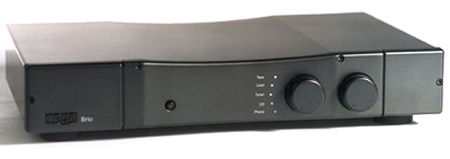
The Rega Brio is housed in a textured, black, cast-aluminum "clamshell" casing—two castings fit together to enclose the innards. The front panel is strikingly uncluttered: The small power button is accompanied by a green LED power indicator and two large knobs—one for source switching, the other for volume—both inset with green LEDs. The rear has RCA inputs for four sources (phono, labeled as "Disc," and three line-level), as well as a tape loop. Speaker connections are four widely spaced binding posts with knurled plastic nuts that accept spades, bare wire, or bananas. A dedicated mains cable and a grounding screw (for the phono section) complete the facilities. Nothing is more complicated than it needs to be. The phono section is for moving-magnet or high-output moving-coil cartridges only, as is appropriate for an amplifier in this price range—I can't see many consumers hooking up $2000 MCs to a $595 integrated. I tried several cartridges with the phono section, and it seemed robust and responsive, suggesting that the Brio would be a good choice for the vinyl-loving audiophile on a budget. Rega sent me a schematic for the unit, and it looks to be a classic transistor design with few surprises, which these days is surprising in itself. When I caught up with company founder Roy Gandy in the midst of a New York vacation, he confirmed this:
"We had our designer, Terry Bateman, come up with eight different approaches using traditional circuitry, and we made them all and had about 20 people listen to them over a period of three months—using both blind and sighted tests. This particular design [the Brio} repeatedly came up as sounding good. It's a fairly low-tech circuit—it was based on an old Texas Instruments transistor circuit, and to make it work well, we actually had to use fairly low-tech transistors.
"As it so happens, our listening and our measurements were somewhat in conflict with this circuit. Sometimes we can produce a circuit that measures well and sounds good; at other times we have produced amplifiers that measure well and sound awful. This time, however, it sounds quite nice but it measures quite badly—particularly the overall distortion levels at high frequencies can get quite high.
Footnote 1: Fiesta is a holiday celebrated only in Santa Fe. We Santa Feans consider it ours—even to the point of scheduling it after Labor Day, when the tourists have left. Robert's house is in the heights overlooking the site where the crowning glory of Fiesta is staged: a 50' papier-mâchè puppet of Zozobra—"Old Man Gloom"—is ritually set afire to measured drumbeats. As he writhes and moans in flames, about $30,000 worth of fireworks are ignited. It's loud, somewhat pagan, and tremendous fun.—Wes Phillips
I found that out in the early 1970s when one of my father's drinking buddies rashly decided to let me drive his (then) late-model Corvette unchaperoned. It was heavy, and an automatic (!) to boot, but despite its undeniable power, it just didn't excite me on the curvy Virginia back roads I subjected it to. My roommate's VW fastback felt zippier and far more nimble powering into the curves. My dad's good ol' boy companion was disgusted by my lack of enthusiasm—he had a 'Vette. All my roomie had was a Volkswagen.
Similarly, stereo components don't always reveal all on the test bench. If'n you want to know how good they sound, you have to set 'em up and play 'em. Sometimes they'll surprise you.
The Rega Brio is housed in a textured, black, cast-aluminum "clamshell" casing—two castings fit together to enclose the innards. The front panel is strikingly uncluttered: The small power button is accompanied by a green LED power indicator and two large knobs—one for source switching, the other for volume—both inset with green LEDs. The rear has RCA inputs for four sources (phono, labeled as "Disc," and three line-level), as well as a tape loop. Speaker connections are four widely spaced binding posts with knurled plastic nuts that accept spades, bare wire, or bananas. A dedicated mains cable and a grounding screw (for the phono section) complete the facilities. Nothing is more complicated than it needs to be. The phono section is for moving-magnet or high-output moving-coil cartridges only, as is appropriate for an amplifier in this price range—I can't see many consumers hooking up $2000 MCs to a $595 integrated. I tried several cartridges with the phono section, and it seemed robust and responsive, suggesting that the Brio would be a good choice for the vinyl-loving audiophile on a budget. Rega sent me a schematic for the unit, and it looks to be a classic transistor design with few surprises, which these days is surprising in itself. When I caught up with company founder Roy Gandy in the midst of a New York vacation, he confirmed this:
Footnote 1: Fiesta is a holiday celebrated only in Santa Fe. We Santa Feans consider it ours—even to the point of scheduling it after Labor Day, when the tourists have left. Robert's house is in the heights overlooking the site where the crowning glory of Fiesta is staged: a 50' papier-mâchè puppet of Zozobra—"Old Man Gloom"—is ritually set afire to measured drumbeats. As he writhes and moans in flames, about $30,000 worth of fireworks are ignited. It's loud, somewhat pagan, and tremendous fun.—Wes Phillips