HDMI is the invention of the Devil. I grant that the Devil is very smart—he has put on a single cable both hi-rez audio and video, and paid tribute to the gods of industry by incorporating obligatory content protection. However, he has confounded the rest of us by using a connector that, while it relies on friction to maintain physical contact, has so little friction that the cable connector can be easily displaced from or misaligned with the chassis connector. The traditional audiophile predilection for heavy cables is, in this case, actually counterproductive—exerting just a bit of torque on a stiff HDMI cable can be enough to break the connection.
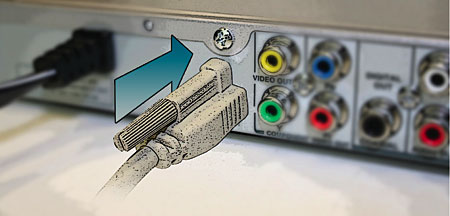 It gets worse. Repeated misalignments of the connector can result in actual misalignment of the contact elements so that proper contact becomes impossible. One must then replace the cable or repair the component, and I don't know which is worse. You can pay the cost of having the factory replace the HDMI chassis connector, but in some cases the cost and bother of snaking a new HDMI cable through the wall can be even greater. Believe me, I know—the connector of one of my in-wall HDMI cables failed, and HDMI connectors are not field-replaceable.
Of course, none of this is a secret, and many in the cable industry are working on the problem. The most common solution is the use of Port-savers: short, flexible male-female HDMI cables that intercede between your component and your long, heavy-duty HDMI cable to relieve the torque on the chassis connection. These do the job, and are inexpensive (less than $3 from Monoprice). However, they're not a perfect solution, for two reasons: they add one more physical/electrical connection to the circuit, and further contribute to the mare's nest of cables and connections behind the equipment rack. What we really need is a better HDMI connector—one that attaches firmly to the chassis, resists being yanked out accidentally, and prevents the wiggling that can compromise an electrical contact.
In the past few weeks, I've played with a few solutions. The simplest is the new PPC Locking HDMI Cable (6', $59.99). This flexible, high-quality cable has gold-plated pins and, to eliminate interference, 100% foil coverage and braided shielding. What makes this product unique, however, is that the undersurface of its HDMI connector is split to create a spring latch, which engages the shell of the chassis socket as it is inserted. There's a button on the connector shell to release the latch.
It gets worse. Repeated misalignments of the connector can result in actual misalignment of the contact elements so that proper contact becomes impossible. One must then replace the cable or repair the component, and I don't know which is worse. You can pay the cost of having the factory replace the HDMI chassis connector, but in some cases the cost and bother of snaking a new HDMI cable through the wall can be even greater. Believe me, I know—the connector of one of my in-wall HDMI cables failed, and HDMI connectors are not field-replaceable.
Of course, none of this is a secret, and many in the cable industry are working on the problem. The most common solution is the use of Port-savers: short, flexible male-female HDMI cables that intercede between your component and your long, heavy-duty HDMI cable to relieve the torque on the chassis connection. These do the job, and are inexpensive (less than $3 from Monoprice). However, they're not a perfect solution, for two reasons: they add one more physical/electrical connection to the circuit, and further contribute to the mare's nest of cables and connections behind the equipment rack. What we really need is a better HDMI connector—one that attaches firmly to the chassis, resists being yanked out accidentally, and prevents the wiggling that can compromise an electrical contact.
In the past few weeks, I've played with a few solutions. The simplest is the new PPC Locking HDMI Cable (6', $59.99). This flexible, high-quality cable has gold-plated pins and, to eliminate interference, 100% foil coverage and braided shielding. What makes this product unique, however, is that the undersurface of its HDMI connector is split to create a spring latch, which engages the shell of the chassis socket as it is inserted. There's a button on the connector shell to release the latch.
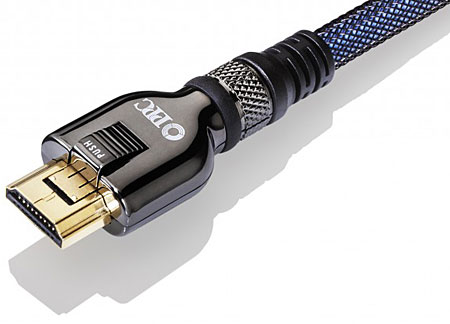 PPC claims that this latch increases threefold its resistance to pull-out, and that's what it feels like to me. Sure, I can yank the cable out without pressing the release button, but it takes a lot more effort than with regular HDMI cables. It was not dislodged by normal environmental stresses, such as those caused by moving a component or connecting nearby cables—or, indeed, by moving the PPC cable itself. Moreover, as I subjected the PPC to these stresses, the integrity of the audio and video signals was never compromised. While there was practically no vertical play in the PPC connection, there was some play from side to side—though still less than with conventional HDMI connectors. But since the functional electrical contact remained unaffected by any wiggling of connector, I can't fault the PPC, and its use requires no installation, or any change in the way you normally hook up an HDMI cable.
Although the PPC seemed immune to my determined wiggling of HDMI cables, its lateral play still reminded me of all the wiggling I'd done when nursing failing HDMI cables, and that made me desire an even more secure connection. However, these require a bit of installation, and aren't as convenient as the PPC for those (read: equipment reviewers) who frequently swap out components and connections. In addition, these devices are not universal solutions—they rely on the user being able to access the screw that usually fixes the HDMI socket to a component's rear panel. For example, the screw on my Zektor HDMI switcher is inaccessible.
The first of these types is an HDMI cable with a long screw fitted to a prominence on the connector shell. The user removes the screw from the rear panel of the component and, after inserting the cable into the socket, inserts and tightens the cable's screw into the chassis' threads, firmly locking the cable to the rear panel. I tried cables of this general description from Gefen and Xantech.
The Gefen Mono-LOK cable is a breeze to use and, by linking the connector housing to the component chassis, relieves any stress due to cable routing or manipulation (6', $49). I thought the rigidity of the connection, particularly in the lateral plane, to be much greater than with the PPC cable, and certainly more than with standard HDMI. My only cavil is that the cable requires you to replace the flat screw holding the HDMI connector (on the sink or source side) with the cable's screw to hold the lock in place. For fairly stable and permanent arrangements, this is not an issue.
PPC claims that this latch increases threefold its resistance to pull-out, and that's what it feels like to me. Sure, I can yank the cable out without pressing the release button, but it takes a lot more effort than with regular HDMI cables. It was not dislodged by normal environmental stresses, such as those caused by moving a component or connecting nearby cables—or, indeed, by moving the PPC cable itself. Moreover, as I subjected the PPC to these stresses, the integrity of the audio and video signals was never compromised. While there was practically no vertical play in the PPC connection, there was some play from side to side—though still less than with conventional HDMI connectors. But since the functional electrical contact remained unaffected by any wiggling of connector, I can't fault the PPC, and its use requires no installation, or any change in the way you normally hook up an HDMI cable.
Although the PPC seemed immune to my determined wiggling of HDMI cables, its lateral play still reminded me of all the wiggling I'd done when nursing failing HDMI cables, and that made me desire an even more secure connection. However, these require a bit of installation, and aren't as convenient as the PPC for those (read: equipment reviewers) who frequently swap out components and connections. In addition, these devices are not universal solutions—they rely on the user being able to access the screw that usually fixes the HDMI socket to a component's rear panel. For example, the screw on my Zektor HDMI switcher is inaccessible.
The first of these types is an HDMI cable with a long screw fitted to a prominence on the connector shell. The user removes the screw from the rear panel of the component and, after inserting the cable into the socket, inserts and tightens the cable's screw into the chassis' threads, firmly locking the cable to the rear panel. I tried cables of this general description from Gefen and Xantech.
The Gefen Mono-LOK cable is a breeze to use and, by linking the connector housing to the component chassis, relieves any stress due to cable routing or manipulation (6', $49). I thought the rigidity of the connection, particularly in the lateral plane, to be much greater than with the PPC cable, and certainly more than with standard HDMI. My only cavil is that the cable requires you to replace the flat screw holding the HDMI connector (on the sink or source side) with the cable's screw to hold the lock in place. For fairly stable and permanent arrangements, this is not an issue.
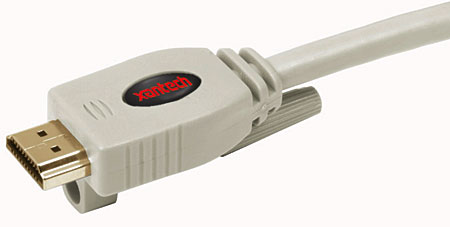 The Xantech Locking HDMI cable (6', $60) is quite like the Gefen, but also comes with a pair of threaded hex-body standoffs just like the ones used with RS-232 and DVI cables. It is intended to replace the chassis screws, so that the internal HDMI connector remains firmly fixed to the chassis even when, later, you have to change HDMI cables. The Xantech enhancement appears to contribute little to the security of the cable connection, but it did contribute to my peace of mind—I knew that there was no chance of misaligning an HDMI connection while fumbling with that or other cables. The standoffs are also fully compatible with the Gefen cables, and can be purchased from any supplier of computer parts.
It gets worse. Repeated misalignments of the connector can result in actual misalignment of the contact elements so that proper contact becomes impossible. One must then replace the cable or repair the component, and I don't know which is worse. You can pay the cost of having the factory replace the HDMI chassis connector, but in some cases the cost and bother of snaking a new HDMI cable through the wall can be even greater. Believe me, I know—the connector of one of my in-wall HDMI cables failed, and HDMI connectors are not field-replaceable.
Of course, none of this is a secret, and many in the cable industry are working on the problem. The most common solution is the use of Port-savers: short, flexible male-female HDMI cables that intercede between your component and your long, heavy-duty HDMI cable to relieve the torque on the chassis connection. These do the job, and are inexpensive (less than $3 from Monoprice). However, they're not a perfect solution, for two reasons: they add one more physical/electrical connection to the circuit, and further contribute to the mare's nest of cables and connections behind the equipment rack. What we really need is a better HDMI connector—one that attaches firmly to the chassis, resists being yanked out accidentally, and prevents the wiggling that can compromise an electrical contact.
PPC claims that this latch increases threefold its resistance to pull-out, and that's what it feels like to me. Sure, I can yank the cable out without pressing the release button, but it takes a lot more effort than with regular HDMI cables. It was not dislodged by normal environmental stresses, such as those caused by moving a component or connecting nearby cables—or, indeed, by moving the PPC cable itself. Moreover, as I subjected the PPC to these stresses, the integrity of the audio and video signals was never compromised. While there was practically no vertical play in the PPC connection, there was some play from side to side—though still less than with conventional HDMI connectors. But since the functional electrical contact remained unaffected by any wiggling of connector, I can't fault the PPC, and its use requires no installation, or any change in the way you normally hook up an HDMI cable.
Although the PPC seemed immune to my determined wiggling of HDMI cables, its lateral play still reminded me of all the wiggling I'd done when nursing failing HDMI cables, and that made me desire an even more secure connection. However, these require a bit of installation, and aren't as convenient as the PPC for those (read: equipment reviewers) who frequently swap out components and connections. In addition, these devices are not universal solutions—they rely on the user being able to access the screw that usually fixes the HDMI socket to a component's rear panel. For example, the screw on my Zektor HDMI switcher is inaccessible.
The Xantech Locking HDMI cable (6', $60) is quite like the Gefen, but also comes with a pair of threaded hex-body standoffs just like the ones used with RS-232 and DVI cables. It is intended to replace the chassis screws, so that the internal HDMI connector remains firmly fixed to the chassis even when, later, you have to change HDMI cables. The Xantech enhancement appears to contribute little to the security of the cable connection, but it did contribute to my peace of mind—I knew that there was no chance of misaligning an HDMI connection while fumbling with that or other cables. The standoffs are also fully compatible with the Gefen cables, and can be purchased from any supplier of computer parts.