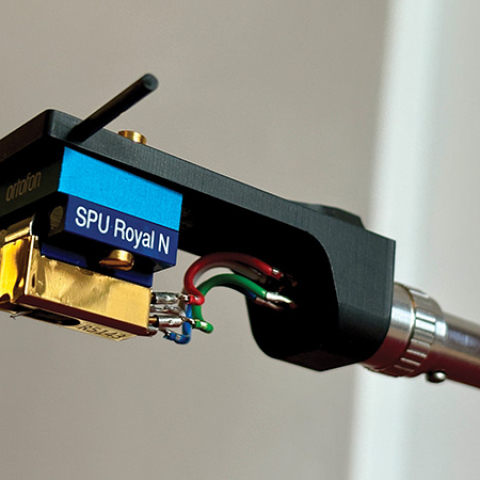
There are a thousand different ways to make a loudspeaker. A hundred to make an amplifier. And at least a million to make a piece of wire. But here's the deal with a moving-coil phono cartridge: stylus, cantilever, rubber grommet, tensioning wire, coils, magnet, output pins, and maybe a body. Done.
 ,.
That's one reason I love cartridges so well: The physical and technical differences among various makes and models don't seem remarkable, yet the sonic and musical results of those differences certainly are. Even those audio mavens who think of themselves (howsoever wrongly) as objectivists agree that it's easy to hear differences among phono cartridges, whereas the sonic differences among amplifiers, which contain many more parts and whose workings can be a function of wildly different technologies and operating types, elude them entirely. I could cry.
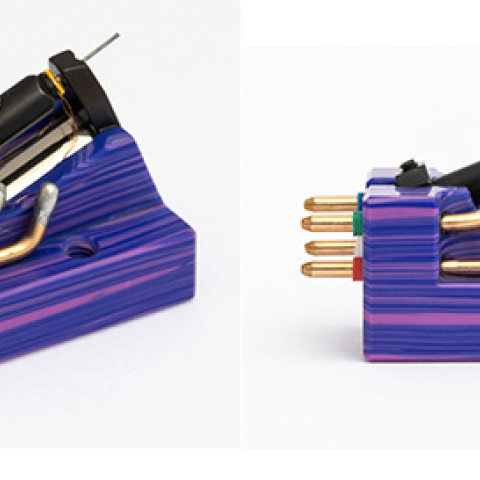
The Titanium phono cartridge, built by Brinkmann Audio from a moving-coil model supplied by EMT, is a fine example—not only for its individual blend of musical and sonic qualities, but because its sparse internals are exposed to view, inviting much contemplation during listening sessions to come. The basic EMT model is the forerunner of all such naked pickups: The first cartridges from ElektroMessTechnik were built into dedicated headshells, but as the popularity of that style waned, the company simply offered a version of the same thing that was stripped to its essentials—and which has remained mostly unchanged for more than half a century (footnote 1).
The Titanium is unmistakably EMT, with its billboard front and its phenolic sides, the latter serving as miniature tag boards for connections between the coil wires and the output pins. (In other EMT cartridges, including such earlier OEM models as the Roksan Shiraz and Einstein Audio's Tubaphon TU-3, those boards also facilitate the use of very small tantalum capacitors for electrical damping—but those are forgone in the Brinkmann version.) Centered between the boards is a modern-looking generator held in place with three exceedingly small setscrews. Apart from an obvious advantage in terms of rigidity, that mounting arrangement allows the user to adjust stylus azimuth by rotating the generator itself relative to the rest of the cartridge. The Titanium's magnet is made of alnico, which has enjoyed a resurgence of interest from audio traditionalists in recent years.
The 6N copper coils of this low-output generator (0.21mV at the usual groove velocity) are wound onto a square former, and the cantilever is a good old-fashioned aluminum tube. The stylus is a rectangular-shank diamond ground to a 4µm van den Hul shape by EMT, pressed into the flattened end of the cantilever, and cemented from above. Because that process tends to leave a rough edge on the underside of the end of the cantilever (think: exit wound), Helmut Brinkmann uses a microscope and a steady hand to smooth the seam, in order to prevent the buildup of dirt and consequent mistracking. The recommended downforce is between 1.8 and 2gm, and the Titanium's compliance is very slightly higher than average, indicating a good match with all modern tonearms except those of the very lowest and highest mass—avoid the Grace 707 at one extreme, the Zeta at the other. Although EMT doesn't publish a coil-resistance spec, their recommended load for active gain devices is 600 ohms.
Perhaps the most obvious of Herr Brinkmann's contributions to the design of the Titanium cartridge is a mechanical one: The top of the EMT's minimal body structure is bonded to an aluminum shell with a very small amount of damping compound, and the upper plate of the shell—the portion that contacts the tonearm—is a precision-made titanium plate. Brinkman also bonds a pair of cylindrical copper mounting nuts—machined in-house from 6N stock—to the body of the EMT, and supplies with the cartridge a set of aluminum mounting screws and titanium washers. In much the same way that English audio designer Denis Morecroft aims to prevent the propagation of eddy currents within his products (see "Listening" in the April 2004 and May 2004 Stereophiles), Brinkmann believes in breaking up electromagnetic energy wherever possible, hence the dissimilar metals.
Another Brinkmann refinement is an improved mounting arrangement for the output pins: a weak point in certain other EMT cartridges, where the pins are on a small plastic plate that's secured only with a drop of cement. In the Titanium, the pin mount is integral to the rest of the alloy body, and the pins themselves—which are slightly larger and longer than average, and appear to have been machined from copper telluride—are nicely spread out for ease of installation.
Setup and listening
,.
That's one reason I love cartridges so well: The physical and technical differences among various makes and models don't seem remarkable, yet the sonic and musical results of those differences certainly are. Even those audio mavens who think of themselves (howsoever wrongly) as objectivists agree that it's easy to hear differences among phono cartridges, whereas the sonic differences among amplifiers, which contain many more parts and whose workings can be a function of wildly different technologies and operating types, elude them entirely. I could cry.
The Titanium phono cartridge, built by Brinkmann Audio from a moving-coil model supplied by EMT, is a fine example—not only for its individual blend of musical and sonic qualities, but because its sparse internals are exposed to view, inviting much contemplation during listening sessions to come. The basic EMT model is the forerunner of all such naked pickups: The first cartridges from ElektroMessTechnik were built into dedicated headshells, but as the popularity of that style waned, the company simply offered a version of the same thing that was stripped to its essentials—and which has remained mostly unchanged for more than half a century (footnote 1).
The Titanium is unmistakably EMT, with its billboard front and its phenolic sides, the latter serving as miniature tag boards for connections between the coil wires and the output pins. (In other EMT cartridges, including such earlier OEM models as the Roksan Shiraz and Einstein Audio's Tubaphon TU-3, those boards also facilitate the use of very small tantalum capacitors for electrical damping—but those are forgone in the Brinkmann version.) Centered between the boards is a modern-looking generator held in place with three exceedingly small setscrews. Apart from an obvious advantage in terms of rigidity, that mounting arrangement allows the user to adjust stylus azimuth by rotating the generator itself relative to the rest of the cartridge. The Titanium's magnet is made of alnico, which has enjoyed a resurgence of interest from audio traditionalists in recent years.
The 6N copper coils of this low-output generator (0.21mV at the usual groove velocity) are wound onto a square former, and the cantilever is a good old-fashioned aluminum tube. The stylus is a rectangular-shank diamond ground to a 4µm van den Hul shape by EMT, pressed into the flattened end of the cantilever, and cemented from above. Because that process tends to leave a rough edge on the underside of the end of the cantilever (think: exit wound), Helmut Brinkmann uses a microscope and a steady hand to smooth the seam, in order to prevent the buildup of dirt and consequent mistracking. The recommended downforce is between 1.8 and 2gm, and the Titanium's compliance is very slightly higher than average, indicating a good match with all modern tonearms except those of the very lowest and highest mass—avoid the Grace 707 at one extreme, the Zeta at the other. Although EMT doesn't publish a coil-resistance spec, their recommended load for active gain devices is 600 ohms.
Perhaps the most obvious of Herr Brinkmann's contributions to the design of the Titanium cartridge is a mechanical one: The top of the EMT's minimal body structure is bonded to an aluminum shell with a very small amount of damping compound, and the upper plate of the shell—the portion that contacts the tonearm—is a precision-made titanium plate. Brinkman also bonds a pair of cylindrical copper mounting nuts—machined in-house from 6N stock—to the body of the EMT, and supplies with the cartridge a set of aluminum mounting screws and titanium washers. In much the same way that English audio designer Denis Morecroft aims to prevent the propagation of eddy currents within his products (see "Listening" in the April 2004 and May 2004 Stereophiles), Brinkmann believes in breaking up electromagnetic energy wherever possible, hence the dissimilar metals.
Another Brinkmann refinement is an improved mounting arrangement for the output pins: a weak point in certain other EMT cartridges, where the pins are on a small plastic plate that's secured only with a drop of cement. In the Titanium, the pin mount is integral to the rest of the alloy body, and the pins themselves—which are slightly larger and longer than average, and appear to have been machined from copper telluride—are nicely spread out for ease of installation.
Setup and listening
My review context wasn't the norm. Helmut Brinkmann believes in a systems approach, and I suppose he spent a long time voicing the Titanium phono cartridge for his company's own tonearm and turntable—but I used the Brinkmann EMT cartridge in my Naim Aro tonearm on my Linn LP12 turntable, both of which are very different from Brinkmann's designs (footnote 2). So even as you note the excellent results I had with the Brinkmann EMT, feel free to wonder if I still haven't gotten the best out of it. Interestingly—and setting aside the ease with which the EMT generator can be adjusted for azimuth—I found that the Titanium was one of those few cartridges that forced me to move the Naim Aro's azimuth weight out to its most extreme position. When it came to setting overhang in the Aro's nonadjustable headshell, I saw that the distance from Titanium's stylus to its mounting-hole was about 1mm longer than the "Linn standard"—meaning that a tenacious owner could probably get overhang dead-on by using the small amount of play in the fit between an LP12's subchassis and armboard to his or her advantage. I had excellent results tracking the Brinkmann EMT cartridge at 2gm, and noted that its audible performance changed much less during break-in than I'm used to hearing. I'll admit I've enjoyed virtually every EMT-made cartridge I've heard, including the aforementioned OEM products, and the Titanium followed suit. If you've never heard an EMT, and if you're conditioned to think of European phono pickups as being somewhat sterile, you have a pleasant surprise ahead of you. The Titanium was a typical EMT: slightly warmer than average and very nicely textured, with just the right balance of bass and treble. It tracked perfectly well in my tonearm, was reasonably forgiving of beat-up LPs, and imaged quite well to boot, delivering up a realistically large and open soundspace when the music called for it.
Footnote 1: Dedicated-headshell versions of EMT's basic cartridge types—low-output stereo and mono, as well as high-output mono samples—are still available. Also, EMT has just introduced the high-output JSD, their first completely new cartridge design in years. Footnote 2: Also: While I spent a week or so auditioning the Titanium through a Linn Linto phono preamp, which is at least superficially similar to Brinkmann Audio's own offering—active gain, solid-state—I spent even more time using it with a step-up transformer, ultimately driving the moving-magnet phono section of a tubed preamplifier.
,.
That's one reason I love cartridges so well: The physical and technical differences among various makes and models don't seem remarkable, yet the sonic and musical results of those differences certainly are. Even those audio mavens who think of themselves (howsoever wrongly) as objectivists agree that it's easy to hear differences among phono cartridges, whereas the sonic differences among amplifiers, which contain many more parts and whose workings can be a function of wildly different technologies and operating types, elude them entirely. I could cry.
The Titanium phono cartridge, built by Brinkmann Audio from a moving-coil model supplied by EMT, is a fine example—not only for its individual blend of musical and sonic qualities, but because its sparse internals are exposed to view, inviting much contemplation during listening sessions to come. The basic EMT model is the forerunner of all such naked pickups: The first cartridges from ElektroMessTechnik were built into dedicated headshells, but as the popularity of that style waned, the company simply offered a version of the same thing that was stripped to its essentials—and which has remained mostly unchanged for more than half a century (footnote 1).
The Titanium is unmistakably EMT, with its billboard front and its phenolic sides, the latter serving as miniature tag boards for connections between the coil wires and the output pins. (In other EMT cartridges, including such earlier OEM models as the Roksan Shiraz and Einstein Audio's Tubaphon TU-3, those boards also facilitate the use of very small tantalum capacitors for electrical damping—but those are forgone in the Brinkmann version.) Centered between the boards is a modern-looking generator held in place with three exceedingly small setscrews. Apart from an obvious advantage in terms of rigidity, that mounting arrangement allows the user to adjust stylus azimuth by rotating the generator itself relative to the rest of the cartridge. The Titanium's magnet is made of alnico, which has enjoyed a resurgence of interest from audio traditionalists in recent years.
My review context wasn't the norm. Helmut Brinkmann believes in a systems approach, and I suppose he spent a long time voicing the Titanium phono cartridge for his company's own tonearm and turntable—but I used the Brinkmann EMT cartridge in my Naim Aro tonearm on my Linn LP12 turntable, both of which are very different from Brinkmann's designs (footnote 2). So even as you note the excellent results I had with the Brinkmann EMT, feel free to wonder if I still haven't gotten the best out of it. Interestingly—and setting aside the ease with which the EMT generator can be adjusted for azimuth—I found that the Titanium was one of those few cartridges that forced me to move the Naim Aro's azimuth weight out to its most extreme position. When it came to setting overhang in the Aro's nonadjustable headshell, I saw that the distance from Titanium's stylus to its mounting-hole was about 1mm longer than the "Linn standard"—meaning that a tenacious owner could probably get overhang dead-on by using the small amount of play in the fit between an LP12's subchassis and armboard to his or her advantage. I had excellent results tracking the Brinkmann EMT cartridge at 2gm, and noted that its audible performance changed much less during break-in than I'm used to hearing. I'll admit I've enjoyed virtually every EMT-made cartridge I've heard, including the aforementioned OEM products, and the Titanium followed suit. If you've never heard an EMT, and if you're conditioned to think of European phono pickups as being somewhat sterile, you have a pleasant surprise ahead of you. The Titanium was a typical EMT: slightly warmer than average and very nicely textured, with just the right balance of bass and treble. It tracked perfectly well in my tonearm, was reasonably forgiving of beat-up LPs, and imaged quite well to boot, delivering up a realistically large and open soundspace when the music called for it.
Footnote 1: Dedicated-headshell versions of EMT's basic cartridge types—low-output stereo and mono, as well as high-output mono samples—are still available. Also, EMT has just introduced the high-output JSD, their first completely new cartridge design in years. Footnote 2: Also: While I spent a week or so auditioning the Titanium through a Linn Linto phono preamp, which is at least superficially similar to Brinkmann Audio's own offering—active gain, solid-state—I spent even more time using it with a step-up transformer, ultimately driving the moving-magnet phono section of a tubed preamplifier.