It's a simple premise: power corrupts. You can buy the finest audio components in the world, but if the foundation of your aural house is rotten, you won't get anything vaguely resembling the level of performance your gear was designed to provide. Over time, I've come to realize just how fragile the audio signal chain is, dependent as it is on electrical sources fatally compromised by all manner of aural schmutz pouring through the local grid. I've become obsessed with figuring out how to liberate my system from the line noise, reactive loads, and voltage anomalies that veil the presentation, obscure resolution, and limit dynamic range. Like so many pilgrims wary about buying into esoteric audiophile voodoo, it took me a while to accept how important the quality of electricity is. Early on, I began using high-quality speaker cables, interconnects, and power cords. However, as there were no available outlets behind my loudspeakers and amp stand, for a long time I was compelled to run 8m of hardware-store extension cord, terminating in a surge protector, from a 20 amp dedicated line in the room next to my listening suite. I never suspected how much grunge the protector was adding to my system until JPS Labs provided me with an 8m version of their Power AC Outlet Center—a first-rate, 8-gauge power cord terminated in an outlet box instead of an IEC socket. Inspired, I daisy-chained two 5m Power AC Outlet Centers to the front-end gear in my equipment rack, just downriver on the short wall: one line for analog, the other for digital, to minimize crosstalk. The improvements in resolution and the reduction in grain were dramatic, and even more so when I replaced the Power AC Outlet Centers with the more sophisticated JPS Labs' Kaptovator Outlet Centers.
However, given the voltage, current, and grounding anomalies of my ancient Upper Manhattan building, I still hadn't achieved the requisite levels of resolution for evaluation purposes or personal pleasure. This was made clear one evening by a local audio rep, who brought by a PS Audio P300 Power Plant for me to audition. While I could clearly hear the positive benefits this power regenerator conferred on my front-end gear, it lacked the reserves of current necessary to drive my power amp—I'd have to use a P300 and a P600 to achieve system-wide power conditioning. But the P600 is the size of a small motorboat, and I don't have much room. Power regenerators also dissipate a good proportion of their wattage in the form of heat; I wondered how many watts of draw would be required to produce 720W of output. Such tradeoffs gave me pause. And since PS Audio had already received considerable acclaim from Stereophile, I thought I would investigate long-term solutions other than power regeneration. Monster Cable AVS 2000 Automatic Voltage Stabilizer
Monster Cable's AVS 2000 ($1499) exudes no discernible heat while offering a clever, straightforward response to the kind of anomalies that occur when appliances, machines, and commercial enterprises combine to place varying demands on the local power grid, causing wild fluctuations that can seriously impede the audio quality of your components, and even inflict long-term damage.
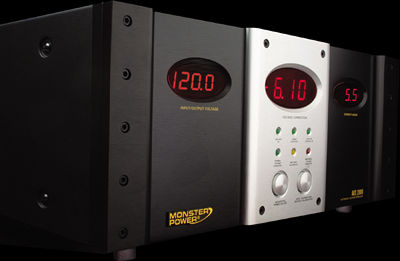 "Filters are mainly concerned with removing broadband noise," explained audio designer Demian Martin, who developed both the AVS 2000 and the Sigma Retro Gold line of cables and interconnects for Monster. "However, what the filters do not do is address problems of power-supply instabilities where the voltages fluctuate, and also where the higher load causes the supplies to sag. When the voltage goes high, it puts a lot of stress on capacitors. When the voltage goes low, it can put a great deal of stress on semiconductors, because they need to draw more current to deliver the same output. In either case, the heat output goes up and the life [of the semiconductors] will be shortened. Inside the AVS 2000 there's a large variable transformer—a variation on a Variac—that employs a special servo-motor with its own computer monitor, which dynamically adjusts it to hold the output voltage within 1% of 120V. The AVS 2000 is designed to maintain that within 30 amps continuous draw. On momentary transients, it can actually deliver 120 amps without substantial sag."
Monster Cable's AVS 2000 ($1499) exudes no discernible heat while offering a clever, straightforward response to the kind of anomalies that occur when appliances, machines, and commercial enterprises combine to place varying demands on the local power grid, causing wild fluctuations that can seriously impede the audio quality of your components, and even inflict long-term damage.
"Filters are mainly concerned with removing broadband noise," explained audio designer Demian Martin, who developed both the AVS 2000 and the Sigma Retro Gold line of cables and interconnects for Monster. "However, what the filters do not do is address problems of power-supply instabilities where the voltages fluctuate, and also where the higher load causes the supplies to sag. When the voltage goes high, it puts a lot of stress on capacitors. When the voltage goes low, it can put a great deal of stress on semiconductors, because they need to draw more current to deliver the same output. In either case, the heat output goes up and the life [of the semiconductors] will be shortened. Inside the AVS 2000 there's a large variable transformer—a variation on a Variac—that employs a special servo-motor with its own computer monitor, which dynamically adjusts it to hold the output voltage within 1% of 120V. The AVS 2000 is designed to maintain that within 30 amps continuous draw. On momentary transients, it can actually deliver 120 amps without substantial sag."