Over the years as a reviewer, I have tracked the swings of opinion and popularity of various audio ideas and technologies. Amid a sea of advanced designs that achieve powerful technical performance and laudable specifications, I'm reminded of a major blind listening test of 18 power amplifiers that I set up for the long-since-defunct UK magazine Hi-Fi for Pleasure back in 1975. We had "advanced technology" then: the transistor amplifier had matured and was well accepted by audiophiles. Prices of the review samples ranged from $300 to $3000 (equivalent to $1000-$10,000 in today's dollars). The auditioning sessions were graced by the presence of many industry leaders, among them the late Spencer Hughes of Spendor, Julian Vereker of Naim, Philip Swift then of Audiolab, Alan Harris then of retailer Audio T., Bob Stuart of Meridian, and John Wright of IMF (now TDL in the UK). On the suggestion of Alan Harris, a serious tube amplifier fan, I introduced a ringer to those tests: an ancient (over 10 years old) 25Wpc tube amplifier, the Radford STA-25 III, worth perhaps $100 at the time on the used market. I used a selection of master tapes as the source. When the results of the blind test were analyzed, the tubed Radford had come in first, despite showing the poorest measured performance. (Needless to say, its secondhand value soared after the review appeared.) This result dramatically illustrated almost a quarter-century ago that the association between measured performance and sound quality is uncertain. However, unsuspected at that time was the possible benefit in that test context of the Radford's relatively low level of negative feedback and the consequent effect on sound quality.
Feedback and the Ferry
The dominant problem in the early days of long-distance telephony was that the harmonic and frequency distortion added to the signal both by the line and by the necessary chain of repeater amplifiers made voices unrecognizable and unintelligible. Harold Black graduated from Worcester Polytechnic Institute in 1921 and took a post as a research scientist at what later became Bell Labs. For six years he struggled with the telephony distortion problem. The solution was the use of negative feedback. Black described how he conceived the theory and the equations for negative feedback in a flash one day in 1927 while commuting to work on the Lackawanna ferry (footnote 1). To understand the revolutionary nature of Black's idea, consider a device with useful voltage or power gain (µ) that may be compromised by undesirable nonlinearity or distortion. It may also have a nonflat frequency response. Prior to Black's flash of insight, all the output of an amplifier was fed to the next stage, be it a transducer or another amplification stage (fig.1). But instead, if a proportion of the output (ß) is fed back into the input of the amplifier and applied in inverted form (fig.2), the fed-back distortion and frequency-response errors will cancel those generated within the device. In addition, the amplifier's output impedance will be lowered. The price to be paid for these performance gains is that the amplifier's overall gain or amplification is reduced in proportion to the amount of negative feedback. But in theory, if the amplifier, operated "open-loop," has a surplus of gain above that which is required, closing the negative feedback loop allows its errors to be reduced to negligible levels. The concept of negative feedback is hugely valuable both in electronics and in control systems, and is firmly entrenched as a powerful design tool. Many audio engineers see it as a panacea for the ills of practical amplifying devices, using feedback---often with great skill---to engineer amplifiers with superb linearity and consequently low levels of measurable distortion. By and large, negative feedback works. It has made a vast variety of audio products possible and manufacturable. It is hard to conceive of the world of audio engineering without Harold Black's negative feedback.
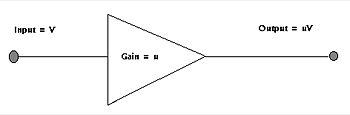
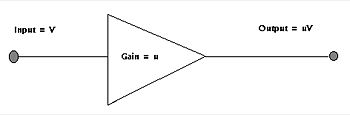 Fig.1 In an amplifier without feedback, the output consists of the input signal multiplied by the gain µ.
 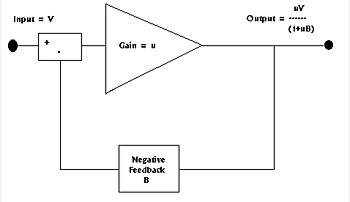 Fig.2 In an amplifier with negative feedback, a proportion of the output (ß) is fed back to the input with inverted polarity. The ratio of the output to the input (the "Amplification Factor") = µ/(1+µß).
Footnote 1: Black published his work on feedback in "Stabilized Feed-Back Amplifiers" in the January 1934 issue of Electrical Engineering, published by the American Institute of Electrical Engineering. See James E. Brittain, "Scanning the Past: Harold S. Black and the Negative Feedback Amplifier," Proceedings of the IEEE, Vol.85 No.8, August 1997.---JA
The dominant problem in the early days of long-distance telephony was that the harmonic and frequency distortion added to the signal both by the line and by the necessary chain of repeater amplifiers made voices unrecognizable and unintelligible. Harold Black graduated from Worcester Polytechnic Institute in 1921 and took a post as a research scientist at what later became Bell Labs. For six years he struggled with the telephony distortion problem. The solution was the use of negative feedback. Black described how he conceived the theory and the equations for negative feedback in a flash one day in 1927 while commuting to work on the Lackawanna ferry (footnote 1). To understand the revolutionary nature of Black's idea, consider a device with useful voltage or power gain (µ) that may be compromised by undesirable nonlinearity or distortion. It may also have a nonflat frequency response. Prior to Black's flash of insight, all the output of an amplifier was fed to the next stage, be it a transducer or another amplification stage (fig.1). But instead, if a proportion of the output (ß) is fed back into the input of the amplifier and applied in inverted form (fig.2), the fed-back distortion and frequency-response errors will cancel those generated within the device. In addition, the amplifier's output impedance will be lowered. The price to be paid for these performance gains is that the amplifier's overall gain or amplification is reduced in proportion to the amount of negative feedback. But in theory, if the amplifier, operated "open-loop," has a surplus of gain above that which is required, closing the negative feedback loop allows its errors to be reduced to negligible levels. The concept of negative feedback is hugely valuable both in electronics and in control systems, and is firmly entrenched as a powerful design tool. Many audio engineers see it as a panacea for the ills of practical amplifying devices, using feedback---often with great skill---to engineer amplifiers with superb linearity and consequently low levels of measurable distortion. By and large, negative feedback works. It has made a vast variety of audio products possible and manufacturable. It is hard to conceive of the world of audio engineering without Harold Black's negative feedback.
Fig.1 In an amplifier without feedback, the output consists of the input signal multiplied by the gain µ. Fig.2 In an amplifier with negative feedback, a proportion of the output (ß) is fed back to the input with inverted polarity. The ratio of the output to the input (the "Amplification Factor") = µ/(1+µß). Footnote 1: Black published his work on feedback in "Stabilized Feed-Back Amplifiers" in the January 1934 issue of Electrical Engineering, published by the American Institute of Electrical Engineering. See James E. Brittain, "Scanning the Past: Harold S. Black and the Negative Feedback Amplifier," Proceedings of the IEEE, Vol.85 No.8, August 1997.---JA