One of the challenges I faced in optimizing the performance of the Thiel CS7.2 loudspeakers that I reviewed in February 2000 was controlling and tuning their interaction with my listening room. Intuition, experience, trial and error—all came into play, as did several of the procedures and calculations covered by Jonathan Scull in his "Fine Tunes" column. I even had expert guidance—in the form of visits from Bruce Brisson and Joe Abrams of MIT, and Art Noxon of Acoustic Sciences Corporation (ASC), who led me through a two-step process. First, we concentrated on getting smooth overall response and good, even articulation. Then we dialed-in depth, dimensionality, and ambience. One of the most powerful tools we used in the first process was the Music Articulation Test Tone (MATT) test, Track 19 on Stereophile's Test CD 2 (STPH004-2, See the secure "Recordings page" to order it). The test was created by Art Noxon as a way of characterizing an audio system's response and articulation. "It's basically a music intelligibility test," he explained. "Home theater installers have standards for intelligibility, and pro sound people have a standard. But, oddly enough, high-end audio, where we pride ourselves on superb sound, has no such standard."
The test consists of a tone that ramps at 16Hz per second from 28Hz to 780Hz and back again. Instead of being constant, however, it turns on and off rapidly, creating 1/16th-second tone bursts, each 2Hz higher (or, on the way down, lower) than the previous burst, interspersed with 1/16th-second periods of silence. The test not only characterizes a system's frequency response by the average level at any frequency, but also its articulation—ie, how cleanly it turns on and off. The test can be conducted by listening or by watching the needle on a sound-level meter, and noting the times when the level varies or the pulses aren't cleanly reproduced. Because the tones ramp up linearly, time can easily be converted to frequency to isolate the problems. The most graphic method, however, is to use the level meter's output to drive a chart recorder or computer data-acquisition board. The trace's average levels indicate the system's frequency response, and the width of the trace shows how effectively and cleanly the system turns on and off. It's significant to note that the test characterizes the entire system, including the listening room. In fact, the room interactions typically dominate the test. If the room is removed, either by listening to the test through headphones or by holding the level meter close to a speaker, the results are nearly perfect—crystal-clear reproduction, or a flat, fat trace indicative of flat overall response and consistently good articulation.
Fig.1 shows the results of a MATT test in my listening room without any room treatment, but with the CS7.2s carefully positioned for the best overall sound. It was an excellent-sounding setup, but fig.1 shows that both the level and articulation varied somewhat, with both being at a minimum at around 360Hz (a), and the system being its most articulate (fattest trace) in the 550-600Hz region (b). 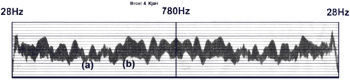 Fig.1 The results of a MATT test performed in BD's listening room, without room treatment. Note the greater articulation (thicker trace) at 550-600Hz (a), and the reduced level and articulation at approximately 360Hz (b). We then experimented with ASC Tube Traps, beginning with them oriented as absorbers. Using the MATT test to check each configuration, we added columns of Tube Traps in the corners for bass control, at the side wall's first reflection points, and between the speakers, to make the soundstage coalesce/cohere better. Fig.2 shows the MATT results for our final configuration, which added Echo Busters absorbers behind the listening position. While there's still a minimum in both level and articulation at about 360Hz, fig.2 shows that the dip isn't as severe with this setup, and that the articulation is much better throughout the frequency range covered by the test.
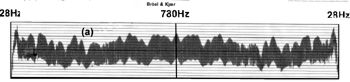 Fig.2 The results of a MATT test performed in BD's listening room, treated with Tube Traps and Echo Busters panel absorbers. Note overall improvement in articulation compared to the setup in fig.1. Articulation is still a minimum at approximately 360Hz (a), but significantly improved over the untreated room.
Fig.1 The results of a MATT test performed in BD's listening room, without room treatment. Note the greater articulation (thicker trace) at 550-600Hz (a), and the reduced level and articulation at approximately 360Hz (b). We then experimented with ASC Tube Traps, beginning with them oriented as absorbers. Using the MATT test to check each configuration, we added columns of Tube Traps in the corners for bass control, at the side wall's first reflection points, and between the speakers, to make the soundstage coalesce/cohere better. Fig.2 shows the MATT results for our final configuration, which added Echo Busters absorbers behind the listening position. While there's still a minimum in both level and articulation at about 360Hz, fig.2 shows that the dip isn't as severe with this setup, and that the articulation is much better throughout the frequency range covered by the test. Fig.2 The results of a MATT test performed in BD's listening room, treated with Tube Traps and Echo Busters panel absorbers. Note overall improvement in articulation compared to the setup in fig.1. Articulation is still a minimum at approximately 360Hz (a), but significantly improved over the untreated room.