We all have biases. The trick is knowing your biases so they don't get in your way. Mine are pretty obvious. I don't like "fussy" gear that demands special care and feeding. I'm lazy—I want to just turn stuff on and begin listening. Perhaps that's why I have a positive bias toward Nelson Pass's designs. They're reliable, untweaky, and usually sound good.
 The Aleph 1.2 is the third piece of Pass Labs electronics I've lived with. I own a pair of Aleph 0 amplifiers, and I reviewed the Aleph P preamp in the February '96 Stereophile. Because of my past experience with Pass gear, my expectations for the Pass Aleph 1.2 were stratospheric. But everybody knows that high expectations often lead to disappointment. Did the Aleph 1.2 deliver better sound along with its increased power? Let's see what came to...pass.
Tech Tour
The Aleph 1.2 is the third piece of Pass Labs electronics I've lived with. I own a pair of Aleph 0 amplifiers, and I reviewed the Aleph P preamp in the February '96 Stereophile. Because of my past experience with Pass gear, my expectations for the Pass Aleph 1.2 were stratospheric. But everybody knows that high expectations often lead to disappointment. Did the Aleph 1.2 deliver better sound along with its increased power? Let's see what came to...pass.
Tech Tour
The Aleph 1.2 is the largest amplifier from Pass Laboratories. It idles at 500W and delivers a maximum of 200W in single-ended class-A—the circuit topology of lowest efficiency. If properly designed, a single-ended amplifier exhibits primarily second- and even-order harmonic structure, similar to the transfer characteristic of air. The price paid for this performance is outrageously high idle current and heat dissipation, generally three to five times the output rating.
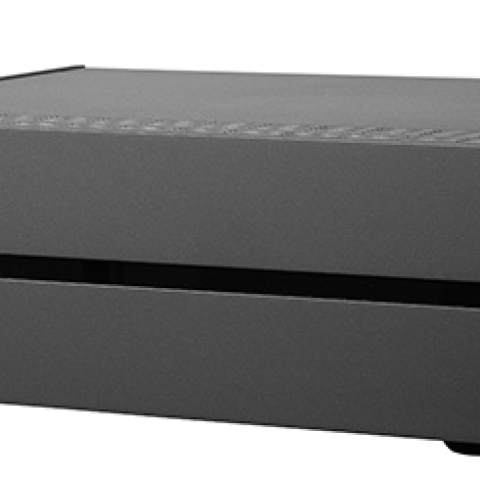
Like other Aleph series amplifiers, the 1.2 is a large black box with fins on all four sides. A small blue light on the front peeks out to alert you to the amp's "on" status. The rear of the amp has both balanced XLR and single-ended RCA inputs. A double pair of gold-plated five-way binding posts, an AC fuse receptacle, large on/off rocker switch, and an EIC AC connector complete the amp's geography.
The Aleph 1.2 has very few parts in series with the signal path. The input signal travels through a resistor to the input MOSFET transistor, then through another resistor to the parallel output MOSFETs, with, finally, a power resistor before the loudspeaker. Active current sources separately bias the input and output stages.
The Aleph 1.2 is unlike the original Aleph 1 in two ways. First, it has only two gain stages instead of three. The amplifier does not have the auxiliary pull circuitry that permitted the Aleph 1 to deliver very high currents into low-impedance loads. This may be a purer approach, but it doesn't allow for greater power into loads below 4 ohms. The current-source biasing of the output stage is also new. It attempts to optimize the load-line of the single-ended output devices, hence lowering distortion. Nelson Pass's current-source design is protected by a US patent application.
The Aleph 1.2 uses power MOSFETs for both of its gain stages. These MOSFETs were chosen because they have an optimal transfer curve for use in a single-ended class-A design. MOSFETs also allow high-current operation with low circuit complexity, delivering high performance in minimalist topologies. The input P-channel and output N-channel MOSFETs are carefully selected from the same manufacturing lot codes and matched within a tolerance of 2%. The input gain devices are pulse-rated at 8A, and are followed by output devices with pulse ratings of 50A each. The amplifier's output stage has an overall power rating of 3.6kW, and the massive heatsinks are rated at 0.05°C per watt. During active operation, each output device is operating at only 14% of its rated power.
Resistors are precision metal-film throughout. The Aleph 1.2 is protected from overheating by a 75°C thermal switch, and from internal failure by a slow-blow fuse. The amplifier is powered by a toroidal transformer rated at 10 times the amplifier's output rating. This unregulated supply feeds the output transistors with a full-power ripple of about half a volt.
The Aleph 1.2 is equipped with a balanced input featuring a common-mode input noise rejection of –60dB, accomplished through a passive network tied directly into the input stage of the amplifier. There is no additional active input circuitry. Unbalanced inputs are accommodated by RCA connectors. On balanced inputs both positive and negative signals are used. The positive input signal goes to the gate of the positive-phase device of the input differential pair of MOSFETs and the negative input signal goes to the gate of the differential pair's negative-phase device.
Ergonomics
Operating idiosyncrasies were few. There was a slight pop at the speakers when the amps were first turned on, but this was quieter than the turn-on transient from the Pass Aleph 0. Even though I used the balanced inputs, the amps had to be turned off before changing interconnects to avoid connection and disconnection noises. While it's always good practice to turn amps off before swapping cables of any kind, folks with balanced gear sometimes get blasé about it. Don't. The Alephs have enough juice to put out some serious transients. Another caveat: Don't even think of trying to lift these amps without some thick gloves and at least one burly friend. There's no way to avoid gripping the heatsink fins, which feel like dull knives on bare flesh. At 130 lbs each, these are certainly not "one-person" amps. Sound
The Pass Aleph 1.2 is a wonderful amp. A very hot amplifier—it uses tons of electricity—but a glorious-sounding one nonetheless. Perhaps if you buy one you should also purchase some stock in your local electric utility. When your electric bill goes up 40% (as mine did), at least you can take some comfort in the fact that you're helping your electric company's bottom line.
What did the 1.2's juice-sucking prowess have to do with its sound? Simply, it sounded best when warm, and that took at least 45 minutes. You could leave it on all the time, but it'll cost you plenty. If, like me, you're "thrifty" (a polite way of saying "cheap"), you'll try to turn on the amps about an hour before any serious listening.
It isn't their harmonic balance that changed as the 1.2s warmed up, but their dimensional capabilities. There was a recurring moment, about 35 to 45 minutes from startup, when the image just blossomed—from decent solid-state soundstaging to "Oh my God; they just showed me the magic." Pass Aleph 0s also take at least 30 minutes to bloom, but their metamorphosis isn't nearly as dramatic.
The Aleph 1.2 is the third piece of Pass Labs electronics I've lived with. I own a pair of Aleph 0 amplifiers, and I reviewed the Aleph P preamp in the February '96 Stereophile. Because of my past experience with Pass gear, my expectations for the Pass Aleph 1.2 were stratospheric. But everybody knows that high expectations often lead to disappointment. Did the Aleph 1.2 deliver better sound along with its increased power? Let's see what came to...pass.
Tech Tour
The Aleph 1.2 is the largest amplifier from Pass Laboratories. It idles at 500W and delivers a maximum of 200W in single-ended class-A—the circuit topology of lowest efficiency. If properly designed, a single-ended amplifier exhibits primarily second- and even-order harmonic structure, similar to the transfer characteristic of air. The price paid for this performance is outrageously high idle current and heat dissipation, generally three to five times the output rating.
Operating idiosyncrasies were few. There was a slight pop at the speakers when the amps were first turned on, but this was quieter than the turn-on transient from the Pass Aleph 0. Even though I used the balanced inputs, the amps had to be turned off before changing interconnects to avoid connection and disconnection noises. While it's always good practice to turn amps off before swapping cables of any kind, folks with balanced gear sometimes get blasé about it. Don't. The Alephs have enough juice to put out some serious transients. Another caveat: Don't even think of trying to lift these amps without some thick gloves and at least one burly friend. There's no way to avoid gripping the heatsink fins, which feel like dull knives on bare flesh. At 130 lbs each, these are certainly not "one-person" amps. Sound
The Pass Aleph 1.2 is a wonderful amp. A very hot amplifier—it uses tons of electricity—but a glorious-sounding one nonetheless. Perhaps if you buy one you should also purchase some stock in your local electric utility. When your electric bill goes up 40% (as mine did), at least you can take some comfort in the fact that you're helping your electric company's bottom line.