"A guy's gotta carry a cow across a river. He's not strong enough, of course, so the only way he can do it is to cut the cow into pieces, carry them across a few at a time, and re-assemble the beast on the other side. When he's finished, he's got a cow on the other side of the river, but it's not exactly the same cow."
 I forget who told me that parable at the 2005 Consumer Electronics Show, but the context was the analog vs digital debate, which in the audiophile community often takes on the tone of holy war. However, as big an analog devotee as I am, when it comes to audio, I don't buy the cow routine. Yes, it has proven to be mostly true with respect of digital audio for the past 25 years or so, but as sampling rates increase, bit words lengthen, and processing attains levels of finesse that only time and experience can buy, digital sound has improved to the point where in some cases it's almost the same cow. DSD recording at 1 bit/2.83MHz, for instance, can be about as true to a live source as I've heard. Using studio-quality converters the likes of which most of us can't afford, I wouldn't want to have to choose which was which in a blind test.
Which is not to say I might not prefer an analog recording that actually did change the sound of the source. Recording is an art as well as a science. I remember John Atkinson telling me that the DSD version of a recording session he'd produced was closer to the mike feed, but that everyone involved preferred the sound of the analog tape.
So when, recently, a reader alerted me to Yamaha's $5000, 500Wpc MX-D1 "digital" amplifier, I thought it worthy of a Stereophile review, I wasn't worried that my pro-analog bias would get in the way of an honest assessment of its sonic performance.
Natural Sound heritage
I forget who told me that parable at the 2005 Consumer Electronics Show, but the context was the analog vs digital debate, which in the audiophile community often takes on the tone of holy war. However, as big an analog devotee as I am, when it comes to audio, I don't buy the cow routine. Yes, it has proven to be mostly true with respect of digital audio for the past 25 years or so, but as sampling rates increase, bit words lengthen, and processing attains levels of finesse that only time and experience can buy, digital sound has improved to the point where in some cases it's almost the same cow. DSD recording at 1 bit/2.83MHz, for instance, can be about as true to a live source as I've heard. Using studio-quality converters the likes of which most of us can't afford, I wouldn't want to have to choose which was which in a blind test.
Which is not to say I might not prefer an analog recording that actually did change the sound of the source. Recording is an art as well as a science. I remember John Atkinson telling me that the DSD version of a recording session he'd produced was closer to the mike feed, but that everyone involved preferred the sound of the analog tape.
So when, recently, a reader alerted me to Yamaha's $5000, 500Wpc MX-D1 "digital" amplifier, I thought it worthy of a Stereophile review, I wasn't worried that my pro-analog bias would get in the way of an honest assessment of its sonic performance.
Natural Sound heritage
Yamaha may once have built a loudspeaker driver in the shape of the human ear (see my review of the Sonus Faber Stradivari Homage in the January 2005 Stereophile, p.98), but the company's audiophile bona fides, beginning with its Natural Sound receivers back in the 1970s, have never been in doubt. Yamaha also builds musical instruments; they have folks on staff who know what music sounds like and appreciate the quest to accurately reproduce it in the home. That must also be true for those in Yamaha's engineering and management departments—designing, manufacturing, and marketing a product such as the MX-D1 is an expensive and risky proposition for a mainstream audio company. As with Sharp's SM-SX100, an expensive, jewel-like, 1-bit integrated amplifier that I reviewed in the July 2000 Stereophile, Yamaha's engineering exercise of designing the MX-D1 will probably yield a host of trickle-down digital amplifiers for home theater and other applications in which high power and compact, lightweight design make an attractive combination.
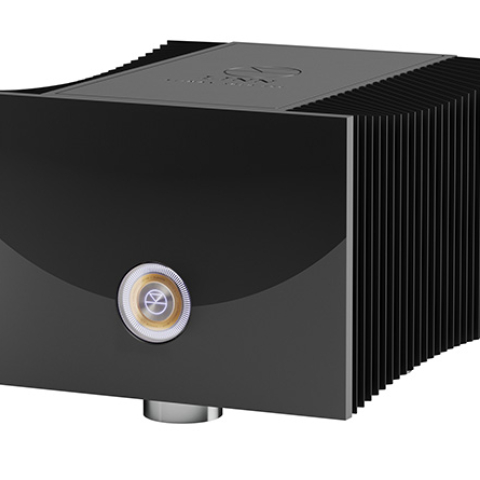
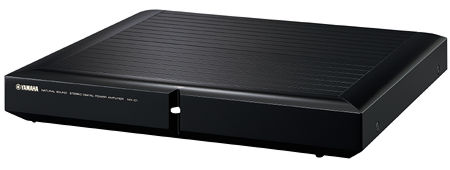
The road case in which my sample of the MX-D1 arrived weighs almost twice as much as the 23-lb amp itself. Finished in a smooth, glossy black so rich it almost seems translucent, the MX-D1's appearance is attractive yet understated. The transparent plastic On/Off switch nests in a notch placed midway on the front panel. Push it in and it glows a cool LED blue.
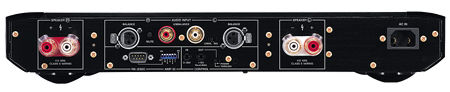
The MX-D1's overall construction and parts quality appear to be extremely high; the heavy, copper-plated chassis has extensive magnetic shielding and vibration control. Use in multichannel and home theater installation is provided for with an RS-232 serial interface that provides for remote triggered on/off and other custom-installation needs. High-quality speaker terminals and single-ended and balanced WBT inputs (the amp itself is not a balanced design) signal Yamaha's intention to crack the audiophile market.
But to really appreciate what Yamaha has done in that regard, you have to crack the case. Inside is a true dual-mono design, including separate power supplies, that Yamaha calls Twin Monaural Construction. Yamaha also designed and developed two custom chipsets: the YDA 133, a constant-gain phase-locked loop (PLL) modulator; and the YDA 134 power MOSFET driver. The modulator syncs to a clock and outputs a fixed-frequency (352.8kHz), pulse-width-modulated waveform operating at the power supply voltages that represents the input music superimposed on the power supply's output voltage. A digital pulse-feedback loop is said to improve the linearity of the output stage and the modulator circuit. A 30kHz low-pass LC filter removes the 352.8kHz carrier, leaving an amplified version of the input. Each channel's output filter is a custom-made, double-coil toroidal inductor of low impedance with "extra-large" custom electrolytic capacitors, which Yamaha claims are critical to the amplifier's sound.
Yamaha applies an Advanced Analog Feedback Circuit to the signal after this low-pass filter. According to them, this results in a 100kHz bandwidth (–3dB) and high damping factor (over 200) independent of load impedance.
 Yamaha's Active Power Control System is claimed to allow the MX-D1 to vary its output with the speaker load (2–8 ohms) by detecting the output current and adjusting the power-supply voltage output limit. The result is said to be optimal power output regardless of speaker load. Dual, independent, switching-type power supplies operate at 88kHz and feature high-efficiency, low-noise, magnetic-coupling rectification circuits. Protection is provided by a "super-fast" circuit capable of measuring the current of a single pulse, as well as by a circuit that detects DC; each of these can instantly shut down the MX-D1 when necessary.
The result of all of this innovation is the claimed 500Wpc RMS output from a relatively small, lightweight, cool-running amp that consumes little power and has a very low claimed total harmonic distortion (0.003% or less at 1kHz), 120dB dynamic range, and exceptionally wide bandwidth: 1Hz–100kHz, ±3dB.
Setup
Yamaha's Active Power Control System is claimed to allow the MX-D1 to vary its output with the speaker load (2–8 ohms) by detecting the output current and adjusting the power-supply voltage output limit. The result is said to be optimal power output regardless of speaker load. Dual, independent, switching-type power supplies operate at 88kHz and feature high-efficiency, low-noise, magnetic-coupling rectification circuits. Protection is provided by a "super-fast" circuit capable of measuring the current of a single pulse, as well as by a circuit that detects DC; each of these can instantly shut down the MX-D1 when necessary.
The result of all of this innovation is the claimed 500Wpc RMS output from a relatively small, lightweight, cool-running amp that consumes little power and has a very low claimed total harmonic distortion (0.003% or less at 1kHz), 120dB dynamic range, and exceptionally wide bandwidth: 1Hz–100kHz, ±3dB.
Setup
I placed the MX-D1 on my Ginkgo Audio Cloud 11 Isolation stand, which sat atop my Musical Fidelity kW amplifiers' shared outboard power supply (shut off, of course), which in turn sat on a Symposium Acoustics Ultra platform—all of which made the MX-D1 look more like a system accessory than the main event. The kW's power supply alone weighs more than 90 lbs and is taller than three or four stacked MX-D1s. You'd have to pile up five or six MX-D1s to equal the height of one kW monoblock, yet this little slab of technology is claimed to output 500W—half of the kW's prodigious rated output into 8 ohms, but still more power than most far larger audiophile-grade amps. Solid-state vs Tubes: Six of one . . .
Must substantially different amplifier technologies yield substantially different sounds? It seems to be so. Even a tube amp that doesn't sound "tubey" has a particular sound, a particular way of unraveling the musical thread. Likewise, even the least "solid-state–sounding" transistor amps tend to have signature sounds. The best ones don't sound etched or bright on top, nor need the midrange feel threadbare or lacking in harmonic completeness.
I forget who told me that parable at the 2005 Consumer Electronics Show, but the context was the analog vs digital debate, which in the audiophile community often takes on the tone of holy war. However, as big an analog devotee as I am, when it comes to audio, I don't buy the cow routine. Yes, it has proven to be mostly true with respect of digital audio for the past 25 years or so, but as sampling rates increase, bit words lengthen, and processing attains levels of finesse that only time and experience can buy, digital sound has improved to the point where in some cases it's almost the same cow. DSD recording at 1 bit/2.83MHz, for instance, can be about as true to a live source as I've heard. Using studio-quality converters the likes of which most of us can't afford, I wouldn't want to have to choose which was which in a blind test.
Which is not to say I might not prefer an analog recording that actually did change the sound of the source. Recording is an art as well as a science. I remember John Atkinson telling me that the DSD version of a recording session he'd produced was closer to the mike feed, but that everyone involved preferred the sound of the analog tape.
Yamaha may once have built a loudspeaker driver in the shape of the human ear (see my review of the Sonus Faber Stradivari Homage in the January 2005 Stereophile, p.98), but the company's audiophile bona fides, beginning with its Natural Sound receivers back in the 1970s, have never been in doubt. Yamaha also builds musical instruments; they have folks on staff who know what music sounds like and appreciate the quest to accurately reproduce it in the home. That must also be true for those in Yamaha's engineering and management departments—designing, manufacturing, and marketing a product such as the MX-D1 is an expensive and risky proposition for a mainstream audio company. As with Sharp's SM-SX100, an expensive, jewel-like, 1-bit integrated amplifier that I reviewed in the July 2000 Stereophile, Yamaha's engineering exercise of designing the MX-D1 will probably yield a host of trickle-down digital amplifiers for home theater and other applications in which high power and compact, lightweight design make an attractive combination.
Yamaha's Active Power Control System is claimed to allow the MX-D1 to vary its output with the speaker load (2–8 ohms) by detecting the output current and adjusting the power-supply voltage output limit. The result is said to be optimal power output regardless of speaker load. Dual, independent, switching-type power supplies operate at 88kHz and feature high-efficiency, low-noise, magnetic-coupling rectification circuits. Protection is provided by a "super-fast" circuit capable of measuring the current of a single pulse, as well as by a circuit that detects DC; each of these can instantly shut down the MX-D1 when necessary.
The result of all of this innovation is the claimed 500Wpc RMS output from a relatively small, lightweight, cool-running amp that consumes little power and has a very low claimed total harmonic distortion (0.003% or less at 1kHz), 120dB dynamic range, and exceptionally wide bandwidth: 1Hz–100kHz, ±3dB.
I placed the MX-D1 on my Ginkgo Audio Cloud 11 Isolation stand, which sat atop my Musical Fidelity kW amplifiers' shared outboard power supply (shut off, of course), which in turn sat on a Symposium Acoustics Ultra platform—all of which made the MX-D1 look more like a system accessory than the main event. The kW's power supply alone weighs more than 90 lbs and is taller than three or four stacked MX-D1s. You'd have to pile up five or six MX-D1s to equal the height of one kW monoblock, yet this little slab of technology is claimed to output 500W—half of the kW's prodigious rated output into 8 ohms, but still more power than most far larger audiophile-grade amps. Solid-state vs Tubes: Six of one . . .
Must substantially different amplifier technologies yield substantially different sounds? It seems to be so. Even a tube amp that doesn't sound "tubey" has a particular sound, a particular way of unraveling the musical thread. Likewise, even the least "solid-state–sounding" transistor amps tend to have signature sounds. The best ones don't sound etched or bright on top, nor need the midrange feel threadbare or lacking in harmonic completeness.