Recently, on the Stereophile Web forum, reader Natal commented on Robert J. Reina's review of the Creek Audio Destiny integrated amplifier in the January 2007 issue: "Maybe it's just me but I've never found any piece of electronic equipment sexy."
 My first reaction was pity. Be there a man with soul so dead / Who never to himself hath said / Hubba-hubba, zing-zing-zing / I've got to plug into that thing?
My second thought was somewhat more rational: Right on, Natal—stereo components are just appliances. After all, nobody thinks toasters or vacuum cleaners are sexy, right?
A few seconds with a broadband connection and a search engine disabused me of that notion.
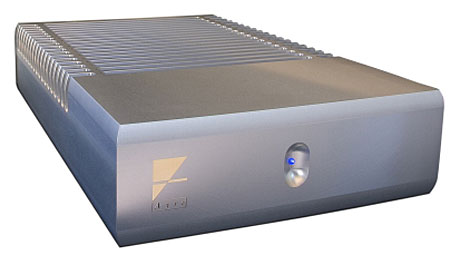
Besides, I kept gazing at my hi-fi shelves, visually caressing the sleek Ayre MX-R monoblocks ($16,500/pair in silver, $17,000 in black). Sexy? God help me, I do think so. Carved out of a 75-lb billet of aluminum, each MX-R its routed and shaped (11" W by 18.75" D by 3.75" H) into a hunka hunka shiny, anodized audio presence. It's too physical to look cute and too sleek to look like a monster amp—until you read the specs. Output of 300W (600W into 4 ohms)? DC–250kHz frequency response? Input impedance of 2 megohms? That's not sexy?
Then there's the way it sounds playing music . . .
Ayre conditioning?
My first reaction was pity. Be there a man with soul so dead / Who never to himself hath said / Hubba-hubba, zing-zing-zing / I've got to plug into that thing?
My second thought was somewhat more rational: Right on, Natal—stereo components are just appliances. After all, nobody thinks toasters or vacuum cleaners are sexy, right?
A few seconds with a broadband connection and a search engine disabused me of that notion.
Besides, I kept gazing at my hi-fi shelves, visually caressing the sleek Ayre MX-R monoblocks ($16,500/pair in silver, $17,000 in black). Sexy? God help me, I do think so. Carved out of a 75-lb billet of aluminum, each MX-R its routed and shaped (11" W by 18.75" D by 3.75" H) into a hunka hunka shiny, anodized audio presence. It's too physical to look cute and too sleek to look like a monster amp—until you read the specs. Output of 300W (600W into 4 ohms)? DC–250kHz frequency response? Input impedance of 2 megohms? That's not sexy?
Then there's the way it sounds playing music . . .
Ayre conditioning?
Let's get the size thing out of the way. While it's far from tiny, most people think the MX-R is too small to produce 300W without resorting to class-D technology or a switch-mode power supply. But the MX-R is just your ordinary zero-feedback, discrete design with a linear power supply—a dual-transformer power supply, actually, employing custom-designed trannies that Ayre has built to spec just to fit the MX-R's shape.
Starting with that 75-lb billet of aluminum, Ayre has its machine shop carve away about two-thirds of the material, leaving the amp's monocoque chassis about as mechanically stable as they come. This construction has the added benefits of serving as one honkin' huge heatsink and allowing attachment points "about anywhere I want," says Ayre's Charlie Hansen. "That's the real reason we could get everything so compact."
Hansen is quick to point out that the MX-R is both a big leap forward for Ayre and an extension of the company's usual way of doing things. "Zero-feedback, fully balanced discrete circuitry is all we've ever done (well, the AX-7 and CX-7 aren't discrete, we use transistor arrays), so there's nothing new there—it's just the good old Ayre recipe."
With a few twists, of course. The MX-R is the first time Ayre has used ON Semiconductor Corp.'s ThermalTrak output devices. With conventional bipolar transistors (and most MOSFETs, for that matter), the optimum bias voltage changes with temperature; this makes designers either underbias output devices so that thermal runaway doesn't occur, or use a heat-sensing circuit, usually on the device's heatsink, to drive output-compensation circuitry, which is complex and subject to time lag. ThermalTrak transistors have internal bias control and real-time temperature sensing. Problem solved, right?
"You'd think so," said Hansen, "but when we built on Semi's recommended circuit using ThermalTraks, we discovered it still took some jiggering to de-funkify it. But we're tenacious. We don't stop until we solve the problem—and in the process, we got to learn a lot more about semiconductors than we ever wanted to know."
Then there's Ayre's EquiLock circuitry. Hansen again: "The Ayre recipe says to use FETs in a balanced-differential input (which means four of 'em), feeding current mirrors coupled to whatever we're using as an output stage, which in the case of our power amps are big freakin' things. We do this because it allows us to couple the input and output stages without using any capacitors, and that allows us to have a true DC amplifier with no phase shift or capacitor signature. No problems, in other words.
"I have some beliefs that approach religious faith: FETs are better than bipolars, zero feedback is better than feedback, balanced is better than single-ended, and the simpler a circuit, the better. But here's the thing: Just because I believe something doesn't make it true, and designing the MX-R taught me some lessons.
"The first is that, in parts of the circuit, bipolar devices sound better than FETs, so that's what we used. And then there's the EquiLock circuit, which violates my 'simpler is better' dictum. EquiLock is kind of like creating a cascode by combining two triodes. You could say we're joining together two transistors to act like one transistor that has a really stable operating point. Adding a second transistor to the signal path seems like it deviates from my belief that simpler is better, except that it works better."
The MX-R also includes the AC filtering system incorporated into most of Ayre's products, including the L-5xe AC filter ($1500). L-5xe . Hansen calls this the Ayre Conditioner. The first part of Ayre Conditioning is not particularly unusual—it's just a capacitor across the line to filter out RF and lower impedance.
"Everybody does that," said Hansen. "The other part is just weird. We used to use ferrite blobs in our products' power supplies. Ferrites work—they absorb HF energy. Here's my understanding of what they do: Ferrites contain magnetic domains, which are tiny microcrystals, and when you put a magnetic field in there, it moves them—and that creates friction, which creates heat. So ferrites take that energy and turn it into heat and get rid of it, which is good. The background is quieter and the hash goes away.
"Eventually, anything that has a ferrite on it begins to sound hard, glassy, and dynamically constricted. I discovered that you could use a bulk-tape demagnetizer to restore the effectiveness of the ferrite, so I toyed with the idea of installing some kind of degaussing circuit in there, but that's not a very elegant solution. I don't like Band-Aids, because they just treat the symptom—we had to come up with a solution to the problem. I thought about it for a while and I finally came up with a solution."
And that is . . . ?
"Our secret." He cackled.
Solid Ayre
Operationally, audio components don't come simpler than the MX-R. The two-color LED in the center of the front panel serves as the standby/on switch. There's a single XLR balanced input, two AyreLink (remote control) ports, an IEC socket, and a hearty Cardas binding post designed to mate with spade lugs. By the way, the MX-R's speaker output is balanced, so don't connect it to anything with a common ground or your life won't be so simple. There's no power-off option, which might bother some—the MX-R consumes 45W in standby mode and 120W powered on with no signal. The amp had a clangy opacity when cold, however; once I'd got it comfortably warm and stable, I had an incentive to keep it that way.
Clearing the Ayre
After only a few hours of play, the MX-R sounded far more relaxed than it had at first, although the sound continued to improve gradually over the next week or so. It wasn't a steady progression, however. In each new listening session, I'd find a different nit to pick—but beginning around day three, the music became increasingly more full-bodied, liquid, and three-dimensional, until all the nits had disappeared.
My first reaction was pity. Be there a man with soul so dead / Who never to himself hath said / Hubba-hubba, zing-zing-zing / I've got to plug into that thing?
My second thought was somewhat more rational: Right on, Natal—stereo components are just appliances. After all, nobody thinks toasters or vacuum cleaners are sexy, right?
Let's get the size thing out of the way. While it's far from tiny, most people think the MX-R is too small to produce 300W without resorting to class-D technology or a switch-mode power supply. But the MX-R is just your ordinary zero-feedback, discrete design with a linear power supply—a dual-transformer power supply, actually, employing custom-designed trannies that Ayre has built to spec just to fit the MX-R's shape.
Operationally, audio components don't come simpler than the MX-R. The two-color LED in the center of the front panel serves as the standby/on switch. There's a single XLR balanced input, two AyreLink (remote control) ports, an IEC socket, and a hearty Cardas binding post designed to mate with spade lugs. By the way, the MX-R's speaker output is balanced, so don't connect it to anything with a common ground or your life won't be so simple. There's no power-off option, which might bother some—the MX-R consumes 45W in standby mode and 120W powered on with no signal. The amp had a clangy opacity when cold, however; once I'd got it comfortably warm and stable, I had an incentive to keep it that way.
After only a few hours of play, the MX-R sounded far more relaxed than it had at first, although the sound continued to improve gradually over the next week or so. It wasn't a steady progression, however. In each new listening session, I'd find a different nit to pick—but beginning around day three, the music became increasingly more full-bodied, liquid, and three-dimensional, until all the nits had disappeared.