"I want you to review an amplifier," John Atkinson said.
"I've just reviewed an amplifier. Two, in fact."
"This one's a little bit different. It's 50Wpc, class-A, and beautifully built."
"So what makes it different?"
"It's under $4000; $3950, to be precise. It's made by Coda."
Who?
Exposition
Coda's roots are in Threshold, where founding members Eric Lauchli, B.D. Dale, and Lorin Peterson all manned the R&D trenches. After founding the company as Continuum Electronics in 1985, they renamed it Coda Technologies, Inc. in 1989, producing such innovative products as the FET Preamplifier 01 and the System 100 and System 200 amplifier systems, which employed separate chassis for their voltage-gain and current-gain stages. In 1995, the Continuum Electronics identity was resurrected to produce affordable, high-performance components. The two companies are collectively known as the Continuum Group, but everyone knows them as Nancy—er, Coda.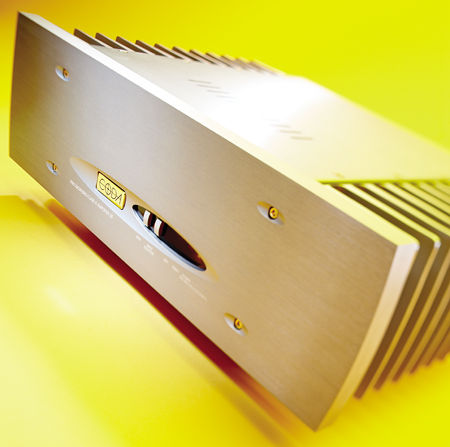 Hmmm. In music, a coda is a portion of a work that rounds out, concludes, or summarizes what has gone before. If we choose to think of Coda as a coda to Threshold, I don't reckon anyone there will object too loudly.
Engineer Eric Lauchli says the S5's genesis was in the System 100 amplifier, which was "essentially everything we could think of wanting in an amplifier." The System 100, he explained, could drive virtually any load: "In fact, when we experimented with loads approaching 0.4 ohm, we began to notice the factory's lights dimming and we figured it was time to stop the torture tests."
They did, however, wonder how close to the System 100 they could get in an affordable amp. That was the start of the S series. The amp reviewed here, the S5, departs from the System 100's blueprint in that it uses a single chassis and boasts only two stages of current gain instead of the S100's three.
The S5 is rated at 50Wpc "pure class-A" into 8 ohms, 100Wpc into 4 ohms, or 200Wpc into 2 ohms. It can also be bridged to deliver 200W into 8 ohms or 400W into 4 ohms. Like the S100, the S5 is DC-coupled, using a FET input, MOSFET voltage-gain stage, high-speed bipolar current-gain stages, and no—repeat, no—overall feedback. The S5 uses sixty 50MHz bipolar output transistors, each rated at 8 amps/150V. Lauchli deadpanned, "FETs are inherently better at voltage gain and their transfer function is better, but our way calls for a high parts count."
That sort of dreadnaught overbuild might cause a problem in some DC-coupled designs, but Lauchli points out that the S5 incorporates an extremely effective input filter that isolates the gain stages from line noise and any upstream DC. The S5 has no capacitors in the audio circuitry—they reside only in the power supply, which boasts independent windings, rectification, and supply caps for each channel. "This keeps the S5 operationally simple," Lauchli said, "which is a very different thing from actually being simple."
The S5 also sports what Coda has dubbed Precision Bias topology. According to Lachli, "It provides a more efficient and elegant implementation of class-A amplification by fine-tuning and precisely calibrating circuit parameter control to yield an exceptionally smooth cooperation between the positive and negative output banks."
At the low power levels, where most of us listen to music, the load is shared equally by all devices. However, at the limits of bias current at higher power, Precision Bias allows one bank of output devices to gradually increase its share of the load as the other backs off, until one bank has full control of the load and the other is off. Lauchli said that Precision Bias's tight control of the circuit parameters, coupled with high speed, linearity, and near-perfect matching of the output devices, allows the transition to occur with virtually no effect on the transfer function of the output stage as a whole. "The practical effect of Precision Bias is that a transfer function is achieved that is virtually indistinguishable from conventional very-high-current class-A bias levels," he said. "The results are equal or superior to standard 'class-A into 2 ohm' designs, but without their extreme size, heat, complexity, or power consumption. . . resulting in excellent efficiency compared to more conventional implementations."
In addition to Precision Bias, the S5 also offers a novel standby circuit that turns off the bias current to the gain stage but leaves the rest of the amp powered up. Reactivate the bias and the amp reaches operational thermal stability PDQ—which is pretty nifty, since the amp functions as a fairly good space heater at idle. There's no danger of burning yourself, but it ran hot enough that on cool evenings I could feel its warmth on my face as I walked past where it rested on the floor.
The Bias switch is one of two controls on the S5's front panel. The other is the source switch, which lets you toggle between balanced and single-ended inputs. Two LEDs indicate when the Bias is active, and there's a two-color power LED (red means balanced operation, yellow means single-ended). All of these functions are also remote-controllable.
The rear panel is nicely laid out, with the inputs and binding posts arrayed along the upper half. The posts are stout, solid-metal types, with a soft rubber block that snaps over the connection to keep everything stable (and, presumably, to prevent unintentional grounding). I can't say this contributed to better sound in any way, but it sure made me feel good about the speaker connection. The RCA inputs and the XLRs directly below them both seemed of high quality. There is also a tiny Stereo/Bridged switch on the rear panel. The S5 is available in black, silver, or graphite anodized finishes. My review sample was silver, with the rest of the casework and the substantial heatsinks in black.
Grace note
Hmmm. In music, a coda is a portion of a work that rounds out, concludes, or summarizes what has gone before. If we choose to think of Coda as a coda to Threshold, I don't reckon anyone there will object too loudly.
Engineer Eric Lauchli says the S5's genesis was in the System 100 amplifier, which was "essentially everything we could think of wanting in an amplifier." The System 100, he explained, could drive virtually any load: "In fact, when we experimented with loads approaching 0.4 ohm, we began to notice the factory's lights dimming and we figured it was time to stop the torture tests."
They did, however, wonder how close to the System 100 they could get in an affordable amp. That was the start of the S series. The amp reviewed here, the S5, departs from the System 100's blueprint in that it uses a single chassis and boasts only two stages of current gain instead of the S100's three.
The S5 is rated at 50Wpc "pure class-A" into 8 ohms, 100Wpc into 4 ohms, or 200Wpc into 2 ohms. It can also be bridged to deliver 200W into 8 ohms or 400W into 4 ohms. Like the S100, the S5 is DC-coupled, using a FET input, MOSFET voltage-gain stage, high-speed bipolar current-gain stages, and no—repeat, no—overall feedback. The S5 uses sixty 50MHz bipolar output transistors, each rated at 8 amps/150V. Lauchli deadpanned, "FETs are inherently better at voltage gain and their transfer function is better, but our way calls for a high parts count."
That sort of dreadnaught overbuild might cause a problem in some DC-coupled designs, but Lauchli points out that the S5 incorporates an extremely effective input filter that isolates the gain stages from line noise and any upstream DC. The S5 has no capacitors in the audio circuitry—they reside only in the power supply, which boasts independent windings, rectification, and supply caps for each channel. "This keeps the S5 operationally simple," Lauchli said, "which is a very different thing from actually being simple."
The S5 also sports what Coda has dubbed Precision Bias topology. According to Lachli, "It provides a more efficient and elegant implementation of class-A amplification by fine-tuning and precisely calibrating circuit parameter control to yield an exceptionally smooth cooperation between the positive and negative output banks."
At the low power levels, where most of us listen to music, the load is shared equally by all devices. However, at the limits of bias current at higher power, Precision Bias allows one bank of output devices to gradually increase its share of the load as the other backs off, until one bank has full control of the load and the other is off. Lauchli said that Precision Bias's tight control of the circuit parameters, coupled with high speed, linearity, and near-perfect matching of the output devices, allows the transition to occur with virtually no effect on the transfer function of the output stage as a whole. "The practical effect of Precision Bias is that a transfer function is achieved that is virtually indistinguishable from conventional very-high-current class-A bias levels," he said. "The results are equal or superior to standard 'class-A into 2 ohm' designs, but without their extreme size, heat, complexity, or power consumption. . . resulting in excellent efficiency compared to more conventional implementations."
In addition to Precision Bias, the S5 also offers a novel standby circuit that turns off the bias current to the gain stage but leaves the rest of the amp powered up. Reactivate the bias and the amp reaches operational thermal stability PDQ—which is pretty nifty, since the amp functions as a fairly good space heater at idle. There's no danger of burning yourself, but it ran hot enough that on cool evenings I could feel its warmth on my face as I walked past where it rested on the floor.
The Bias switch is one of two controls on the S5's front panel. The other is the source switch, which lets you toggle between balanced and single-ended inputs. Two LEDs indicate when the Bias is active, and there's a two-color power LED (red means balanced operation, yellow means single-ended). All of these functions are also remote-controllable.
The rear panel is nicely laid out, with the inputs and binding posts arrayed along the upper half. The posts are stout, solid-metal types, with a soft rubber block that snaps over the connection to keep everything stable (and, presumably, to prevent unintentional grounding). I can't say this contributed to better sound in any way, but it sure made me feel good about the speaker connection. The RCA inputs and the XLRs directly below them both seemed of high quality. There is also a tiny Stereo/Bridged switch on the rear panel. The S5 is available in black, silver, or graphite anodized finishes. My review sample was silver, with the rest of the casework and the substantial heatsinks in black.
Grace note
I thought about reading the owner's manual before setting up the S5, but I'm a guy. We don't do that. Consequently, it took me a few minutes to figure out that the button marked Bias was what I would have called Mute or Standby. I applied the time-tested, potentially foolhardy method of pushing everything that remotely looked like a control until I hit Bias and got sound. Remember, kids—I'm a professional. Don't try this at home.
Other than that, there wasn't much to setting up the S5, except to note that you'll want to give it plenty of breathing (should I say radiating?) space. And because I had only the one unit, I never tried the S5 in bridged mode.
Development
The night I connected the S5 to my system, I had every intention of setting it up, turning it on, and letting it cook until after my early-morning rituals the next day. That plan fell by the wayside when the first CD I grabbed from my shelves proved to be the Mobile Fidelity version of the Mahavishnu Orchestra's The Inner Mounting Flame (CD, UDCD 744). I'd missed the band's massed opening chords while futzing around with the Bias button, so the music thundered on at guitarist John McLaughlin's fevered first solo on "Meeting of the Spirit"—notes strung together so fast they sound like liquid silver. An electric shock coursed through my body. This—was—music. I started to write that "I sat down enraptured . . . ," but who am I kidding? It was as if the band had grabbed me by the shoulders and whipsawed me forward and back in time to the music's orgasmic thrusts and lunges, punctuated by short passages of crystalline purity.
Wow, I thought 46 minutes later. Let's do that again. So much for early to bed.
The sound was remarkably clear and detailed—I felt as if I could hear the percussive ping of the tines of Jan Hammer's Fender Rhodes a nanosecond before the amplified bloom of the notes—but also remarkably full-bodied. Yet my first impression was not so much of tonal accuracy and nuance as of the physical power of rhythm and pace.
That never changed. Some components bring out the philosopher in you, allowing you to gaze thoughtfully off into the distance beyond your front wall and contemplate the big truths about music and its message. Other components just want to have fun. I won't say the S5 falls into the latter camp, because I did a fair amount of navel gazing when it was musically appropriate, but the Coda never let me forget that music is a physical medium that is experienced through the body even as it affects the intellect. If you want to sit still for hours, the S5 probably isn't the amp for you.
That's not to say I didn't listen for hours. I did. Boy, did I.
I admit that I sought out recordings that emphasize rhythm and pace—Sir Simon Rattle's new recording of Orff's Carmina Burana, for instance (CD, EMI 57888 2). Oh, I know the piece has become a cliché, and it has some hideously uninteresting passages, but when the machinery clicks, it's very hard to resist. "O Fortuna," for one. Or the precision timing of the chorus on "Tempus est iocundum." Or the pinpoint accuracy of the trumpets in "Were diu werlt alle min." See what I mean? I'm talking about a piece of music that I'm not even all that fond of, and the S5 managed to bypass my intellect and take it straight to my booty—which waggled without asking my mind's permission.
Or take Can's Tago-Mago (CD, Mute 9273 CD), with its epic 19-minute "Halleluwah," a slow burn of a piece that features the thunderous rhythm section of Jaki Liebezeit and Holger Czukay propping up the glossolalia of Damo Suzuki. I have no idea what he's singing, but faced with riddim like that, I'd be ranting, too.
Recapitulation
When I told JA I'd just reviewed an amplifier, I was thinking of the Swiss darTZeel NHB-108 (Stereophile, April 2004), which, thanks to the plummeting dollar, now costs darned close to $20,000. The darTZeel and Coda are completely different critters, of course—but there are similarities, too. The NHB-108 puts out 20Wpc in class-A, entirely isolates the "support technology" from the audio circuitry, and in standby mode shuts off the bias current to the output devices (it has its own name for the process). And, because I still had it in my system when JA dropped off the S5, comparing the two made perfect sense. I began with the Benjamin Zander and the Philharmonia Orchestra's recording of Mahler's Symphony 3 (Telarc 3CD-80599) because it contains just about everything: huge orchestra, big ol' chorus, boys' choir, solo voice. The two amps were more similar than not. Both delivered the work's huge dynamic swings and the variety of timbres extremely well. Lilli Paasikivi's solos were delivered with purity and texture, especially when they were hoist upon clouds of massed strings and brass.
However, the NHB-108 seemed to better place the sound of that voice within Walthamstow Assembly Hall's acoustic. It would be glib to fall back on that old saw about there being more there there, but the there that was there seemed deeper and vaster with the darTZeel, which also did a better job of placing each of the forces against and amid the others.
This was a relatively subtle difference, all things considered. The big difference showed in the NHB-108's authority in the mid- to deep bass. The darTZeel grabbed the lower brass and basses in a vise-like grip and just dug in. The Coda didn't have the same degree of control, sounding somewhat ripe and warm in comparison. Some listeners might hear this as more bass, but it wasn't better bass.
The differences were less extreme on Cantus' Comfort and Joy: Volume One (Cantus CTS-1204), not least because the S5 had an affinity for vocal music that was nothing short of magical. If a recording has life in it, the Coda will let you hear it breathe and experience its heartbeat. Morten Lauridsen's "O magnum mysterium" came through both amplifiers as deep and intense, but sounded a tad lusher and more beguiling through the S5—especially the basses, possibly one of Cantus' unique sonic identifiers.
In terms of comfort (as opposed to Comfort), I preferred the Coda's sound. The darTZeel gave the men of Cantus more of a clangy, ringy sound up on top of the overtones. The problem is, the Cantus singers practice what engineer JA calls "free-ranging vibrato," and that clang is really there—even in live performance. If I hadn't known that, I'd have chosen the S5 for its "better" sound—but just because I liked it don't make it right.
Conclusion and coda
But hey—as Filippo Brunelleschi said, we need to put things in perspective. I liked the Coda S5 before I compared it to a $20,000 superamp, and I liked it afterward. The S5 isn't perfect, but then neither is the darTZeel that JA just managed to snatch away for testing before I could blow it up myself. I've auditioned very few amplifiers that convey the snap and forward momentum of music the way the Coda Technologies S5 does. Listening to music through the S5 was a delight—and a sensation. If your response to music, or life, is to dance, swing, and sway, then the S5 just might be the power amplifier you've been looking for. At the very least, you really ought to experience your music through the S5 at least once. That'll guarantee that Coda is a name you'll remember.
Coda's roots are in Threshold, where founding members Eric Lauchli, B.D. Dale, and Lorin Peterson all manned the R&D trenches. After founding the company as Continuum Electronics in 1985, they renamed it Coda Technologies, Inc. in 1989, producing such innovative products as the FET Preamplifier 01 and the System 100 and System 200 amplifier systems, which employed separate chassis for their voltage-gain and current-gain stages. In 1995, the Continuum Electronics identity was resurrected to produce affordable, high-performance components. The two companies are collectively known as the Continuum Group, but everyone knows them as Nancy—er, Coda.
Hmmm. In music, a coda is a portion of a work that rounds out, concludes, or summarizes what has gone before. If we choose to think of Coda as a coda to Threshold, I don't reckon anyone there will object too loudly.
Engineer Eric Lauchli says the S5's genesis was in the System 100 amplifier, which was "essentially everything we could think of wanting in an amplifier." The System 100, he explained, could drive virtually any load: "In fact, when we experimented with loads approaching 0.4 ohm, we began to notice the factory's lights dimming and we figured it was time to stop the torture tests."
I thought about reading the owner's manual before setting up the S5, but I'm a guy. We don't do that. Consequently, it took me a few minutes to figure out that the button marked Bias was what I would have called Mute or Standby. I applied the time-tested, potentially foolhardy method of pushing everything that remotely looked like a control until I hit Bias and got sound. Remember, kids—I'm a professional. Don't try this at home.
The night I connected the S5 to my system, I had every intention of setting it up, turning it on, and letting it cook until after my early-morning rituals the next day. That plan fell by the wayside when the first CD I grabbed from my shelves proved to be the Mobile Fidelity version of the Mahavishnu Orchestra's The Inner Mounting Flame (CD, UDCD 744). I'd missed the band's massed opening chords while futzing around with the Bias button, so the music thundered on at guitarist John McLaughlin's fevered first solo on "Meeting of the Spirit"—notes strung together so fast they sound like liquid silver. An electric shock coursed through my body. This—was—music. I started to write that "I sat down enraptured . . . ," but who am I kidding? It was as if the band had grabbed me by the shoulders and whipsawed me forward and back in time to the music's orgasmic thrusts and lunges, punctuated by short passages of crystalline purity.
When I told JA I'd just reviewed an amplifier, I was thinking of the Swiss darTZeel NHB-108 (Stereophile, April 2004), which, thanks to the plummeting dollar, now costs darned close to $20,000. The darTZeel and Coda are completely different critters, of course—but there are similarities, too. The NHB-108 puts out 20Wpc in class-A, entirely isolates the "support technology" from the audio circuitry, and in standby mode shuts off the bias current to the output devices (it has its own name for the process). And, because I still had it in my system when JA dropped off the S5, comparing the two made perfect sense. I began with the Benjamin Zander and the Philharmonia Orchestra's recording of Mahler's Symphony 3 (Telarc 3CD-80599) because it contains just about everything: huge orchestra, big ol' chorus, boys' choir, solo voice. The two amps were more similar than not. Both delivered the work's huge dynamic swings and the variety of timbres extremely well. Lilli Paasikivi's solos were delivered with purity and texture, especially when they were hoist upon clouds of massed strings and brass.
But hey—as Filippo Brunelleschi said, we need to put things in perspective. I liked the Coda S5 before I compared it to a $20,000 superamp, and I liked it afterward. The S5 isn't perfect, but then neither is the darTZeel that JA just managed to snatch away for testing before I could blow it up myself. I've auditioned very few amplifiers that convey the snap and forward momentum of music the way the Coda Technologies S5 does. Listening to music through the S5 was a delight—and a sensation. If your response to music, or life, is to dance, swing, and sway, then the S5 just might be the power amplifier you've been looking for. At the very least, you really ought to experience your music through the S5 at least once. That'll guarantee that Coda is a name you'll remember.