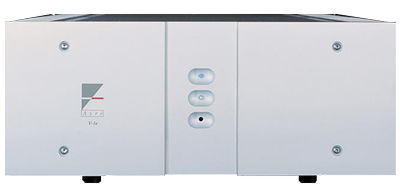
I've heard my share of Krells, Levinsons, Rowlands, and the like in other people's systems—expensive solid-state amplifiers are not my usual beat. With the exception of an inexpensive Adcom a few years back, for more than a decade I've owned and reviewed only tube amps. In fact, until the $7500 Ayre Acoustics V-1 showed up, I'd not had one in my system. Similarly, I'd had only tube preamps until I reviewed the Ayre K-3, which so impressed me that I asked to hear the more expensive K-1—and ended up buying it.  So Ayre's Charlie Hansen was quite comfortable having me review his big baby, the V-1. Or as comfortable as a compulsive can be. Hansen, who has a degree in physics and who designed Avalon's well-regarded Eclipse loudspeaker, is definitely compulsive about his designs, the parts used in them, what cables they should be hooked up with—even about what his amp sits on. For instance, I needed a set of 15' balanced interconnects. While Hansen was sure I should use Cardas, since that's what he's used inside the V-1, he obsessed over whether Neutral Reference or Golden Reference would be best in my system. I ended up with both, and finally decided on the Golden. Hansen sent along a set of wooden Jenga blocks (child's toys), which he suggested I put under the V-1's heatsinks to support the 100-lb amp. I tried that, but ended up using three large Walker Audio Valid Points embedded in three Walker lead/resin discs. I added a pair of discs on top to damp the chassis.
Design
So Ayre's Charlie Hansen was quite comfortable having me review his big baby, the V-1. Or as comfortable as a compulsive can be. Hansen, who has a degree in physics and who designed Avalon's well-regarded Eclipse loudspeaker, is definitely compulsive about his designs, the parts used in them, what cables they should be hooked up with—even about what his amp sits on. For instance, I needed a set of 15' balanced interconnects. While Hansen was sure I should use Cardas, since that's what he's used inside the V-1, he obsessed over whether Neutral Reference or Golden Reference would be best in my system. I ended up with both, and finally decided on the Golden. Hansen sent along a set of wooden Jenga blocks (child's toys), which he suggested I put under the V-1's heatsinks to support the 100-lb amp. I tried that, but ended up using three large Walker Audio Valid Points embedded in three Walker lead/resin discs. I added a pair of discs on top to damp the chassis.
Design
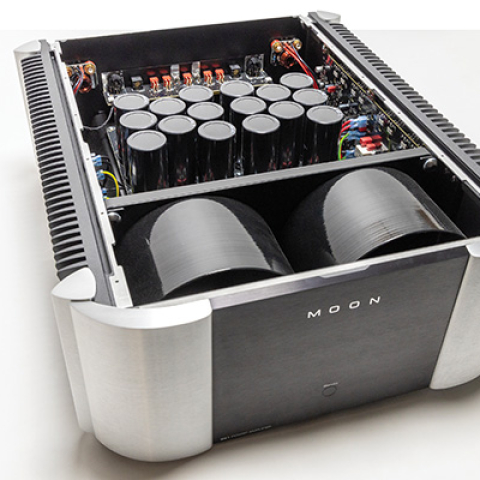
The V-1 is a fully balanced zero-feedback design. Among the reasons Hansen avoids negative feedback is his belief that, when you route the signal at the output back to the input, the speaker cable ("a large antenna," he calls it) induces a healthy dollop of RF. Throw RF back to the input and, depending on the amplifier's intrinsic response, you will amplify it. In order to make that interesting combination of fully balanced and zero negative feedback work as planned, every transistor in the circuit must be individually tested and matched in pairs. That must add at least $5 to the final price of the amp—there are 64 output MOSFETs alone! Rated at 200Wpc continuous power into 8 ohms and twice that into 4, the V-1 should have no trouble driving most loudspeakers. The power supply features a two-stage choke input filter that includes a huge toroidal transformer and two pairs of chokes (one each for the input- and output-stage power supplies), plus a bank of filter caps. The choke/filter-cap combo filters RF from the AC line, and the chokes also store energy in their magnetic fields, so there's a more continuous source of power supply current, according to Hansen. A conventional chokeless power supply charges the reservoir caps with quick pulses, which can act as an internally generated source of RF. The power supply also features discrete rectifiers instead of a rectifier bridge, in order to use the fastest devices available.
The input stage is a cascoded complementary-differential circuit that directly drives the complementary source-follower output stage. Very basic. This same circuit is used in the K-1 and K-3 preamps, with different-value parts and, of course, different voltages: ±15V vs the V-1's ±60V. The input connectors (a pair each of XLR and RCA jacks) are directly soldered to the input board, which is attached to the inside of the rear chassis wall. The boards are the same high-speed ones used in the K-1. Two pairs of Cardas speaker terminals (for biwiring) are connected via short runs of Cardas wire to the output circuit board. The terminals are not in parallel, as they are in most amplifiers. Instead, separate pairs of wires run from the output board to the terminals. There is no servo in the circuit to remove DC. DC offset is minimized at the factory via tiny holes in the back of the chassis—these allow adjustments to be made with the top on, so the amplifier is at normal operating temperature. According to Hansen, the V-1 is a "true DC amplifier": 1V of DC into the circuit will yield 20V DC out. Of course, when the amplifier "sees" DC, power is removed from the output stage and the V-1 reverts to warm-up mode. There is no microprocessor in the protection circuitry. Parts and build qualities appear to be extremely high, though the fins on the heatsinks will Veg-A-Matic your hands if you're not careful.
The sound of tubes?
If you do not currently have or are not planning on buying a balanced preamplifier, I would suggest looking elsewhere for a power amplifier. For one thing, you'd be paying for circuitry you won't use. For another, the V-1 sounded listless with single-ended drive—it just didn't get up and go. When I questioned Charlie Hansen about this, he admitted that he'd never listened to the V-1 in unbalanced mode.
So Ayre's Charlie Hansen was quite comfortable having me review his big baby, the V-1. Or as comfortable as a compulsive can be. Hansen, who has a degree in physics and who designed Avalon's well-regarded Eclipse loudspeaker, is definitely compulsive about his designs, the parts used in them, what cables they should be hooked up with—even about what his amp sits on. For instance, I needed a set of 15' balanced interconnects. While Hansen was sure I should use Cardas, since that's what he's used inside the V-1, he obsessed over whether Neutral Reference or Golden Reference would be best in my system. I ended up with both, and finally decided on the Golden. Hansen sent along a set of wooden Jenga blocks (child's toys), which he suggested I put under the V-1's heatsinks to support the 100-lb amp. I tried that, but ended up using three large Walker Audio Valid Points embedded in three Walker lead/resin discs. I added a pair of discs on top to damp the chassis. The V-1 is a fully balanced zero-feedback design. Among the reasons Hansen avoids negative feedback is his belief that, when you route the signal at the output back to the input, the speaker cable ("a large antenna," he calls it) induces a healthy dollop of RF. Throw RF back to the input and, depending on the amplifier's intrinsic response, you will amplify it. In order to make that interesting combination of fully balanced and zero negative feedback work as planned, every transistor in the circuit must be individually tested and matched in pairs. That must add at least $5 to the final price of the amp—there are 64 output MOSFETs alone! Rated at 200Wpc continuous power into 8 ohms and twice that into 4, the V-1 should have no trouble driving most loudspeakers. The power supply features a two-stage choke input filter that includes a huge toroidal transformer and two pairs of chokes (one each for the input- and output-stage power supplies), plus a bank of filter caps. The choke/filter-cap combo filters RF from the AC line, and the chokes also store energy in their magnetic fields, so there's a more continuous source of power supply current, according to Hansen. A conventional chokeless power supply charges the reservoir caps with quick pulses, which can act as an internally generated source of RF. The power supply also features discrete rectifiers instead of a rectifier bridge, in order to use the fastest devices available.
If you do not currently have or are not planning on buying a balanced preamplifier, I would suggest looking elsewhere for a power amplifier. For one thing, you'd be paying for circuitry you won't use. For another, the V-1 sounded listless with single-ended drive—it just didn't get up and go. When I questioned Charlie Hansen about this, he admitted that he'd never listened to the V-1 in unbalanced mode.