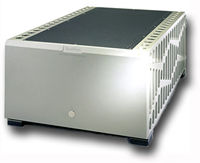
How much power do you really need? How much power can you actually use? What's necessary, and what's icing on the cake? And does anyone really need 1000Wpc? 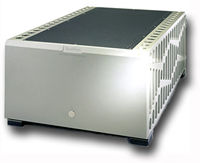 Well, it depends. Take our JMlab Utopia speakers. The Utopia is spec'd at 94.5dB sensitivity, so it should be pretty easy to drive. Or is it? As it happens, despite the system's highish sensitivity, the woofer is a long-throw, ported design that likes a grippy, controlling high-current amplifier. And I have yet to hear a more controlling solid-state amplifier than the huge Boulder 2050 monoblock. In our size-obsessed world, the Boulder amp is truly a giant. The 2050 joins the 2010 Balanced Preamplifier and 2020 Advance D/A converter in completing Boulder's 2000-series system. (Though only the amps are under official scrutiny here, all three pieces were auditioned in our system.) The entire line is built to obvious cost-no-object criteria. The luxurious feel of the controls, the super-high-tech displays, and the very heft and build quality of the components are most impressive. The amplifier is big, beautiful, and enormously heavy: 230 lbs each. The CNC-machined heatsinks down the amplifier's sides are works of art—and they don't ring. (I've been shocked at the ruckus created by running my fingernails along a few big amplifiers' heatsinks.) In fact, the entire massive structure was designed to minimize resonances. The nickel-plated steel subchassis houses two fully encapsulated toroidal power transformers to further lower vibration. As you will learn, Head Boulder Jeff Nelson's entire audio philosophy revolves around low resonance, and especially low distortion.
"The ability to drive real-world loudspeakers without any amplifier dynamic-range limitations was set as a goal," he explained. "That means no distortion, even during the loudest orchestral passages or brashest soprano solos. To reach the goal of wide dynamic range requires more voltage capability. Starting with the microphone and back through the whole recording/playback process, the audio signal is stored as voltage, not as current or power. "Because today's amplifiers are usually specified in watts at a given impedance, you have to back out the numbers to discover the amplifier's actual voltage capability. The typical high-end power amplifier is 200W into 8 ohms. But that's only 40 volts. The Boulder 2050 will drive 1000W into 8 ohms, or almost 90V—more than adequate for today's real-world loudspeakers. The power supply and transistor complement were designed around this 1000W number, regardless of impedance, because it's much more indicative of what speakers need. However, the supply is big enough for larger peak power at lower impedances. At 2 ohms, for example, 4000W is available." Technology
Well, it depends. Take our JMlab Utopia speakers. The Utopia is spec'd at 94.5dB sensitivity, so it should be pretty easy to drive. Or is it? As it happens, despite the system's highish sensitivity, the woofer is a long-throw, ported design that likes a grippy, controlling high-current amplifier. And I have yet to hear a more controlling solid-state amplifier than the huge Boulder 2050 monoblock. In our size-obsessed world, the Boulder amp is truly a giant. The 2050 joins the 2010 Balanced Preamplifier and 2020 Advance D/A converter in completing Boulder's 2000-series system. (Though only the amps are under official scrutiny here, all three pieces were auditioned in our system.) The entire line is built to obvious cost-no-object criteria. The luxurious feel of the controls, the super-high-tech displays, and the very heft and build quality of the components are most impressive. The amplifier is big, beautiful, and enormously heavy: 230 lbs each. The CNC-machined heatsinks down the amplifier's sides are works of art—and they don't ring. (I've been shocked at the ruckus created by running my fingernails along a few big amplifiers' heatsinks.) In fact, the entire massive structure was designed to minimize resonances. The nickel-plated steel subchassis houses two fully encapsulated toroidal power transformers to further lower vibration. As you will learn, Head Boulder Jeff Nelson's entire audio philosophy revolves around low resonance, and especially low distortion.
"The ability to drive real-world loudspeakers without any amplifier dynamic-range limitations was set as a goal," he explained. "That means no distortion, even during the loudest orchestral passages or brashest soprano solos. To reach the goal of wide dynamic range requires more voltage capability. Starting with the microphone and back through the whole recording/playback process, the audio signal is stored as voltage, not as current or power. "Because today's amplifiers are usually specified in watts at a given impedance, you have to back out the numbers to discover the amplifier's actual voltage capability. The typical high-end power amplifier is 200W into 8 ohms. But that's only 40 volts. The Boulder 2050 will drive 1000W into 8 ohms, or almost 90V—more than adequate for today's real-world loudspeakers. The power supply and transistor complement were designed around this 1000W number, regardless of impedance, because it's much more indicative of what speakers need. However, the supply is big enough for larger peak power at lower impedances. At 2 ohms, for example, 4000W is available." Technology
The 2050 amplifiers use automatic load-sensing, "intelligent" class-A circuitry. Jeff Nelson is closed-mouthed about the details. "Our circuit looks at the peak demand and adjusts the bias instantaneously," he says. "Then it backs down in a gradual analog fashion. That ensures that the operation of the circuitry is never audible."
The 2050 is the first Boulder amplifier to include a microprocessor functioning as a supervisor board. With the amps in standby, the supervisor stays alert. Nelson: "Powering up a high-power amplifier can be tricky. You have to reduce the inrush currents so as not to trip a circuit breaker. The processor does this very neatly. And it communicates with the 2010 preamplifier via our 'Boulderlink' communications cable and receives instructions to turn on and off with the 2010. Up to 16 amplifiers can be used in one system with automatic sequential turn-on." I tried to imagine how, sequentially, I might be turned on by a roomful of 2050s. "Any problems with the 2050 monoblocks are reported to the 2010 and shown on its display." Would those messages include $Breviewer meltdown? Up front, a single button low on the substantial faceplate sets the works in motion. A multifunction indicator blinks red and amber during the 45-second warm-up cycle as four expensive-sounding relays turn on the amps. The indicators also signal if, headbanger that you are, you manage to drive these monsters into clipping. I found this idea particularly hilarious—after all, the 2050s are capable of dishing out 4000W peak and 1000Wpc continuous power into 4 ohms. Still, Kathleen likes playing music loud. (She tried to clip 'em, honest...)
Well, it depends. Take our JMlab Utopia speakers. The Utopia is spec'd at 94.5dB sensitivity, so it should be pretty easy to drive. Or is it? As it happens, despite the system's highish sensitivity, the woofer is a long-throw, ported design that likes a grippy, controlling high-current amplifier. And I have yet to hear a more controlling solid-state amplifier than the huge Boulder 2050 monoblock. In our size-obsessed world, the Boulder amp is truly a giant. The 2050 joins the 2010 Balanced Preamplifier and 2020 Advance D/A converter in completing Boulder's 2000-series system. (Though only the amps are under official scrutiny here, all three pieces were auditioned in our system.) The entire line is built to obvious cost-no-object criteria. The luxurious feel of the controls, the super-high-tech displays, and the very heft and build quality of the components are most impressive. The amplifier is big, beautiful, and enormously heavy: 230 lbs each. The CNC-machined heatsinks down the amplifier's sides are works of art—and they don't ring. (I've been shocked at the ruckus created by running my fingernails along a few big amplifiers' heatsinks.) In fact, the entire massive structure was designed to minimize resonances. The nickel-plated steel subchassis houses two fully encapsulated toroidal power transformers to further lower vibration. As you will learn, Head Boulder Jeff Nelson's entire audio philosophy revolves around low resonance, and especially low distortion. The 2050 amplifiers use automatic load-sensing, "intelligent" class-A circuitry. Jeff Nelson is closed-mouthed about the details. "Our circuit looks at the peak demand and adjusts the bias instantaneously," he says. "Then it backs down in a gradual analog fashion. That ensures that the operation of the circuitry is never audible."