Recording artists can reinvent themselves by crossing over into another style of music. Gloria Estefan, who started with Latin music, crossed over into mainstream pop with great success. Doug Sax, who reinvented the direct-to-vinyl disc and produced outstanding LPs for Sheffield Lab, eventually transferred all of his music to compact discs. Ivor Tiefenbrun, designer of the Linn Sondek turntable, now makes CD players.  Similar changes have occurred in electronics. Audio Research, a leading American manufacturer of tube power amplifiers and preamplifiers, introduced a line of solid-state amps. Bill Conrad and Lewis Johnson, who make the C-J triode tube amplifiers and preamplifiers, have also begun to design solid-state equipment. In the May 1998 Stereophile (Vol.21 No.5), Wes Phillips praised C-J's flagship Anniversary Triode (ART) Reference line preamp for its simplicity. Johnson and Conrad kept the ART's output impedance at a low 500 ohms by linking five dual-triode 6922 tubes in parallel, "fabricating the equivalent of a single high-conductance triode" and avoiding the need of an output buffer stage. But in crossing over into transistor products, would Conrad-Johnson be able to retain the simplicity, low distortion, and musicality of their tube designs? Design
As noted above, the basic circuit ideas for the C-J preamplifier line were embodied in the all-tube, dual-chassis ART, which initially cost $14,995 and of which only 250 were made in both the original and Series 2 forms. The all-tube Premier 16LS Series 2 ($8295; see review in August 2001, Vol.24 No.8) was next, and was hailed by Jonathan Scull as a single-chassis version of the ART. Then came the all-tube Premier 17LS ($4495; see review in May 2001, Vol.24 No.5), which Brian Damkroger described as the most affordable incarnation of the ART. All three preamplifiers ended up in Class A of Stereophile's latest edition of "Recommended Components" (October 2002). Now Conrad and Johnson have introduced the solid-state, $3495 Premier 18LS.
In his solid-state circuits, Lew Johnson uses the same principle of simple, single-ended, single-stage preamplifier design that he'd used in his tube designs. To do this, the Premier 18LS uses field effect transistors (FETs) because they minimize odd-order distortion products. Because these distortions are musically unrelated to the fundamental tone, they sound particularly strident and irritating. On the other hand, a FET's even-order distortion products are part of the natural musical overtones. Simplicity meant limiting the 18LS to only one gain stage. For that reason, the preamp had to be a single-ended device. It has no balanced inputs or outputs, which would require another circuit stage. The single gain stage also means that the 18LS inverts phase. The symmetry of FET drivers made possible a total harmonic distortion (THD) level of just 0.005% THD, which meant no feedback loop was needed. Why is this important? Negative feedback is used to reduce measured distortion. Lew Johnson noted that transistors have much more gain and require much more feedback to manage dynamic passages. Yet circuits with lots of feedback can sound edgy due to transient intermodulation distortion (TIM). "Feedback distorts the time information, so that you lose microdynamics," says Johnson. "These are the fine musical gradations that the best preamplifiers can reveal." Feedback also affects macrodynamics. "The Conrad 18LS handles larger signals without requiring feedback because it can create symmetrical currents using the two types of FETs [N-channel and P-channel—Ed.]." There are two kinds of negative feedback: loop feedback (aka global feedback) and local feedback, the latter found in circuits that use a cathode "follower" circuits, whether they be cathode (tube), FET, or bipolar transistor. Johnson's Premier 16LS and 17LS tube preamplifiers do not employ cathode-follower circuits. Similarly, the solid-state Premier 18LS uses C-J's auto-linear gain block, which achieves low distortion with zero loop feedback by exploiting the symmetrical distortion properties of N- and P-channel FETs.
Johnson believes that the design of the power supply is just as important to the quality of the audio signal as that of the signal-bearing circuits. The 18LS's power supplies contain discrete DC regulators carefully designed for minimum impedance even at the highest audio frequencies, to prevent the supplies from distorting the audio signal. Controls
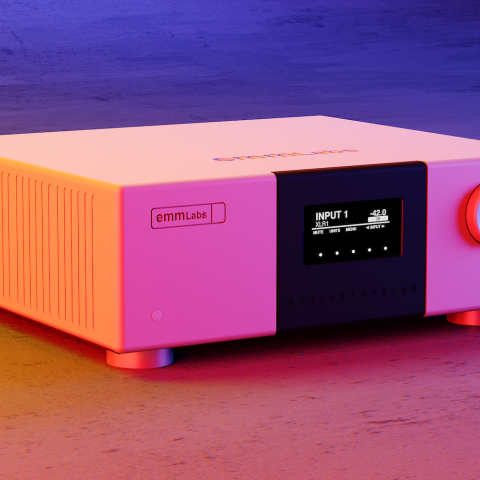
The Premier 18LS's thick faceplate of extruded aluminum is styled like that of Conrad-Johnson's ART preamplifier. Reviewing the 16LS line-stage preamp, Jonathan Scull described the C-J look as "somewhat deco in overall styling, while still retaining a sense of the modern" (Vol.24 No.8).
Similar changes have occurred in electronics. Audio Research, a leading American manufacturer of tube power amplifiers and preamplifiers, introduced a line of solid-state amps. Bill Conrad and Lewis Johnson, who make the C-J triode tube amplifiers and preamplifiers, have also begun to design solid-state equipment. In the May 1998 Stereophile (Vol.21 No.5), Wes Phillips praised C-J's flagship Anniversary Triode (ART) Reference line preamp for its simplicity. Johnson and Conrad kept the ART's output impedance at a low 500 ohms by linking five dual-triode 6922 tubes in parallel, "fabricating the equivalent of a single high-conductance triode" and avoiding the need of an output buffer stage. But in crossing over into transistor products, would Conrad-Johnson be able to retain the simplicity, low distortion, and musicality of their tube designs? Design As noted above, the basic circuit ideas for the C-J preamplifier line were embodied in the all-tube, dual-chassis ART, which initially cost $14,995 and of which only 250 were made in both the original and Series 2 forms. The all-tube Premier 16LS Series 2 ($8295; see review in August 2001, Vol.24 No.8) was next, and was hailed by Jonathan Scull as a single-chassis version of the ART. Then came the all-tube Premier 17LS ($4495; see review in May 2001, Vol.24 No.5), which Brian Damkroger described as the most affordable incarnation of the ART. All three preamplifiers ended up in Class A of Stereophile's latest edition of "Recommended Components" (October 2002). Now Conrad and Johnson have introduced the solid-state, $3495 Premier 18LS.
The Premier 18LS's thick faceplate of extruded aluminum is styled like that of Conrad-Johnson's ART preamplifier. Reviewing the 16LS line-stage preamp, Jonathan Scull described the C-J look as "somewhat deco in overall styling, while still retaining a sense of the modern" (Vol.24 No.8).