Until just recently, only companies known primarily for their surround-sound processors were producing the most advanced—and most expensive—Home Theater products. No longer. It was inevitable that traditional high-end audio manufacturers would begin producing equipment for this fast-growing market.  In the May 1994 Stereophile (Vol.17 No.5, p.91) I evaluated one of two new models from McIntosh; Meridian has recently begun production of its DSP surround-sound processor; Kinergetics has jumped in; Esoteric Audio Design showed an elaborate unit at the SCES in Chicago; and Madrigal, best known for its deluxe line of Mark Levinson electronics, has added the PAV audio/video preamplifier to its more affordable Proceed line. The PAV isn't exactly cheap, but for your money you get perhaps the most complete (with a single exception, as we shall see), intelligently designed, flexible device of its kind. Making the most of the PAV's capabilities—which, after all, you are paying for—does require some effort. It's not for the easily intimidated, or for those whose VCRs endlessly flash "12:00." The PAV will, however, reward those who master its complexities. Madrigal has done their best to simplify this process with a superb 65-page owner's manual. If the length sounds daunting, it's not—the manual is thorough, well-organized, and easy to understand; it even includes chapters on room acoustics and planning your Home Theater installation.
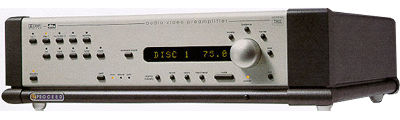
The PAV's front panel is ergonomically slick, including an LED readout that gives you most of the information you're likely to need. But you'll probably rely primarily on the remote control and the on-screen displays. The remote—unusually comprehensive, if complex—provides all the controls you'll need to calibrate and operate the system. More than that, you can "teach" it to operate a VCR, laserdisc player, CD player, or similar device, by programming the additional buttons. Actual everyday operation of the PAV isn't difficult. It doesn't have a zillion different surround modes—just Pro Logic, THX, stereo surround, straight stereo, a mono surround mode, and mono. The primary adjustable audio parameters are the level adjustments (for all channels) and the rear-channel delay. This is the limitation I referred to above. For many, it will be a plus, not a minus; but if you like to diddle endlessly, creating variations on a theme with simulated surround modes, then the Proceed is probably not for you. Setup and calibration are a bit more complex. The "learning" remote is very flexible, but it's a bit nonintuitive in the setup mode, with buttons taking on meanings other than those indicated by their labels. But once you learn to navigate the on-screen menus—again, the manual is indispensable here—you can quickly do the operations. And having full control from the listening chair over all setup adjustments is a convenience I wouldn't care to do without.
As a THX-approved processor, the PAV does all of the THX-approved things to the signal when the THX mode is selected: re-equalization to roll off the treble in a controlled fashion, to compensate film soundtracks that sound too hot in the top octaves in a Home Theater system; timbre matching to better balance the surrounds spectrally with the front; and decorrelation to provide some variation to the left and right mono surrounds, and thus improve spatial presentation. The PAV has a complete complement of audio and video inputs and outputs—S-Video included—plus a remote stereo (two-channel) output intended to feed a system that may be located in another part of the house; it's possible to simultaneously feed different sources to the main and remote circuits. The remote output receives the straight stereo input at full volume (provision to adjust the remote volume must be provided at the remote location), regardless of whether any surround mode is being used by the main system. You can also select a video source, then select an audio source and have the audio source override the video sound. This capability might be useful for receiving simulcasts (though now rare), or to feed the video sound through an outboard D/A converter. The PAV also provides for adjusting the input-level sensitivity to ensure the most accurate tracking of the Dolby Pro Logic circuitry (particularly in the surround channel, where level-sensitive Dolby noise-reduction is used). This input adjustment is not extremely critical (many processors omit it entirely), but it ensures optimum performance and avoids possible overloading of the Pro Logic circuits (footnote 1). The input calibration can be made for all of the inputs, preventing abrupt level changes when switching from one to another.
In the May 1994 Stereophile (Vol.17 No.5, p.91) I evaluated one of two new models from McIntosh; Meridian has recently begun production of its DSP surround-sound processor; Kinergetics has jumped in; Esoteric Audio Design showed an elaborate unit at the SCES in Chicago; and Madrigal, best known for its deluxe line of Mark Levinson electronics, has added the PAV audio/video preamplifier to its more affordable Proceed line. The PAV isn't exactly cheap, but for your money you get perhaps the most complete (with a single exception, as we shall see), intelligently designed, flexible device of its kind. Making the most of the PAV's capabilities—which, after all, you are paying for—does require some effort. It's not for the easily intimidated, or for those whose VCRs endlessly flash "12:00." The PAV will, however, reward those who master its complexities. Madrigal has done their best to simplify this process with a superb 65-page owner's manual. If the length sounds daunting, it's not—the manual is thorough, well-organized, and easy to understand; it even includes chapters on room acoustics and planning your Home Theater installation.
The PAV's front panel is ergonomically slick, including an LED readout that gives you most of the information you're likely to need. But you'll probably rely primarily on the remote control and the on-screen displays. The remote—unusually comprehensive, if complex—provides all the controls you'll need to calibrate and operate the system. More than that, you can "teach" it to operate a VCR, laserdisc player, CD player, or similar device, by programming the additional buttons. Actual everyday operation of the PAV isn't difficult. It doesn't have a zillion different surround modes—just Pro Logic, THX, stereo surround, straight stereo, a mono surround mode, and mono. The primary adjustable audio parameters are the level adjustments (for all channels) and the rear-channel delay. This is the limitation I referred to above. For many, it will be a plus, not a minus; but if you like to diddle endlessly, creating variations on a theme with simulated surround modes, then the Proceed is probably not for you. Setup and calibration are a bit more complex. The "learning" remote is very flexible, but it's a bit nonintuitive in the setup mode, with buttons taking on meanings other than those indicated by their labels. But once you learn to navigate the on-screen menus—again, the manual is indispensable here—you can quickly do the operations. And having full control from the listening chair over all setup adjustments is a convenience I wouldn't care to do without.
As a THX-approved processor, the PAV does all of the THX-approved things to the signal when the THX mode is selected: re-equalization to roll off the treble in a controlled fashion, to compensate film soundtracks that sound too hot in the top octaves in a Home Theater system; timbre matching to better balance the surrounds spectrally with the front; and decorrelation to provide some variation to the left and right mono surrounds, and thus improve spatial presentation. The PAV has a complete complement of audio and video inputs and outputs—S-Video included—plus a remote stereo (two-channel) output intended to feed a system that may be located in another part of the house; it's possible to simultaneously feed different sources to the main and remote circuits. The remote output receives the straight stereo input at full volume (provision to adjust the remote volume must be provided at the remote location), regardless of whether any surround mode is being used by the main system. You can also select a video source, then select an audio source and have the audio source override the video sound. This capability might be useful for receiving simulcasts (though now rare), or to feed the video sound through an outboard D/A converter. The PAV also provides for adjusting the input-level sensitivity to ensure the most accurate tracking of the Dolby Pro Logic circuitry (particularly in the surround channel, where level-sensitive Dolby noise-reduction is used). This input adjustment is not extremely critical (many processors omit it entirely), but it ensures optimum performance and avoids possible overloading of the Pro Logic circuits (footnote 1). The input calibration can be made for all of the inputs, preventing abrupt level changes when switching from one to another.
Footnote 1: Most laserdisc and CD players have maximum outputs of about 2V, but a few exceed this by a considerable margin.
In the May 1994 Stereophile (Vol.17 No.5, p.91) I evaluated one of two new models from McIntosh; Meridian has recently begun production of its DSP surround-sound processor; Kinergetics has jumped in; Esoteric Audio Design showed an elaborate unit at the SCES in Chicago; and Madrigal, best known for its deluxe line of Mark Levinson electronics, has added the PAV audio/video preamplifier to its more affordable Proceed line. The PAV isn't exactly cheap, but for your money you get perhaps the most complete (with a single exception, as we shall see), intelligently designed, flexible device of its kind. Making the most of the PAV's capabilities—which, after all, you are paying for—does require some effort. It's not for the easily intimidated, or for those whose VCRs endlessly flash "12:00." The PAV will, however, reward those who master its complexities. Madrigal has done their best to simplify this process with a superb 65-page owner's manual. If the length sounds daunting, it's not—the manual is thorough, well-organized, and easy to understand; it even includes chapters on room acoustics and planning your Home Theater installation. Footnote 1: Most laserdisc and CD players have maximum outputs of about 2V, but a few exceed this by a considerable margin.