Although Kentucky loudspeaker manufacturer Thiel has produced some standmounted models for home-theater use, all of their serious music speakers have been floorstanders. Enter the PCS: even though styled to match every Thiel speaker since the groundbreaking CS5 of 1989, the 19"-high PCS sits on a stand, not the floor. 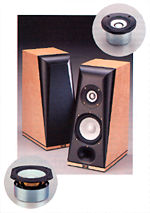 All the PCS's drive-units are made in-house by Thiel, and the heart of the speaker is the coaxial tweeter-midrange unit, similar to that used in the Thiel CS2.3. As Brian Damkroger discussed this unit at length in his January 1999 review of the '2.3 , I will refer you to his description. The important fact to note is that it uniquely uses a single motor and a mechanical crossover between the tweeter and midrange diaphragms. This unit crosses over below 700Hz or so to a metal-cone woofer, reflex-loaded by a shallow, flared port on the sloped-back front baffle. The woofer has a massive 2.5-lb magnet and features Thiel's traditional long-gap, short-coil construction to minimize magnetic nonlinearities. The electrical crossover is a two-way, first-order type, but still appears complex, to judge from the number of components used. These components are mounted behind the single pair of terminal posts. High-quality plastic-film capacitors and air-cored coils are used, and the internal wiring appears to be relatively small-gauge Kimber. The enclosure is made of veneered 1" MDF, with the 2"-thick front baffle painted black and carefully contoured to optimize the dispersion of the compound upper-frequency driver. The sloped baffle brings the acoustic centers of the drive-units into time alignment. There is extensive internal bracing, and the airspace is packed with fiber batting of some kind. The vestigial grille is held to the baffle by small magnets glued to its thin steel frame, which adhere to the heads of the bolts holding the drive-units in place. (Some of these came unglued during the auditioning.) In any case, the PCS is handsome enough without its grille.
Sound
All the PCS's drive-units are made in-house by Thiel, and the heart of the speaker is the coaxial tweeter-midrange unit, similar to that used in the Thiel CS2.3. As Brian Damkroger discussed this unit at length in his January 1999 review of the '2.3 , I will refer you to his description. The important fact to note is that it uniquely uses a single motor and a mechanical crossover between the tweeter and midrange diaphragms. This unit crosses over below 700Hz or so to a metal-cone woofer, reflex-loaded by a shallow, flared port on the sloped-back front baffle. The woofer has a massive 2.5-lb magnet and features Thiel's traditional long-gap, short-coil construction to minimize magnetic nonlinearities. The electrical crossover is a two-way, first-order type, but still appears complex, to judge from the number of components used. These components are mounted behind the single pair of terminal posts. High-quality plastic-film capacitors and air-cored coils are used, and the internal wiring appears to be relatively small-gauge Kimber. The enclosure is made of veneered 1" MDF, with the 2"-thick front baffle painted black and carefully contoured to optimize the dispersion of the compound upper-frequency driver. The sloped baffle brings the acoustic centers of the drive-units into time alignment. There is extensive internal bracing, and the airspace is packed with fiber batting of some kind. The vestigial grille is held to the baffle by small magnets glued to its thin steel frame, which adhere to the heads of the bolts holding the drive-units in place. (Some of these came unglued during the auditioning.) In any case, the PCS is handsome enough without its grille.
Sound
When the Thiel PCSes were first set up in my room, I was using the relatively inexpensive AudioQuest CV-4 speaker cables, which had worked well with the PSB Alpha A/Vs and Acoustic Energy Aegis Ones that I reviewed in April and May. With the speakers toed-in to the listening position, the sound was quite bright. There was superb presentation of detail, but just too much treble in absolute terms. Pointing the speakers straight ahead brought the high frequencies into better balance with the midrange, but there was still too much HF energy. There was a slight exaggeration of sibilance that I thought indicated the presence of a small resonant peak in the mid-treble, as well as a slight treble grain that would be fatiguing over the long run. What did I have to lose? I changed the cables to AudioQuest's ultra-expensive Sterling. Well, to those benighted souls who "know" that "wire is wire," I just wish I could drag you into my listening room to experience what happened. The PCS's highs fell into the appropriate balance with the mids and the grain disappeared, leaving a smooth but superbly detailed treble. Recorded sibilance was no longer exaggerated but sounded natural. What I had taken to be a speaker defect was actually associated with the inexpensive cable. But the silver-conductored Sterlings also tightened up the low frequencies slightly, and though the perceived bass was now more extended, this was a step in the wrong direction. When Jim Thiel subsequently visited Santa Fe and listened to this comparison, he told me that he had exclusively used the flat Goertz cables during the development of the PCS, and recommended them highly. He arranged for Goertz to send me a set of their AG3 Divinity cables, which I used for the remainder of the review period.
Another transformation! The treble balance became even smoother, and the lightweight bass became more fleshed-out in the upper bass. Stanley Clarke's aggressive double-bass solo on "Nevermind" (on Stereophile's Test CD 3, STPH006-2) had beautiful definition and sufficient weight to be convincing.
All the PCS's drive-units are made in-house by Thiel, and the heart of the speaker is the coaxial tweeter-midrange unit, similar to that used in the Thiel CS2.3. As Brian Damkroger discussed this unit at length in his January 1999 review of the '2.3 , I will refer you to his description. The important fact to note is that it uniquely uses a single motor and a mechanical crossover between the tweeter and midrange diaphragms. This unit crosses over below 700Hz or so to a metal-cone woofer, reflex-loaded by a shallow, flared port on the sloped-back front baffle. The woofer has a massive 2.5-lb magnet and features Thiel's traditional long-gap, short-coil construction to minimize magnetic nonlinearities. The electrical crossover is a two-way, first-order type, but still appears complex, to judge from the number of components used. These components are mounted behind the single pair of terminal posts. High-quality plastic-film capacitors and air-cored coils are used, and the internal wiring appears to be relatively small-gauge Kimber. The enclosure is made of veneered 1" MDF, with the 2"-thick front baffle painted black and carefully contoured to optimize the dispersion of the compound upper-frequency driver. The sloped baffle brings the acoustic centers of the drive-units into time alignment. There is extensive internal bracing, and the airspace is packed with fiber batting of some kind. The vestigial grille is held to the baffle by small magnets glued to its thin steel frame, which adhere to the heads of the bolts holding the drive-units in place. (Some of these came unglued during the auditioning.) In any case, the PCS is handsome enough without its grille. When the Thiel PCSes were first set up in my room, I was using the relatively inexpensive AudioQuest CV-4 speaker cables, which had worked well with the PSB Alpha A/Vs and Acoustic Energy Aegis Ones that I reviewed in April and May. With the speakers toed-in to the listening position, the sound was quite bright. There was superb presentation of detail, but just too much treble in absolute terms. Pointing the speakers straight ahead brought the high frequencies into better balance with the midrange, but there was still too much HF energy. There was a slight exaggeration of sibilance that I thought indicated the presence of a small resonant peak in the mid-treble, as well as a slight treble grain that would be fatiguing over the long run. What did I have to lose? I changed the cables to AudioQuest's ultra-expensive Sterling. Well, to those benighted souls who "know" that "wire is wire," I just wish I could drag you into my listening room to experience what happened. The PCS's highs fell into the appropriate balance with the mids and the grain disappeared, leaving a smooth but superbly detailed treble. Recorded sibilance was no longer exaggerated but sounded natural. What I had taken to be a speaker defect was actually associated with the inexpensive cable. But the silver-conductored Sterlings also tightened up the low frequencies slightly, and though the perceived bass was now more extended, this was a step in the wrong direction. When Jim Thiel subsequently visited Santa Fe and listened to this comparison, he told me that he had exclusively used the flat Goertz cables during the development of the PCS, and recommended them highly. He arranged for Goertz to send me a set of their AG3 Divinity cables, which I used for the remainder of the review period.