The Mirage OM-6 loudspeaker, from Canadian manufacturer Audio Products International, mightily impressed Stereophile's Tom Norton when he reviewed it back in November 1997. But with its "omnipolar" design and powered woofer, the OM-6 wasn't a speaker for those of us with more conventional tastes in speaker design. So when I heard that Mirage's Ian Paisley was working on a high-performance two-way minimonitor based on the OM-6's drive-unit technology, I asked API's affable PR man, Jeff Percy, for review samples.  Meet Mr. M-1
The MRM-1 may not be very big, but at 35 lbs each it is more than a handful. The sides, top, and base of the 1"-thick MDF carcass are lined and stiffened with steel plate, while the 3/4" MDF front baffle is faced with a 1" layer of black Corian, its upper edges rounded to reduce acoustic obstructions around the tweeter, and giving the impression that the speaker tapers toward its top. The woofer is reflex-loaded, with a flared port mounted on the rear panel above the terminals---at 8" deep, this extends almost to the tweeter magnet. The airspace is filled with three rolled-up pieces of acrylic fiber. The drive-units are hi-tech in conception and construction. The 1" tweeter---descended from the unit first seen in the Mirage M1-si---has a dome made from a titanium alloy, with the voice-coil wound on the "skirt" of the dome. The cloth surround is compliant enough to allow operation to a lower frequency than usual, the tweeter taking over from the woofer above 1.8kHz. The woofer itself is constructed on an injection-molded copolymer basket, this said to be acoustically inert compared with the usual metal basket. The straight-sided cone is injection-molded from polypropylene, which has been impregnated with graphite and mica to maximize stiffness. A butyl-rubber composite surround is used to allow large excursions, and a concentric mass-loading ring covers the inner diameter of the cone to damp cone resonances. There is no dustcap, the polepiece being formed into a conical phase plug. The voice-coil is wound in a bifilar, two-layered manner for the most even current distribution. The complex crossover---I counted 18 elements---is mounted on a printed circuit board fastened to the inside of the two pairs of terminal posts. It features mainly air-cored coils and high-quality Solen capacitors. Internal wiring is specified as being by Cardas. Electrical connection to the drive-units is via gold-plated spring clips rather than solder joints.
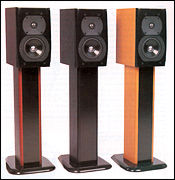
The vestigial grille is fabricated from black cloth stretched over a metal-tube frame. The review speakers were finished in a dark "Tigerwood" veneer that was very handsome, to say the least. The matching 28" stands were finished in the same veneer. About my only gripe was that the supplied spikes were not long enough to pierce my rug and pad to reach the tile beneath.
Meet Mr. M-1 The MRM-1 may not be very big, but at 35 lbs each it is more than a handful. The sides, top, and base of the 1"-thick MDF carcass are lined and stiffened with steel plate, while the 3/4" MDF front baffle is faced with a 1" layer of black Corian, its upper edges rounded to reduce acoustic obstructions around the tweeter, and giving the impression that the speaker tapers toward its top. The woofer is reflex-loaded, with a flared port mounted on the rear panel above the terminals---at 8" deep, this extends almost to the tweeter magnet. The airspace is filled with three rolled-up pieces of acrylic fiber. The drive-units are hi-tech in conception and construction. The 1" tweeter---descended from the unit first seen in the Mirage M1-si---has a dome made from a titanium alloy, with the voice-coil wound on the "skirt" of the dome. The cloth surround is compliant enough to allow operation to a lower frequency than usual, the tweeter taking over from the woofer above 1.8kHz. The woofer itself is constructed on an injection-molded copolymer basket, this said to be acoustically inert compared with the usual metal basket. The straight-sided cone is injection-molded from polypropylene, which has been impregnated with graphite and mica to maximize stiffness. A butyl-rubber composite surround is used to allow large excursions, and a concentric mass-loading ring covers the inner diameter of the cone to damp cone resonances. There is no dustcap, the polepiece being formed into a conical phase plug. The voice-coil is wound in a bifilar, two-layered manner for the most even current distribution. The complex crossover---I counted 18 elements---is mounted on a printed circuit board fastened to the inside of the two pairs of terminal posts. It features mainly air-cored coils and high-quality Solen capacitors. Internal wiring is specified as being by Cardas. Electrical connection to the drive-units is via gold-plated spring clips rather than solder joints.