Polk Audio is the Rodney Dangerfield of high-end audio. Why does this conscientious, innovative, and well-organized company garner no respect from hard-to-please audiophiles? 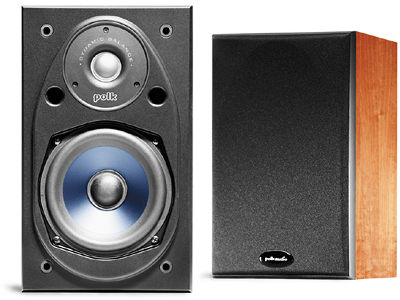 Well, for years we've all seen the multipage glossy color ads featuring designer Matthew Polk in his pristine lab coat. The audiophile cynic responds: How can these speakers be any good? But Matthew Polk shouldn't be criticized for sponsoring an aggressive marketing and distribution campaign? It certainly seems to have worked; the name recognition of his company among the general public seems to be a great deal higher than that of many companies listed in Stereophile's "Recommended Components." As it had been nearly two decades since I'd critically listened to a Polk design, I jumped at the chance to audition their entry in the Bob Reina Search for Speaker Nirvana at Cheapskate Prices: the $320/pair RT25i.
Description
Well, for years we've all seen the multipage glossy color ads featuring designer Matthew Polk in his pristine lab coat. The audiophile cynic responds: How can these speakers be any good? But Matthew Polk shouldn't be criticized for sponsoring an aggressive marketing and distribution campaign? It certainly seems to have worked; the name recognition of his company among the general public seems to be a great deal higher than that of many companies listed in Stereophile's "Recommended Components." As it had been nearly two decades since I'd critically listened to a Polk design, I jumped at the chance to audition their entry in the Bob Reina Search for Speaker Nirvana at Cheapskate Prices: the $320/pair RT25i.
Description
The RT25i, one model up from the least expensive Polk speaker, is a two-way bookshelf satellite sporting a 1" trilaminate polymer-dome tweeter and a 5?" mineral-loaded polymer/composite-cone woofer, both drivers shielded for home-theater applications. The woofer was designed using Polk's Dynamic Balance technology, which employs heterodyning laser-interferometer analysis to minimize resonances. The rear-ported enclosure uses Polk's unique Power Port technology, which consists of a cone at the mouth of the port and space between the rear of the cabinet and the port cone to maximize efficiency while minimizing port noise, or "chuffing." The cabinet also uses two small ports on the front of the speaker, these tuned to resonate at the same frequency as the cabinet's internal depth resonance. This is intended to minimize coloration resulting from the cabinet's air-space resonance. The RT25i has two interesting features not usually found in a speaker at this price. First, the cabinets are finished in real wood, unlike the vinyl finishes found on most budget speakers. My review pair's maple finish was astonishingly beautiful for the price; I wouldn't be ashamed to have wood that nice on any of the necks in my guitar collection. Second, the aforementioned Power Port doubles as a handy wall-mounting device. I mounted the RT25i's on Celestion Si speaker stands, spiked and filled with sand and lead shot. Although I tried the speakers with their grilles off, I heard the most natural tonal balance when I left the grilles on, despite a slight loss of transparency. Polk's detailed and well-written owner's manual recommends leaving the grilles in place.
Listening: The Downside
Before I begin to gush about this little speaker, I'll point out the RT25i's two serious shortcomings, both of which are consistent with the design limitations inherent in bookshelf speakers with very small cabinets. The Polk's first serious problem was a lack of dynamic bloom in the bass frequencies during densely modulated passages. When the program material was fairly active and complex, the RT25i's bass performance, although tight, fast, and low in coloration, did not achieve a sense of dynamic bloom—a marked departure from the speaker's lively and wide dynamic capabilities further up the frequency spectrum. The result was that mid- and upper bass sounded confined, compressed, and disconnected dynamically from the rest of the spectrum. This was very noticeable in the normally driving bass guitar in Mighty Sam McClain's "Too Proud" (from Give It Up for Love, AudioQuest XRCD 0012-2), and in the forward, rapid, and deep bass synth lines throughout Sade's Love Deluxe (Epic EK 53178). The latter sounded more akin to some of the mechanical-sounding bass lines on the more antiseptic Kraftwerk albums.
This problem was much less severe when the bass instrument stood alone in less complex material, such as the timpani in Kohjiba's Transmigration of the Soul (Festival, Stereophile STPH007-2), and the string bass in George Crumb's Quest (Bridge 9069), both of which sounded natural, tuneful, and dynamic. Like the Aln Petite and the Mission 731i, both of which also have very small cabinets, the Polk's in-room bass extension was impressive—down to the lower 50Hz region—in the two smaller listening rooms I used, but sounded a bit bass-shy in my large primary listening room: realistic down to the upper 50Hz region, audible but unconvincing below that. However, the harmonic accuracy of what bass was produced was sufficiently convincing that the organ pedals in John Rutter's Requiem (Reference Recordings RR57-CD) seemed natural, even though the lowest notes were missing in action. The RT25i's second serious shortcoming was severe dynamic compression during densely modulated passages. Orchestrally dense works such as Messiaen's Turangalla Symphony (André Previn, EMI SLS 5117) seemed flat and lacked vibrancy in the more demanding and cacophonous passages. Similarly, the title track from Hole's rock blockbuster, Celebrity Skin (Geffen DGC-25164), sounded as compressed as an FM broadcast of this familiar tune. However, on "Use Once and Destroy" from the same album, the shifting textures of closely miked vocals, acoustic guitars, timpani, and synthesizers kicked ass as the quieter passages gave the Polk a chance to breathe. Equally convincing were highly varied chamber works (the aforementioned Kohjiba track) and orchestral works such as Penderecki's Symphony (EMI EMD 5507), a blockbuster whose dramatic use of space, dynamics, decay, and the subtle as well as cacophonous use of strings as percussion, shone on the Polks.
Well, for years we've all seen the multipage glossy color ads featuring designer Matthew Polk in his pristine lab coat. The audiophile cynic responds: How can these speakers be any good? But Matthew Polk shouldn't be criticized for sponsoring an aggressive marketing and distribution campaign? It certainly seems to have worked; the name recognition of his company among the general public seems to be a great deal higher than that of many companies listed in Stereophile's "Recommended Components." As it had been nearly two decades since I'd critically listened to a Polk design, I jumped at the chance to audition their entry in the Bob Reina Search for Speaker Nirvana at Cheapskate Prices: the $320/pair RT25i. The RT25i, one model up from the least expensive Polk speaker, is a two-way bookshelf satellite sporting a 1" trilaminate polymer-dome tweeter and a 5?" mineral-loaded polymer/composite-cone woofer, both drivers shielded for home-theater applications. The woofer was designed using Polk's Dynamic Balance technology, which employs heterodyning laser-interferometer analysis to minimize resonances. The rear-ported enclosure uses Polk's unique Power Port technology, which consists of a cone at the mouth of the port and space between the rear of the cabinet and the port cone to maximize efficiency while minimizing port noise, or "chuffing." The cabinet also uses two small ports on the front of the speaker, these tuned to resonate at the same frequency as the cabinet's internal depth resonance. This is intended to minimize coloration resulting from the cabinet's air-space resonance. The RT25i has two interesting features not usually found in a speaker at this price. First, the cabinets are finished in real wood, unlike the vinyl finishes found on most budget speakers. My review pair's maple finish was astonishingly beautiful for the price; I wouldn't be ashamed to have wood that nice on any of the necks in my guitar collection. Second, the aforementioned Power Port doubles as a handy wall-mounting device. I mounted the RT25i's on Celestion Si speaker stands, spiked and filled with sand and lead shot. Although I tried the speakers with their grilles off, I heard the most natural tonal balance when I left the grilles on, despite a slight loss of transparency. Polk's detailed and well-written owner's manual recommends leaving the grilles in place.
Before I begin to gush about this little speaker, I'll point out the RT25i's two serious shortcomings, both of which are consistent with the design limitations inherent in bookshelf speakers with very small cabinets. The Polk's first serious problem was a lack of dynamic bloom in the bass frequencies during densely modulated passages. When the program material was fairly active and complex, the RT25i's bass performance, although tight, fast, and low in coloration, did not achieve a sense of dynamic bloom—a marked departure from the speaker's lively and wide dynamic capabilities further up the frequency spectrum. The result was that mid- and upper bass sounded confined, compressed, and disconnected dynamically from the rest of the spectrum. This was very noticeable in the normally driving bass guitar in Mighty Sam McClain's "Too Proud" (from Give It Up for Love, AudioQuest XRCD 0012-2), and in the forward, rapid, and deep bass synth lines throughout Sade's Love Deluxe (Epic EK 53178). The latter sounded more akin to some of the mechanical-sounding bass lines on the more antiseptic Kraftwerk albums.