Paul Barton is a legend in the speaker business. For 25 years this musician and engineer has dedicated his life to providing speaker purchasers with higher levels of sonic realism at lower prices. Barton is a frugal perfectionist, and his obsession with psychoacoustics is evident in all his designs. I was mightily impressed with his midpriced Image 4T (Stereophile, February 2001), which was, like all Barton designs, designed with the assistance of the facilities of Canada's National Research Council. 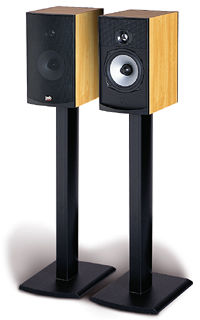 Although PSB makes more than two dozen speakers ranging from $199 to $2699/pair, it is the affordable Alpha speaker, introduced 10 years ago (and reviewed in the July 1992 and January 1994 Stereophiles and the very first issue of Stereophile Guide to Home Theater, in 1995) that created all the fuss, at the time setting a new benchmark for affordable loudspeakers. But Barton is not one to rest on his laurels. Into this third and latest generation of the Alpha, the Alpha B, he has trickled down some of the design and manufacturing innovations of his more expensive Image series.
The Update
Although PSB makes more than two dozen speakers ranging from $199 to $2699/pair, it is the affordable Alpha speaker, introduced 10 years ago (and reviewed in the July 1992 and January 1994 Stereophiles and the very first issue of Stereophile Guide to Home Theater, in 1995) that created all the fuss, at the time setting a new benchmark for affordable loudspeakers. But Barton is not one to rest on his laurels. Into this third and latest generation of the Alpha, the Alpha B, he has trickled down some of the design and manufacturing innovations of his more expensive Image series.
The Update
The trickle-down from the Image series to the diminutive, two-way, rear-ported Alpha B is evident in the B's manufacturing as well as its design. First, the 5¼" polypropylene woofer cone is identical to that used in the Image models—with, however, a different voice-coil, one more appropriate for the smaller cabinet. (The aluminum-dome tweeter is the same as that recently introduced in PSB's entry-level speaker, the Alpha Intro.) As I indicated in my review of the PSB Image 4T, Paul Barton keeps costs down by using modular, molded design in all his Image speakers, thus minimizing separate manufacturing processes for each model. With the Alpha B, PSB has for the first time extended this modular construction to one of their least expensive models.
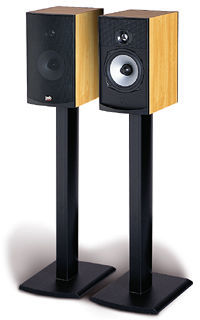
The Alpha B has molded plastic front and rear baffles connected by an MDF "sleeve" available in black or light cherry wood-grain finish. My cherry-finished sample was understatedly elegant. Unlike the original Alpha and the successor Alpha A/V, which John Atkinson reviewed in April 2000, the Alpha B has a grillecloth of fine wire mesh, removable "if one is careful," says Barton. I don't recommend removing it; it's difficult to do without bending the thin, attractive grille. Anyway, the Alpha B sounded virtually the same, with or without grilles. Like the Alpha A/V, the Alpha B is magnetically shielded for home-theater applications. The Alpha Bs are available with the solid-wood SP25i stands ($99) in attractive black, but I listened to them using my trusty single-pillar Celestion Si stands, loaded with lead shot and sand. The Sound
I was immediately struck by the Alpha B's smoothness and its uniformity of frequency response from the midbass to the extreme treble. In fact, aside from a slight forward character in the mid- to upper midrange (which adversely affected only certain instruments), the Alpha B was one of the most neutral inexpensive speakers I've heard.
The Alpha B excelled with vocals, especially those of the seductive female type. I'd just moved my VPI TNT/Immedia/Koetsu analog rig back to the large listening room of my relatively new house; anxious to mine my vinyl collection, I cued up a track from my original pressing of Ella Fitzgerald's Clap Hands, Here Comes Charlie! (Verve V64053). I was so taken by the warm, vibrant, immediate, natural quality of the mighty Ella that I put down my pen and pad and played through both sides of the disc. The Alpha B's natural vocal production was enhanced by the speaker's excellent articulation of subtle transients and microdynamic inflections. This is critical to achieving a realistic reproduction of a unique voice such as Joni Mitchell's, on "Chinese Café/Unchained Melody," from Hits (CD, Reprise 46325-2). I have never heard a speaker costing less than $1000/pair that reproduces woodwinds more naturally than did the Alpha B. I cued up an old mono pressing of Louis Armstrong Plays W.C. Handy (LP, Columbia CL 591), and, during the entire recording, found myself ignoring the vocals and trumpet (difficult to do with Pops) and just following the clarinet. My notes: "Damn, that's a real clarinet!" Further down the frequency spectrum, the Alpha B's midbass reproduction was superb. On well-recorded jazz discs, the string bass was as realistic as I'd heard from such an inexpensive speaker. The bass solo on Sonny Rollins' "Oleo," from Our Man in Jazz (LP, RCA/Classic LSP-2612), had a woody, resonant quality that was uncolored and rich without a hint of overhang. In fact, the bass was quite extended, with good definition down to about 50Hz, but without a trace of the kind of hooty flatulence I've heard from many inexpensive ported speakers. Below that frequency, however, the bass went missing in action, and recordings with significant pipe-organ pedal content lacked bottom-end air.
Although PSB makes more than two dozen speakers ranging from $199 to $2699/pair, it is the affordable Alpha speaker, introduced 10 years ago (and reviewed in the July 1992 and January 1994 Stereophiles and the very first issue of Stereophile Guide to Home Theater, in 1995) that created all the fuss, at the time setting a new benchmark for affordable loudspeakers. But Barton is not one to rest on his laurels. Into this third and latest generation of the Alpha, the Alpha B, he has trickled down some of the design and manufacturing innovations of his more expensive Image series.
The Update The trickle-down from the Image series to the diminutive, two-way, rear-ported Alpha B is evident in the B's manufacturing as well as its design. First, the 5¼" polypropylene woofer cone is identical to that used in the Image models—with, however, a different voice-coil, one more appropriate for the smaller cabinet. (The aluminum-dome tweeter is the same as that recently introduced in PSB's entry-level speaker, the Alpha Intro.) As I indicated in my review of the PSB Image 4T, Paul Barton keeps costs down by using modular, molded design in all his Image speakers, thus minimizing separate manufacturing processes for each model. With the Alpha B, PSB has for the first time extended this modular construction to one of their least expensive models.
I was immediately struck by the Alpha B's smoothness and its uniformity of frequency response from the midbass to the extreme treble. In fact, aside from a slight forward character in the mid- to upper midrange (which adversely affected only certain instruments), the Alpha B was one of the most neutral inexpensive speakers I've heard.