While audio writers find the siren song of cost-no-object components an ever-present temptation, I do ask Stereophile's reviewers to be on the lookout for affordable products that sound better than they have any right to. So when I listened to an inexpensive system based on Monitor Audio's Silver S2 loudspeaker and Musical Fidelity amplification at Home Entertainment 2002, held at the Manhattan Hilton in May 2002, I followed my own instruction and asked the US distributor of this English model to send me review samples. 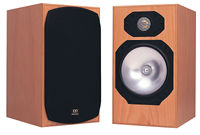 The Silver S2 is a nicely finished speaker with elegant proportions. The unbraced cabinet is made from ¾" MDF, veneered on both sides and lined with foam. The crossover is mounted to a printed circuit board behind the two pairs of binding posts. The drivers are connected with fairly heavy-duty cable, and the connections are soldered, a nice touch at this price level. The two magnetically shielded drive-units are mounted vertically in line. As well as cast chassis, they feature diaphragms formed from an aluminum-magnesium alloy that Monitor Audio calls "C-CAM." The 1" tweeter has a protective mesh grille, the woofer a flared cone with a bullet-shaped dustcap and a half-roll rubber surround. The woofer's nominal chassis diameter is 7"—quite large for a two-way design. Sound
The Silver S2s sat on 24" Celestion Si stands, the central pillars of which were filled with sand and lead shot, and I discarded the bulky fabric-over-wood-frame grilles for my auditioning. With the speakers sitting in the same positions as the Earthworks monitors that I reviewed in June and that had preceded them in my listening room, my initial impressions were positive. Although the Monitor Audios offered nothing like the vividly clear view into the recorded soundstage that the very much more expensive Earthworks had done, the English speakers offered a noticeably bighearted sound.
The most obvious characteristic of the Silver S2's sonic signature was its mellow treble. When cymbals were recorded too "hot"—as they are in most rock—the Monitor Audios made them sound acceptable. But when cymbals had been recorded with a more natural high-frequency balance, as on Ry Cooder and Manuel Galbán's Mambo Sinuendo (CD, Perro Verde/Nonesuch PRCD 300999), some of the instruments' top-octave air was suppressed. And old recordings of uncertain pedigree, as on Keith Richards' superbly eclectic The Devil Music blues compilation (cover-mounted a while back on an issue of UK magazine Uncut), were a little on the lifeless side. But so tired am I of the rather relentless highs that rock engineers seem to feel mandatory—as on Fleetwood Mac's new Say You Will DVD-Audio disc, for example (Reprise 48394-9)—that I can put up with a speaker not having enough energy above 5kHz much more easily than I can one that has exaggerated highs. The overall level of coloration was respectably low, taking the speaker's $750/pair price into account. There was a touch of "bite" occasionally audible in the mid-treble as added sibilance, but not so much as to distract from the music. The upper midrange was clean, though piano sounded rather uneven, some notes sounding more "hooty" than others. Well-recorded orchestral recordings such as July's "Recording of the Month," violinist Rachel Podger performing Vivaldi concertos (CD, Channel Classics CCS19598), again sounded a little on the warm side. While this was not unpleasant, the S2's lower midrange definitely lacked clarity, though there was nothing specific that I could put my finger on. This was partly because the effect was very recording-dependent. The superbly natural-sounding SACD of Dennis Russell Davies' somewhat cautious performance of Holst's The Planets (two-channel mix, Chesky SACD 234), for example, sounded much cleaner than I was expecting from my prior listening to the Channel Classics Vivaldi, though this might well have something to do with the composer's very open scoring for the enormous orchestral forces demanded by this work.
The Silver S2 is a nicely finished speaker with elegant proportions. The unbraced cabinet is made from ¾" MDF, veneered on both sides and lined with foam. The crossover is mounted to a printed circuit board behind the two pairs of binding posts. The drivers are connected with fairly heavy-duty cable, and the connections are soldered, a nice touch at this price level. The two magnetically shielded drive-units are mounted vertically in line. As well as cast chassis, they feature diaphragms formed from an aluminum-magnesium alloy that Monitor Audio calls "C-CAM." The 1" tweeter has a protective mesh grille, the woofer a flared cone with a bullet-shaped dustcap and a half-roll rubber surround. The woofer's nominal chassis diameter is 7"—quite large for a two-way design. Sound The Silver S2s sat on 24" Celestion Si stands, the central pillars of which were filled with sand and lead shot, and I discarded the bulky fabric-over-wood-frame grilles for my auditioning. With the speakers sitting in the same positions as the Earthworks monitors that I reviewed in June and that had preceded them in my listening room, my initial impressions were positive. Although the Monitor Audios offered nothing like the vividly clear view into the recorded soundstage that the very much more expensive Earthworks had done, the English speakers offered a noticeably bighearted sound.