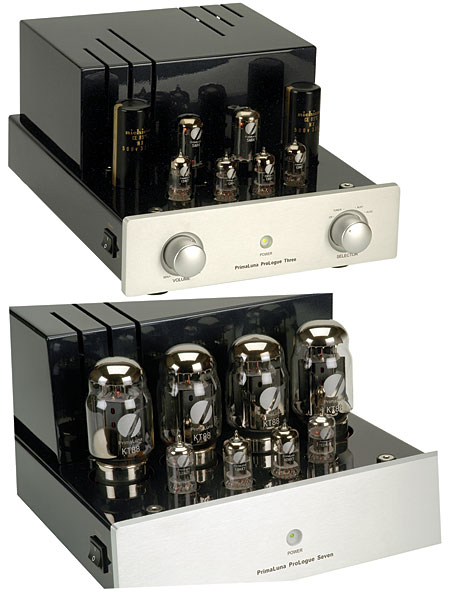
Everybody loves a bargain. No—make that: Most people love a bargain. Some just want the best, and they don't care about the cost. Some even distrust and reject out of hand any product that's not expensive enough. If you're one of these people, you might as well stop reading this review right now—the PrimaLuna ProLogue Three and ProLogue Seven are not for you. $1395 for a tube preamp? $2695 for a pair of 70Wpc tube monoblocks equipped with four KT88 tubes each? Must be based on old designs in the public domain using cheap parts carelessly assembled...
 But in fact—and putting sound quality aside for the moment—these PrimaLuna products are serious, well-thought-out designs of considerable originality, in which are found such high-quality parts as Solen capacitors, Alps potentiometers, and fast-recovery diodes. The ProLogue Three and ProLogue Seven are claimed to have been made with "workmanship equal to or better than any product that you can buy at any price, period," and I'm not about to refute that claim.
As for the sound...well, I'll get to that shortly.
Some background
But in fact—and putting sound quality aside for the moment—these PrimaLuna products are serious, well-thought-out designs of considerable originality, in which are found such high-quality parts as Solen capacitors, Alps potentiometers, and fast-recovery diodes. The ProLogue Three and ProLogue Seven are claimed to have been made with "workmanship equal to or better than any product that you can buy at any price, period," and I'm not about to refute that claim.
As for the sound...well, I'll get to that shortly.
Some background
PrimaLuna products represent true international cooperation. The company was founded by Herman van den Dungen, a high-end audio distributor in the Netherlands; the designer is Marcel Croese, who held that position with Goldmund in Switzerland. The products are made in the People's Republic of China (at these prices, did you think they'd be Swiss-made?). International marketing and liaison with the Chinese manufacturing facility is handled by Dominique Chenet, who hails from France, where she worked for Jadis. US distribution is by Kevin Deal of Upscale Audio, known in some quarters as the "tube guru."
As Herman van den Dungen tells the story, his grandfather, also named Herman, was given the nickname "Maontje," which means "Little Moon" in Dutch, by his wife, and that's also now the name of van den Dungen's little dog. Herman's father's name was Cor, so he is called "Herman from Cor from Maontje van den Dungen." And so—I hope you're following all this—"that's why I thought of First Moon as a brand name."
And why an Italian name? Well, that's not really explained, except to say that there is a small town near Lake Como called Primaluna—but it has nothing to do with the audio business. My theory is that Herman van den Dungen just liked the sound of PrimaLuna, which does roll off the tongue in a very musical way.
Description and design
The ProLogue Three and ProLogue Seven share certain characteristics. They're exactly the same size and are built by hand with point-to-point wiring; the fully vented chassis are of heavy-gauge steel with five coats of finish, each coat hand-rubbed and polished. Premium parts are used throughout; supplier names include Alps, Nichicon, Solen, Swellong, and WBT. The ProLogue Three and Seven both have a SoftStart circuit to extend the life of components and reduce thermal shock, and there's a removable protective metal cage that fits over the tube compartment. I kept these on for all my listening.
The ProLogue Three is a dual-mono design, with separate toroidal transformers for the left and right channels. Two 5AR4 tubes are used for rectification; there is no loop negative feedback or cathode followers. The ProLogue Three uses a choke-regulated power supply and DC tube heaters, which is said to make it less picky about tube choices. The ProLogue Three sports four sets of line-level inputs, one of them optionally convertible to an internal moving-magnet photo stage ($159). There are two sets of main inputs—a useful feature when you want to add a supplemental subwoofer and don't want the signal for the main amplifiers to go through any sort of crossover or switches. Controls are in the minimalist tradition of source selection and volume—that's it. There is no balance control, no mute switch. The power switch is on the left side of the chassis, near the front.
The ProLogue Seven, at the top of PrimaLuna's amplifier line, produces a maximum output of 70W. Its circuitry is "classic ultralinear," with dual-feedback topology: cross-coupled current feedback for gain stability, then an additional small amount of negative feedback to obtain low distortion and low output impedance. This design is claimed to produce all the benefits of feedback without any of its drawbacks. An interesting feature of the Seven is that, in addition to the supplied KT88s, it accepts a wide range of other tubes as well, including EL34, 6L6GC, 7581A, and KT66, the power output dropping slightly when using any of these tubes. This flexibility is made possible by the action of a circuit called Adaptive Autobias, which monitors bias, adjusting it as necessary to reduce distortion and to compensate for tube aging. Kevin Deal sent me a set of EL34s to try in addition to the stock KT88s.
There are separate output terminals for speakers with impedances of 2, 4, or 8 ohms. My Avantgarde Acoustic Unos are easy loads, their impedance hardly dipping below 8 ohms, so that was the setting I used. Like the ProLogue Three, the ProLogue Seven's power switch is on the left side, near the front, which is more convenient than having a switch on the rear panel, as some other amps do.
Examining the ProLogue Three and Seven, I was impressed with the quality of their construction and the general presentation. Nothing ostentatious, no sense that a major part of the cost was spent on flashy industrial design—just an understated feel of quality, with no rough edges or poorly fitted bolts. The package includes a pair of white gloves for handling the tubes and to prevent fingerprint smudges on the finish.
Sound
As is my practice, my initial listening to the PrimaLunas was informal: I plugged them in, made the appropriate connections, ensured that everything worked, and started playing CDs. At this early stage, I try not to be analytical or critical in any way; after all, the equipment may need some breaking in before reaching its potential, so it would be unfair to evaluate it at this point. It also might need some tweaking to optimize the sound quality. So I just listened to the music. As it turned out, in addition to my Avantgarde Unos, I had on hand two pairs of speakers to be reviewed: the Silverline Audio Preludes and the Fujitsu Eclipse TD-712zs. They, too, were in need of break-in, so I spent some time listening to them as well. As much as I try to put any critical attitude aside in this sort of informal listening, I can't avoid forming some impressions, and it quickly became apparent that I was dealing with some very good components. Determining exactly how good, as well as evaluating the respective contributions to the sound of preamp and amps, would take some analytical listening and comparisons with other components—but I already knew that this was going to be anything but a chore.
Before trying any new component, I like to "calibrate my ears" by listening to my usual system: CAT SL-1 Ultimate preamp, Audiopax Model Eighty Eight monoblocks (reviewed in the May 2003 issue, now in Mk.II configuration), and Avantgarde Uno 3.0 speakers. Apart from a remnant of horn coloration, this system has almost everything: a fundamentally neutral tonal balance (excellent bass extension obtained with its powered subwoofers), natural-sounding harmonics, great dynamics, and precise imaging. Not as good as the sounds of real instruments and voices, mind you, but a pretty good facsimile thereof. I also make it a practice to use familiar recordings, some of them audiophile favorites and others classics (though not necessarily classical). These may be boring to talk about (and sometimes to listen to), but for me they have the great advantage of being highly familiar; I've heard them many times in a variety of systems, so I have a good idea of what they can sound like with different pieces of equipment. (Having direct experience with making the recordings, as John Atkinson does, would be even better, but not all of us are that fortunate.)
But in fact—and putting sound quality aside for the moment—these PrimaLuna products are serious, well-thought-out designs of considerable originality, in which are found such high-quality parts as Solen capacitors, Alps potentiometers, and fast-recovery diodes. The ProLogue Three and ProLogue Seven are claimed to have been made with "workmanship equal to or better than any product that you can buy at any price, period," and I'm not about to refute that claim.
As for the sound...well, I'll get to that shortly.
Some background
PrimaLuna products represent true international cooperation. The company was founded by Herman van den Dungen, a high-end audio distributor in the Netherlands; the designer is Marcel Croese, who held that position with Goldmund in Switzerland. The products are made in the People's Republic of China (at these prices, did you think they'd be Swiss-made?). International marketing and liaison with the Chinese manufacturing facility is handled by Dominique Chenet, who hails from France, where she worked for Jadis. US distribution is by Kevin Deal of Upscale Audio, known in some quarters as the "tube guru."
The ProLogue Three and ProLogue Seven share certain characteristics. They're exactly the same size and are built by hand with point-to-point wiring; the fully vented chassis are of heavy-gauge steel with five coats of finish, each coat hand-rubbed and polished. Premium parts are used throughout; supplier names include Alps, Nichicon, Solen, Swellong, and WBT. The ProLogue Three and Seven both have a SoftStart circuit to extend the life of components and reduce thermal shock, and there's a removable protective metal cage that fits over the tube compartment. I kept these on for all my listening.
As is my practice, my initial listening to the PrimaLunas was informal: I plugged them in, made the appropriate connections, ensured that everything worked, and started playing CDs. At this early stage, I try not to be analytical or critical in any way; after all, the equipment may need some breaking in before reaching its potential, so it would be unfair to evaluate it at this point. It also might need some tweaking to optimize the sound quality. So I just listened to the music. As it turned out, in addition to my Avantgarde Unos, I had on hand two pairs of speakers to be reviewed: the Silverline Audio Preludes and the Fujitsu Eclipse TD-712zs. They, too, were in need of break-in, so I spent some time listening to them as well. As much as I try to put any critical attitude aside in this sort of informal listening, I can't avoid forming some impressions, and it quickly became apparent that I was dealing with some very good components. Determining exactly how good, as well as evaluating the respective contributions to the sound of preamp and amps, would take some analytical listening and comparisons with other components—but I already knew that this was going to be anything but a chore.