|
Recent Additions
Budget Components Audacious Audio
Loudspeakers
Amplification
Digital Sources
Analog Sources
Accessories Listening / Art Dudley The Fifth Element / John Marks Music in the Round / Kal Rubinson Fine Tunes / Jonathan Scull Special Features Reference Interviews Think Pieces Historical Recording of the Month Records 2 Die 4 Music/Recordings Stephen Mejias Robert Baird Fred Kaplan Wes Phillips Audio News Past eNewsletters FSI 2008 CES 2008 RMAF 2007 CEDIA 2007 HE 2007 FSI 2007 CES 2007 China 2006 RMAF 2006 HFN 2006 CEDIA 2006 HE 2006 FSI 2006 CES 2006 Forums Galleries Vote Previous Votes Dealer Locator AV Links Audiophile Societies Contact Us Customer Service New Subscription Digital Subscription Renew Give a Gift Sub Services Recordings Backissues More . . . Phono Preamp Hi-Fi Phono Cartridge Amplifiers Stereo Speakers |
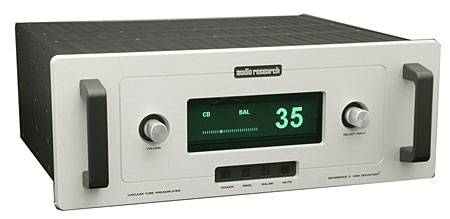
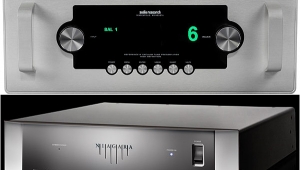
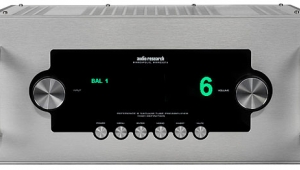
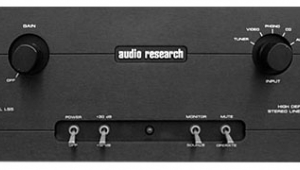
Audio Research Reference 3 line preamplifier
In any category of product or service, there is a gold standardone company that epitomizes the best in its field of endeavor. Consider the Rolex watch, the Ferrari sports car, the Steinway piano, the Dunhill pipe. All of these artisanal manufacturers have spent decades, even centuries, earning their names' cachet with their histories of consistent excellence. While high-end audio boasts no names with a 60-year pedigree, such as Ferrari'smuch less Steinway & Sons' +150 yearsthere is one firm whose storied past stretches back to the very emergence of the concept of high-end audio itself: Audio Research Corporation.
William Z. Johnson was building amplifiers long before he founded Audio Research. Should you be lucky enough to stumble on an Electronic Industries amplifier from the 1960s, consider yourself extremely fortunate. Electronic Industries was Bill Johnson's first nameplate, and in 1970 that enterprise evolved into Audio Research. Through the 1970s, when the transistor loomed monolithically over audio, it was Johnson and ARC that bravely, and at times solely, continued to fly the flag for the vacuum tube as a superior reproducer of sound. During those years, Johnson and ARC created a series of legendary preamplifiers and power amplifiers. Veteran audiophiles still recall with fondness the SP-3, SP-10, and SP-14 preamplifiers, and the D-79, D-150, and D-250 power amplifiers, to mention only a few of ARC's landmark components. A surprisingly large percentage of those units are still in service today, and ARC will still service every one. When a marque is as storied as Rolex, Dunhill, or Audio Research, the introduction of a new top-line product is something of a double-edged sword. Any new "statement" design is eagerly anticipated by a large and loyal coterie of enthusiasts, but with that comes the expectation that it will not only live up to but surpass the legacy of excellence established by its many illustrious predecessors and thus set a new standard of performance. The burden of history can weigh heavily, but the design team at ARC remains unintimidated by the weight of expectations.
Remake, remodel
Inside, everything is newpop the top and you see nothing but beefy construction and beautiful craftsmanship. Bill Johnson himself designed the power supply and all of the audio circuits. Four new circuit boards and two new transformers replace those used in the Ref.2 Mk.II. The audio circuit is all tube, fully differential, pure class-A, and wholly free of negative feedback. As in previous ARC Reference preamps, two pairs of 6H30 twin-triode tubes provide gain, and the power supply is fully tube-regulated. Outside the signal path, FETs are used for constant current sources, and ARC states that the long-tailed pair used in the Ref.3's input stage provides identical performance (save for the amount of gain) using either the balanced or the single-ended inputs. ARC's chief listener, Warren Gehl, informed me that the storage capacity of the Ref.3's power supply is 50% greater than that of ARC's 55Wpc VS55 power amplifier. And, unusually for a preamplifier, the Ref.3 is fitted with a 20-amp IEC connector. The full-function remote control offers a number of features not present on the sleek front panel, including mono summing and absolute-polarity inversion. While not overly fancy or weighty, the remote worked like a charm and was easy to use. It also gives access to a rare featurethe user can at any time check the number of hours the tubes have operated. ARC predicts a tube life of about 5000 hours, so this is more fun than strictly practical, but it did let me know with some accuracy that the lion's share of break-in was complete by 100 hours, and that the Ref.3 had entirely settled in by 200 hours. About the only luxe feature the Ref.3 doesn't offer is a way to offset and memorize each input's level. After a bit of twiddling around, the Ref.3 ended up sitting on my Ultra Resolution Technologies Bedrock stand, perched atop three Shun Mook IsoQubes. I can't be absolutely sure, but things seemed consistently just a shade purer and more relaxed with the IsoQubes. During my many months with the Ref.3, it behaved perfectly.
Ssssh!

Article Continues: Page 2 »
|
|
|||||||||||||||||||||||||||||||||||||||||||||||||