If any single link in the audio chain should be free of sonic personality, it's the preamplifier. Though a preamplifier's basic job description is "source selector with volume control," from hi-fi's earliest days preamps have been the designated dashboard: the more dials, switches, and lights, the better. All that control came at the cost of quiet, transparency, and tonal neutrality. Still, the quixotic quest for the mythical "straight wire with gain" continued to lead to minimalist designs, including impractical unbuffered "passive" preamps, in which cable length, thus capacitance, affected frequency response.
 With those issues under control, obsessives (love 'em!) turned their ears toward audible differences among volume pots, and from there to audible differences among the resistors used in stepped volume pots, and so on and so on, all in an attempt to eradicate the sonic degradation caused by the necessary preamplifier evils of having to switch among source components, control their output levels, and buffer the final outcome to prevent sonic degradation from driving long lengths of interconnect.
Given the complexity of the signal path used in the recording and mastering of even minimalist recordings, is this obsession with preamp purity misguided? I don't know the answer, but I can say that I've run the Manley Steelhead phono preamp, through its built-in volume control, directly to the power amps, as well as through its fixed output to various preamplifiers, and while each preamplifier has imparted a different character to the sound, for whatever reasons, my ears always preferred the preamplifier version to the volume control's buffered output.
Granted, nothing less than a top-shelf preamplifier was used in these comparisons, and I haven't compared any of them to a passive-obsessive design. The fact remains that every component in the signal path imparts some sort of character to the final sound. I've consistently found that running the signal into a separate preamplifier results in a musical picture that's more cohesive, more rhythmically gripping, and more musically holistic, even if all that is perhaps at the expense of ultimate transparency, and perhaps the loss of some detail. These are all personal value judgments that no audio reviewer can make for you.
BAT's Rex
With those issues under control, obsessives (love 'em!) turned their ears toward audible differences among volume pots, and from there to audible differences among the resistors used in stepped volume pots, and so on and so on, all in an attempt to eradicate the sonic degradation caused by the necessary preamplifier evils of having to switch among source components, control their output levels, and buffer the final outcome to prevent sonic degradation from driving long lengths of interconnect.
Given the complexity of the signal path used in the recording and mastering of even minimalist recordings, is this obsession with preamp purity misguided? I don't know the answer, but I can say that I've run the Manley Steelhead phono preamp, through its built-in volume control, directly to the power amps, as well as through its fixed output to various preamplifiers, and while each preamplifier has imparted a different character to the sound, for whatever reasons, my ears always preferred the preamplifier version to the volume control's buffered output.
Granted, nothing less than a top-shelf preamplifier was used in these comparisons, and I haven't compared any of them to a passive-obsessive design. The fact remains that every component in the signal path imparts some sort of character to the final sound. I've consistently found that running the signal into a separate preamplifier results in a musical picture that's more cohesive, more rhythmically gripping, and more musically holistic, even if all that is perhaps at the expense of ultimate transparency, and perhaps the loss of some detail. These are all personal value judgments that no audio reviewer can make for you.
BAT's Rex
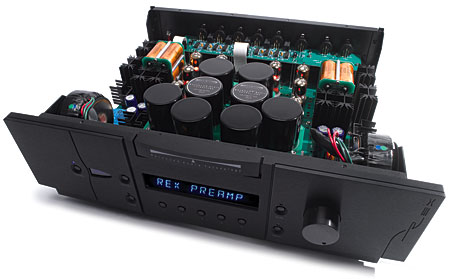
Balanced Audio Technology's dual-chassis Rex preamplifier ($18,500) features hefty control and power modules weighing 40 and 36 lbs, respectively, connected via two Neutrik-terminated umbilicals. Each receives power independently via separate AC cords because each contains a complete power supply for one polarity: negative in the power module, positive in the control module. This arrangement allows for close coupling of the power supply to the gain stage, while isolating the potentially noise-inducing parts of the circuit to the power module. The modules have symmetrical, mirror-imaged layouts. The power module, with five tubes and separate toroidal transformers for each channel, includes 5AR4 tube rectification and a choice of three current-source tubes.
Two 6C19 tubes per channel is standard for the Rex's signal amplification. Add the X-PAK accessory, which consists of an alternate pair of user-switchable current-source boards, and you can use 6H30 SuperTubes instead —or remove the standard board altogether and try 5881s. My review sample came with the standard 6C19 configuration, which BAT feels provides the best combination of sound and electrical performance. In addition, the power supply incorporates a choice of user-switchable AC shunt voltage-regulator tubes (6C45 or 6H30), used to clean the power-supply rails and reduce minute fluctuations in DC voltage. The final DC filtration stage uses BAT's newest custom oil capacitors. Inside the control module reside four 6H30 differential gain-stage tubes per channel. The grand total is 18 tubes, though for all intents and purposes it's 16: only the selected pair of AC shunt voltage-regulation tubes is active.
BAT's Unistage circuit features a single gain element with no buffers or followers and zero global negative feedback. The 16-bit, digital shunt-control –based volume control uses Vishay Bulk Metal resistors to provide 140 steps of 0.5dB each. The tubes are coupled to the output jacks with oil-filled capacitors. John Atkinson's measurements of earlier BAT products, including the similarly circuited VK-51SE preamplifier (November 2003, Vol.26 No.11), have shown that even though they are physically large, these oil-have limited capacitance that raises the Rex's LF output impedance well above the specified output impedance of 200 ohms. While that can roll off the low-frequency response into low-impedance loads, the problem is more theoretical than practical. The Rex should be compatible with most modern power amplifiers having an input impedance of 50k ohms or higher.
The Rex's build quality is superb inside and out, with cosmetics to match —all wholly commensurate with a preamp costing $18,500. No one buying a Rex will be disappointed with the thing itself, even if backlit buttons on the front panel and remote would have been pleasing additions.
Put on a happy interface
Along with its marriage of "lo-tech" vacuum-tube technology and modern microprocessor control, BAT also offers in the Rex the unusually complete and convenient user interface of their VK-51SE preamp, which Paul Bolin reviewed in November 2003. The five inputs are selectable via a horizontal array of buttons on the lower portion of the chassis center, just below the display, which can be set for four brightness levels or extinguished altogether. Two vertically arrayed buttons to the left of the display control Function and Phase, while two on the right do likewise for Mute and Mono. A small Standby button on the left and a large Volume control on the right complete the front-panel controls; all but Standby are duplicated on the remote control. While that may sound spare, the Function button is the key to the kingdom, and to customizing the Rex to your needs.
With those issues under control, obsessives (love 'em!) turned their ears toward audible differences among volume pots, and from there to audible differences among the resistors used in stepped volume pots, and so on and so on, all in an attempt to eradicate the sonic degradation caused by the necessary preamplifier evils of having to switch among source components, control their output levels, and buffer the final outcome to prevent sonic degradation from driving long lengths of interconnect.
Given the complexity of the signal path used in the recording and mastering of even minimalist recordings, is this obsession with preamp purity misguided? I don't know the answer, but I can say that I've run the Manley Steelhead phono preamp, through its built-in volume control, directly to the power amps, as well as through its fixed output to various preamplifiers, and while each preamplifier has imparted a different character to the sound, for whatever reasons, my ears always preferred the preamplifier version to the volume control's buffered output.
Balanced Audio Technology's dual-chassis Rex preamplifier ($18,500) features hefty control and power modules weighing 40 and 36 lbs, respectively, connected via two Neutrik-terminated umbilicals. Each receives power independently via separate AC cords because each contains a complete power supply for one polarity: negative in the power module, positive in the control module. This arrangement allows for close coupling of the power supply to the gain stage, while isolating the potentially noise-inducing parts of the circuit to the power module. The modules have symmetrical, mirror-imaged layouts. The power module, with five tubes and separate toroidal transformers for each channel, includes 5AR4 tube rectification and a choice of three current-source tubes.
Along with its marriage of "lo-tech" vacuum-tube technology and modern microprocessor control, BAT also offers in the Rex the unusually complete and convenient user interface of their VK-51SE preamp, which Paul Bolin reviewed in November 2003. The five inputs are selectable via a horizontal array of buttons on the lower portion of the chassis center, just below the display, which can be set for four brightness levels or extinguished altogether. Two vertically arrayed buttons to the left of the display control Function and Phase, while two on the right do likewise for Mute and Mono. A small Standby button on the left and a large Volume control on the right complete the front-panel controls; all but Standby are duplicated on the remote control. While that may sound spare, the Function button is the key to the kingdom, and to customizing the Rex to your needs.