What do you want from a 21st-century record-playing device? I hear you: you want one that's compact, well-made, easy to set up, holds its setup, sounds great, and doesn't cost a lot. 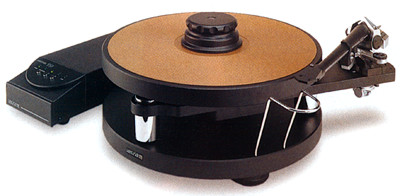 I'll tell you what I don't want: some kind of complex contraption. Some of you do. Fine—feel free to tweak and diddle to your heart's content. That's part of the fun of this hobby. For some analog addicts, a turntable that can't be adjusted in a hundred different ways can't possibly sound good. My experience with the SME 10 and a few other 'tables tells me otherwise. Looks familiar
When Wilson-Benesch issued its ACT tonearm a few years ago, the tapered armtube reminded many of the classic SME V arm. The new SME 10 turntable, strongly reminiscent of W-B's compact, ingenious Full Circle design (reviewed in November 1998, Vol.21 No.11), reverses the spin. But, as with the two arms, the similarities between these two turntables are only skin deep.
The "budget"-priced Full Circle with MDF base and acrylic platter costs $1995, including a Rega RB300 arm. While the 10 is SME's least expensive 'table, it costs a rather stiff $5500 without tonearm, and $5995 with the M10 arm. For that level of investment, you'd expect—and be entitled to—ultra-high-quality design and execution, as well as Class A sound. While the sonic performance of SME's tonearms has been the subject of much debate over the past decade or so, there's been no argument about their design integrity and build quality. It would not be hyperbole to say that SME has set the standard against which all other fixed-bearing tonearms are measured. Anyone familiar with the work of SME's Alastair Robertson-Aikman will tell you that the man and his company seem incapable of producing anything less than extraordinary in terms of machining precision and overall fit'n'finish. Would the Model 10 live up to my high expectations? As I watched Sumiko's Stirling Trayle unpack the box, I hoped so. (I could have set this baby up in my sleep, but it made him feel better to do so for me, so I let him. I'm a generous, giving kind of guy.)
A compact disc player
Taking up little more shelf space than an LP, the Model 10 turntable is a compact, plinthless, "non-floating" (ie, suspensionless) design, yet it weighs in at a hefty 35 lbs—a densely packed product. About a third of the weight is in the aluminum base, which rests on three precision-threaded, 2"-diameter feet fitted with custom-molded polymer inserts similar to Sorbothane or Navcom, but said to be more "liquid" than either. A cross-shaped aluminum subchassis weighing more than 5 lbs is suspended from three tall chrome-plated cylinders fitted with the same precision-molded isolating/damping polymer. The subchassis incorporates the arm-mounting platform and supports the tall bearing assembly, the bottom of which fits through an opening in the center of the subchassis below. The 9-lb aluminum-alloy platter is "extensionally" damped on both surfaces. In addition, the softer-than-an-LP Isodamp material applied to the record-playing side has been diamond-turned with a fine scroll pattern, which imparts a fiberlike finish said to improve record-to-platter intimacy. The damping compounds used in the 10 are made for SME by EAR, a Chicago-based polymer company that primarily supplies the automotive industry and the military.
The ¾"-diameter, threaded main spindle is machined from high-chrome tool steel, ground and "superfinished" and supported in a Sno-Cone-like tapered bearing. SME claims this increases longevity and minimizes bearing rock while providing a lower center of gravity for the entire assembly. A spiral channel in the bearing surface lifts oil to the top of the bearing well for effective lubrication. A tooled-steel ball fitted to the bearing bottom sits in a bronze thrust plate. The softer bronze allows effective seating and thus lowers bearing chatter. Drive is via a relatively thick, stiff, flat rubber belt identical to the one Linn uses. It rides on a crowned aluminum motor pulley and around the perimeter of the 10½" aluminum subplatter. The pulley is fixed to the motor shaft via three equidistant set screws, which helps ensure pulley concentricity. (I've seen single-set-screw pulleys on $10,000+ turntables. There is no excuse for this on such products—especially those that use multiple motors and pulleys.) The attention to every detail in the design and execution of this turntable is exemplary. For instance, the AC synchronous motor attaches to and is isolated from the base via three long pins, which fit into molded polymer sleeves inserted in holes in the motor housing. The pins are actually angled away from the spindle: when the belt is tensioned on the motor pulley and subplatter, the pins are pulled until they're perpendicular to the base.
The motor is driven by an outboard two-speed controller incorporating an 8-bit microprocessor and torque-maximizing MOSFET bridge circuit. Each speed has an integral, crystal reference that monitors the speed 120 times per revolution. According to the accompanying literature, the PLL (phase-locked loop) speed-control servo "has the effect of multiplying the rotating platter mass by the loop gain, thereby virtually eliminating dynamic wow caused by groove modulation/stylus drag." In plain English, this means that a mudslide in the grooves shouldn't slow this baby down.
I'll tell you what I don't want: some kind of complex contraption. Some of you do. Fine—feel free to tweak and diddle to your heart's content. That's part of the fun of this hobby. For some analog addicts, a turntable that can't be adjusted in a hundred different ways can't possibly sound good. My experience with the SME 10 and a few other 'tables tells me otherwise. Looks familiar When Wilson-Benesch issued its ACT tonearm a few years ago, the tapered armtube reminded many of the classic SME V arm. The new SME 10 turntable, strongly reminiscent of W-B's compact, ingenious Full Circle design (reviewed in November 1998, Vol.21 No.11), reverses the spin. But, as with the two arms, the similarities between these two turntables are only skin deep.
Taking up little more shelf space than an LP, the Model 10 turntable is a compact, plinthless, "non-floating" (ie, suspensionless) design, yet it weighs in at a hefty 35 lbs—a densely packed product. About a third of the weight is in the aluminum base, which rests on three precision-threaded, 2"-diameter feet fitted with custom-molded polymer inserts similar to Sorbothane or Navcom, but said to be more "liquid" than either. A cross-shaped aluminum subchassis weighing more than 5 lbs is suspended from three tall chrome-plated cylinders fitted with the same precision-molded isolating/damping polymer. The subchassis incorporates the arm-mounting platform and supports the tall bearing assembly, the bottom of which fits through an opening in the center of the subchassis below. The 9-lb aluminum-alloy platter is "extensionally" damped on both surfaces. In addition, the softer-than-an-LP Isodamp material applied to the record-playing side has been diamond-turned with a fine scroll pattern, which imparts a fiberlike finish said to improve record-to-platter intimacy. The damping compounds used in the 10 are made for SME by EAR, a Chicago-based polymer company that primarily supplies the automotive industry and the military.