

Photo: John Atkinson
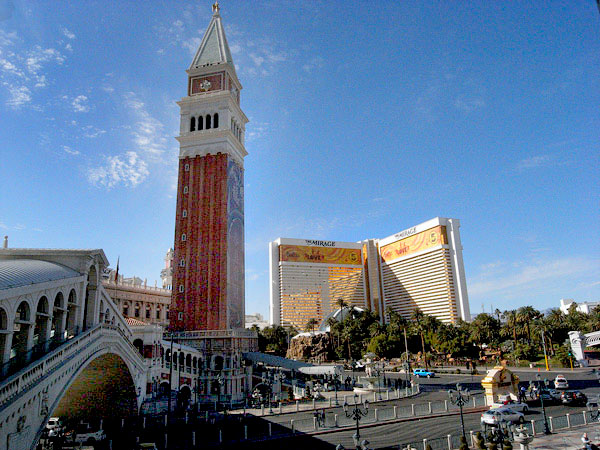
It looks sort of pretty, doesn't it?
Imagine how much prettier it would be if it were real. Imagine again how much prettier it would be if those bridges and roads and towers weren't there at all.
Every time I stepped from the slow elevator and onto the casino floor at Harrah's, where Stereophile's editors spent their sleepless nights, my hatred for Las Vegas was revitalized. This was like some kind of bad joke, some kind of post-modern torture. Oh, god, I am still here. I would turn right and see the same flashing lights, the same low ceilings, the same people who had been there the night before, still sitting, still smoking, still hoping, still staring blank-faced into spinning screens of cherries, spades, and jokers, and I would wonder why.
Why? Most people who visit Las Vegas seem to be looking for money, sex, drugs, or simple escape. Why are we here?
And later, after navigating the long lines and crowded elevators at the Venetian, where one could find the majority of high-end audio exhibits, I walked the seemingly endless halls, praying for invisibility, bobbing and weaving through dealers, distributors, manufacturers, and reps, who would, inevitably, see me, smile, pull me into their suite.
"It's great to see you, too, but I'm supposed to be covering budget amplification," I would protest.
"Ah, but we have this $10,000 amplifier..."
And I couldn't keep from wondering why. Why are we here?
Once free, I would begin my search again, remind myself of the room number I had been headed toward prior to being abducted, realize that that room is not on this floor at all, double back, this time declining the elevators in favor of the stairs because the stairs have got to be faster, down to the 28th floor, onto the elevators with their tiresome opera tunes piping from god knows where, to the lobby and through the casinos, through the smoke, past the manufacturers announcing angrily, impatiently, that no one from Stereophile had been to their room, past the long legs, the short skirts, the cleavage, wondering why. Why? Isn't there a better way than this?
***
A question to the manufacturers, dealers, distributors, marketing and public relations people, publishers, salesmen, editors, writers, bloggers, and anyone else who might be able to provide some insight: Why?
Why do we do this? Does it have to be this way? Is anyone happy? Is this fun? Is this love? Do we do this for love?
***
"Are you having any fun at all?" Jon Iverson asked me.
I looked at him quite seriously and shook my head. "I don't have fun at this show."
***
Maybe this is just work, one way of making money.
***
Some highlights:
1. Breakfast each morning with Jon Iverson and AudioStream's Michael Lavorgna. 2. Dinner with Jon and Michael on Monday night; chocolate milkshakes; Dinner with AudioQuest on Tuesday night; Dinner with MBL on Wednesday night; Dinner with Axiss USA on Thursday night; Dinner with John DeVore, Jonathan Halpern, and Michael Lavorgna on Friday night; duck confit; bacon-wrapped dates; Patrick Butler's sense of humor; the Public House. 3. Getting to thank TAD's Andrew Jones for one of the best hi-fi demonstrations I've ever experienced. Jones presented two complete TAD systems, one comprising the company's "entry-level" Evolution components and the other made of the cost-no-object Reference products. Chances are I'll never be able to afford either one of these systems, so, yes, it's fortunate that I'm in a position to nevertheless experience and enjoy them.
Far too often, however, the most impressive high-end audio products are subject to the absolute worst possible demonstrations, leaving the listener feeling confused, upset, disappointed, disrespected, frustrated, and/or altogether done with hi-fi. And for good reason. After the manufacturer has spent so much time, energy, and money creating an extremely expensive product, one that should perform at an extremely high level, the listener has every right to expect an overwhelmingly good demonstration of that product. In fact, the demonstration should be the simplest part of the entire process: Set the damn things up and play some good music; there's plenty of it in the world.
Why then do so many demonstrations fall miserably short of that simple goal? Put another way: Why do so many demonstrations, especially those of our most audacious products, suck?
Let me take a guess: Could it be that in our race to make money, we've forgotten the basics? Have we forgotten the love and respect owed to our customers, our products, and ourselves?
Do you see another reason for our failure? I don't.
Very happily, I can say that TAD's demonstration of their Evolution and Reference Series components easily exceeded my expectations, lived up to the promise of these undeniably expensive products. They performed in a way that wholly respected the music and the listener. Those who are able to afford such luxuries should be satisfied for a long, long time.
4. The surprisingly excellent HiFiMan press conference.
5. Getting to thank PSB's Paul Barton and Lenbrook's Mark Stone for keeping the affordable Alpha B1 loudspeaker ($299/pair) in production, unchanged, for over six years.
Longevity in an outstanding hi-fi component, especially one as affordable as the Alpha B1, is something to be congratulated.
Another question then: Why don't more hi-fi manufacturers offer this kind of respect and service to their products and customers?
6. Chatting with Scull Communications' Jonathan Scull.
7. Sitting aboard the Gibson tour bus.
8. Meeting readers. In person, people are almost always kind—very different from the personalities I often encounter on the internet.
9. Turning the volume way up and listening to Bruce Springsteen with Jeremy Bryan in his MBL suite, long after the show had closed for the day.
10. The Wharfedale Diamond 10.1 loudspeakers mated to Napa Acoustic electronics and cables.
11. Listening to music with Luke Manley and Bea Lam of VTL.
12. The monorail.
13. Running into Anton Dotson, an especially kind and thoughtful person, a lover of wine, music, and hi-fi, who along with his family and friends has exhibited at T.H.E. Show under the guise of NFS (Not For Sale) Audio for the past several years, recharging minds, bodies, ears, and souls with music, a smile, and a glass of something delicious.
In Anton's room, nothing is for sale. Listeners are invited to come in and relax, have a drink, enjoy a discussion, or just listen to music. There will be no favors asked of you, no so-called "long-term loans" extended under the table and around sideways glances—"Because we all know no one's making a lot of money in this business..."—no words spoken that would in any way make you feel uncomfortable or out of place.
Why does Anton do this? He does this, it seems clear to me, because he knows no other way. He does it out of love.
Anton reminded me of the basics. He enjoys being a part of T.H.E. Show for many reasons, noting especially the camaraderie among exhibitors, the willingness to share, the after-hours parties where guests are invited to come into rooms, music in hand, and simply listen for as long as they'd like.
That's the spirit of hi-fi I want to promote.
***
Some things I missed:
Snooki, Ludacris, 50 Cent, Justin Bieber, too many hi-fi exhibits to list. *** Some things to consider:
1. One loudspeaker manufacturer told me that this year's CES was a surprising success because it introduced his brand to new listeners. How? While in previous years he had mated his speakers to idiosyncratic tube amplifiers, this year he showed with a more well-known, more widely embraced brand. The results were entirely positive, and he may have gained a few new dealers—unambiguously good news. His speakers haven't changed, nor has his philosophy. The only thing that has changed is the way in which his products are perceived by certain audiophiles. What does this say about our hobby?
2. A rep for another loudspeaker manufacturer told me an interesting story. The rep was asked to give an after-hours demo for a potential customer. During the demo, he asked the listener, "Do you like what you hear?"
"Yes," the listener responded, "but I want this sound at 120dB."
The rep was taken by surprise, but not deterred. "In this business," he explained to me, "it's kinda like they say 'jump' and you say 'how high,' so I came up with some ideas..."
Setting aside the health hazards involved—listening to music at 120dB for an extended period of time is sure to cause permanent hearing damage—can we blame the rep for wanting to please his customer? Great amounts of money are at stake. Money is not an issue for the customer. He is a millionaire. But is he an audiophile?
Which reminds me: All sorts of people are drawn to hi-fi shows, and for all sorts of reasons. The hi-fi industry does not only serve music lovers and audiophiles, it serves those who want the security, real or imagined, of knowing that they have the best that money can buy. The hi-fi industry serves the 1%, people with money to burn.
3. Over the course of just a few days, in a single town, the annual Consumer Electronics Show brings together thousands of brands, big and small, allowing even the invisible to be seen, even the silent to be heard.
That should be a good thing, right?
***
In my mind, the questions remain: Why? Isn't there a better way?
For the hi-fi press, the goal, as I see it, is to report on all of the exhibitor rooms, in as thorough and thoughtful a fashion as possible. But this is a goal that, under the present circumstances, is impossible to achieve. The show would have to be a month-long event, and we would need a special breed of unemotional, tireless, exceptionally proficient writer, capable not only with the word, but also with the camera, owner of a smile that never falters, and perhaps with patience and cunning that never runs dry.
Or, we could choose to stay home. Why attend CES at all? Here, in New York City, Stereophile has access to many of the biggest names in hi-fi, as well as some of those creating the most idiosyncratic, hand-made, limited-edition products. We could choose to stay here and report at will, thus we'd be doing what we do anyway, over the course of many years.
And sacrifice the inevitable bump in web traffic? Forfeit the page views?
Doubtful.
And, anyway, what sort of message would we present to our industry if we chose to ignore CES? Manufacturers might assume we didn't care about them.
But, wait. Some of them already feel that way.
***
I listened more to people than to music in Las Vegas. Music in Las Vegas is an ugly sound: the grinding of gears, the jingle of loose change, a terrible hissing noise outside your hotel window—"Was it Paradigm?" someone asked. "No," I replied. "They fixed that."—the buzz and clang of temptation, desperation, desire, despair, poor men and women on the street, slapping business cards against their cold hands, promoting cheap sex—living, breathing, walking spam.
Hi-fi is about making music. CES is about making money.
I suppose the logical solution would be to simply continue doing what we've been doing. We will do our best, while acknowledging our limitations and taking into consideration the inevitable compromises and frustrations of a show like CES. As long as manufacturers of high-end audio choose to be a part of it, Stereophile will be there to cover it.
But from all those involved in high-end audio at the Consumer Electronics Show, I still want to know: Why do we do this? Isn't there a better way?
Maybe there isn't.
But if there is a better way, why aren't we pursuing it?
1. Breakfast each morning with Jon Iverson and AudioStream's Michael Lavorgna. 2. Dinner with Jon and Michael on Monday night; chocolate milkshakes; Dinner with AudioQuest on Tuesday night; Dinner with MBL on Wednesday night; Dinner with Axiss USA on Thursday night; Dinner with John DeVore, Jonathan Halpern, and Michael Lavorgna on Friday night; duck confit; bacon-wrapped dates; Patrick Butler's sense of humor; the Public House. 3. Getting to thank TAD's Andrew Jones for one of the best hi-fi demonstrations I've ever experienced. Jones presented two complete TAD systems, one comprising the company's "entry-level" Evolution components and the other made of the cost-no-object Reference products. Chances are I'll never be able to afford either one of these systems, so, yes, it's fortunate that I'm in a position to nevertheless experience and enjoy them.
Snooki, Ludacris, 50 Cent, Justin Bieber, too many hi-fi exhibits to list. *** Some things to consider:
1. One loudspeaker manufacturer told me that this year's CES was a surprising success because it introduced his brand to new listeners. How? While in previous years he had mated his speakers to idiosyncratic tube amplifiers, this year he showed with a more well-known, more widely embraced brand. The results were entirely positive, and he may have gained a few new dealers—unambiguously good news. His speakers haven't changed, nor has his philosophy. The only thing that has changed is the way in which his products are perceived by certain audiophiles. What does this say about our hobby?















