


Natural sounds produce different waveshapes during their positive and negative phases, and playback-system polarity reversal often changes the reproduced sound. Does this mean our ears are phase-responsive, or is there something else here we've been overlooking?
There has been much discussion recently among perfectionists about the importance of what is called "absolute phase" in sound reproduction (footnote 1). Basically, the contention has been that, since many musical sounds are asymmetrical (having different waveforms during positive and negative phases), it is important that a system make the proper distinctions between positive (compression) and negative (rarefaction) phases in playback.
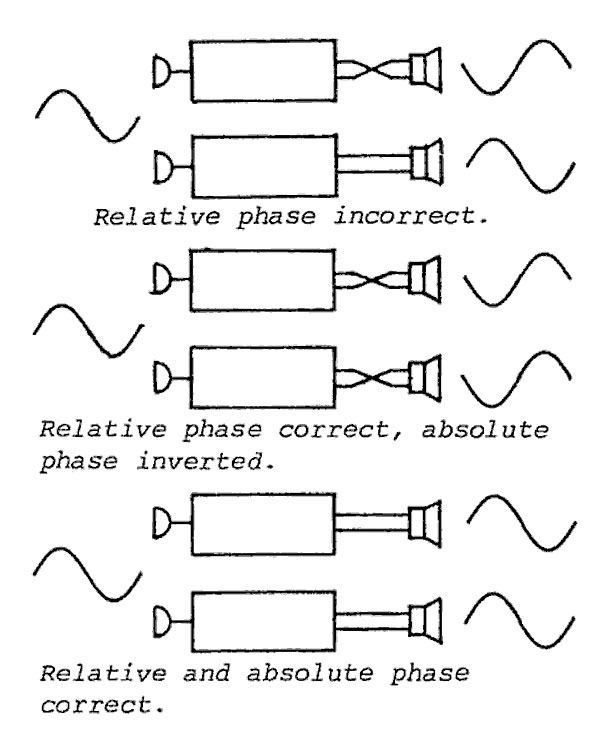
There is no disputing the asymmetrical waveforms. Oscilloscope traces clearly show the upper and lower portions of instrumental waveforms to be quite different (fig.1), and it is obvious that the initial strike of a kettle-drum head will cause a rarefaction wave while the impact transients of clapped hands during applause will cause compression waves. But what has never been conclusively answered is the question: Do our ears perceive these polarity differences? If they don't, then absolute phase reversal in music reproduction should cause no audible change in the sound. If it does, then it seems reasonable to assume that our ears are indeed responsive to polarity, and it becomes important to ensure that a reproducing system maintain the original-sound polarities, reproducing compression waves as compressions and rarefaction waves as rarefactions (fig.2). (Absolute system phasing must not be confused with relative phasing, fig.3.)


 Our suspicions that something might be amiss here were brought to a head when we started conducting listening tests on DB Systems' DB-7 phase-reverse box. Those initial auditions were done with the Berning TF-10 preamplifier, the Infinity HCA power amplifier, and Infinity's RS-4.5 speaker system in single-amplifier (non-biamped) mode. We fully expected the usual audible difference—not what we would call dramatic, but markedly audible, nonetheless. Instead, we were hard-pressed to hear any difference at all, from any recording we tried (including discs and original master tapes that had been miked for maximum phase coherence). And in most cases, the polarity which sounded "more correct" at one moment sounded less so the next. The best we could manage on blind switching was a bland statistical 50%, which is another way of saying we could not really distinguish at all between one polarity condition and the other.
The clear implication was that our ears were simply not responding to the polarity reversals. Yet, on previous occasions, we had heard obvious changes when the connections to both speakers were reversed. So, we removed the DB-7 and tried reversing the speaker connections. Still no change.
Then, on a hunch, we tried substituting a cheap-and-dirty pair of compact speakers for the Infinity 4.5s. And Lo, there was an obvious difference when we reversed their polarity. And would you believe, one position sounded consistently better than the other! So we tried some other transducers we had on hand, including headphones that ranged from excellent to decidedly mediocre. The results were almost perfectly consistent with what we felt we knew about those transducers: The better they were, the less difference was noted when polarity was reversed!
An Experiment
Our suspicions that something might be amiss here were brought to a head when we started conducting listening tests on DB Systems' DB-7 phase-reverse box. Those initial auditions were done with the Berning TF-10 preamplifier, the Infinity HCA power amplifier, and Infinity's RS-4.5 speaker system in single-amplifier (non-biamped) mode. We fully expected the usual audible difference—not what we would call dramatic, but markedly audible, nonetheless. Instead, we were hard-pressed to hear any difference at all, from any recording we tried (including discs and original master tapes that had been miked for maximum phase coherence). And in most cases, the polarity which sounded "more correct" at one moment sounded less so the next. The best we could manage on blind switching was a bland statistical 50%, which is another way of saying we could not really distinguish at all between one polarity condition and the other.
The clear implication was that our ears were simply not responding to the polarity reversals. Yet, on previous occasions, we had heard obvious changes when the connections to both speakers were reversed. So, we removed the DB-7 and tried reversing the speaker connections. Still no change.
Then, on a hunch, we tried substituting a cheap-and-dirty pair of compact speakers for the Infinity 4.5s. And Lo, there was an obvious difference when we reversed their polarity. And would you believe, one position sounded consistently better than the other! So we tried some other transducers we had on hand, including headphones that ranged from excellent to decidedly mediocre. The results were almost perfectly consistent with what we felt we knew about those transducers: The better they were, the less difference was noted when polarity was reversed!
An Experiment
Pursuing this further, we then conducted an experiment of dubious scientific value but having interesting consequences nonetheless. We obtained several inexpensive cone-type drivers, un-baffled, propped each one (in turn) on its side (as it would be if mounted in an enclosure), placed a probe mike in front of the cone, and fed a warbled 1kHz sinewave to it, observing its measured output on a VTVM. Then we used fingers to hold the cone a measured distance (1/8") behind, and then in front of, its normal at-rest position. With two of the speakers, the 1kHz level was almost 2dB lower at one excursion extreme than at the other. In other words, they exhibited a nonlinearity which was compressing the signal level more in one excursion direction than in the other (fig.4). And when we got around to listening to those speakers (still un-baffled), the ones which showed the greatest output difference at the two cone positions rewarded us by producing the greatest audible change when their polarity was reversed!
 Summing Up
It would appear then that the necessity for absolute phasing of a system arises in direct proportion to the amount of asymmetrical nonlinearity it introduces, and that the more significant absolute phasing is found to be, the more transducer asymmetry is present. We can, on the other hand, find no evidence to support the contention that our ears can "tell" whether a reproduced sound field is a replica of the original or is inverted in phase. Thus, absolute phase is apparently one of the few audiophile concerns which is actually of no significance, except insofar as it may subjectively improve the sound of systems whose transducers exhibit asymmetrical nonlinearities. If loudspeakers exhibit this shortcoming, it is reasonable to assume that it afflicts many microphones also, as well—possibly—as circuits incorporating certain configurations of cathode- or emitter-follower outputs. The asymmetrical nonlinearities of these can be expected however to be of many orders of magnitude smaller than those caused by some loudspeakers, so it is pointless to pursue them until the majority of loudspeakers are clean enough to show them up. (For the benefit of those readers who wish to try some of our tests for their own edification, we suggest trying Stax SRX, Infinity ES-1, and Audio Technics TK-33 headphones. If you can tell from these which polarity is which, more than 50% of the time on a blind test (footnote 2), let us know and we'll reconsider our position.
Footnote 1: "Absolute Polarity" is an alternative and more pedantically correct nomenclature.—Ed. Footnote 2: Track 8 on the first Stereophile Test CD allows listeners to test for themselves if they can detect reversals in absolute polarity.—Ed.
Fig.1 The waveform of a violin tone.
Fig.2 When overall absolute phasing is incorrect, air compression and rarefaction phases are inverted.
Fig.3 The distinctions between relative and absolute system phasing.
Many audiophiles who have taken the trouble to experiment with absolute phasing (by reversing the polarity of both pairs of speaker leads) have reported that there is indeed an audible difference, and that in many cases, one system polarity sounds "better" than the other. The conclusion, of course, has been that our ears do respond to polarity, ergo absolute phase is a significant audio-system parameter. There is mounting evidence to suggest that this is not the case.
The differences that are observed when system polarity is reversed—changes in the apparent distance, depth, and "aliveness" of most instruments—have been reported with a disturbing lack of consistency. Some have claimed to hear "dramatic" differences, others whose hearing acuity seems no less well developed have reported very little change or, in a number of cases, no consistent change at all (ie, one polarity sounds right sometimes, the other sounds right other times). Ignoring for the moment the fact that one listener's subtlety is another's "dramatic difference," it would seem that this lack of consistency in the observation of something that ostensibly affects the middle range, where everyone's hearing tends to be most receptive to small changes, must cast some doubts as to whether in fact polarity changes are causing the audible changes.
Note also that there has been no effort made, in any quarter, to actually verify whether what sounds like the correct absolute phase does in fact correspond to the original sound-wave polarity. The "correct" polarity is cited as that which brings the sound forward—a dubious contention when we consider the fact that a common failing of most "perfectionist" systems is a tendency to back sounds away from the listener. (This is called richness and depth.)
Pursuing this further, we then conducted an experiment of dubious scientific value but having interesting consequences nonetheless. We obtained several inexpensive cone-type drivers, un-baffled, propped each one (in turn) on its side (as it would be if mounted in an enclosure), placed a probe mike in front of the cone, and fed a warbled 1kHz sinewave to it, observing its measured output on a VTVM. Then we used fingers to hold the cone a measured distance (1/8") behind, and then in front of, its normal at-rest position. With two of the speakers, the 1kHz level was almost 2dB lower at one excursion extreme than at the other. In other words, they exhibited a nonlinearity which was compressing the signal level more in one excursion direction than in the other (fig.4). And when we got around to listening to those speakers (still un-baffled), the ones which showed the greatest output difference at the two cone positions rewarded us by producing the greatest audible change when their polarity was reversed!
Fig.4 How excursion nonlinearity compresses half of a symmetrical input.
Why would excursional nonlinearity seem to change the tonal balance of reproduced sound? Probably because, in most asymmetrical signals, one half of the waveform conveys more middle-range energy than the other (fig.5). And when that predominantly-mid-range half-cycle is reproduced by the cone-excursion range which exhibits nonlinear compression, the result is an actual attenuation of those middle-range frequencies.
Fig.5 One half of this waveform has more middle-range content than the other.
But wouldn't such nonlinearity show up clearly on conventional harmonic-distortion tests? Certainly it would, and almost certainly does. Rarely does any loudspeaker driver measure below 0.5% harmonic distortion at moderate to high listening levels; never to our knowledge has anyone endeavored to pin down the source of the nonlinearities which are causing such relatively high readings. They could stem from asymmetrical nonlinearity.
It would appear then that the necessity for absolute phasing of a system arises in direct proportion to the amount of asymmetrical nonlinearity it introduces, and that the more significant absolute phasing is found to be, the more transducer asymmetry is present. We can, on the other hand, find no evidence to support the contention that our ears can "tell" whether a reproduced sound field is a replica of the original or is inverted in phase. Thus, absolute phase is apparently one of the few audiophile concerns which is actually of no significance, except insofar as it may subjectively improve the sound of systems whose transducers exhibit asymmetrical nonlinearities. If loudspeakers exhibit this shortcoming, it is reasonable to assume that it afflicts many microphones also, as well—possibly—as circuits incorporating certain configurations of cathode- or emitter-follower outputs. The asymmetrical nonlinearities of these can be expected however to be of many orders of magnitude smaller than those caused by some loudspeakers, so it is pointless to pursue them until the majority of loudspeakers are clean enough to show them up. (For the benefit of those readers who wish to try some of our tests for their own edification, we suggest trying Stax SRX, Infinity ES-1, and Audio Technics TK-33 headphones. If you can tell from these which polarity is which, more than 50% of the time on a blind test (footnote 2), let us know and we'll reconsider our position.
Footnote 1: "Absolute Polarity" is an alternative and more pedantically correct nomenclature.—Ed. Footnote 2: Track 8 on the first Stereophile Test CD allows listeners to test for themselves if they can detect reversals in absolute polarity.—Ed.















