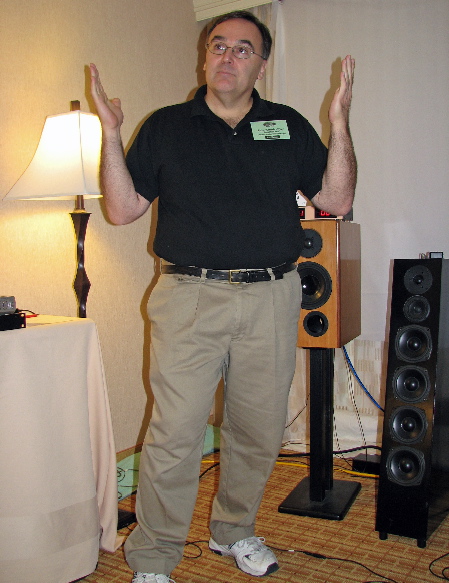
As mentioned in the
introductory post to this blog, Peter "PJay" Smith (above), Bob Cordell, and Darren Kuzma presented gratis "Amplifier and Loudspeaker Listening and Measurement" clinics throughout the show. One of the clinics, which I was unable to attend, interpreted amplifier measurement data supplied by
Stereophile's John Atkinson.
I finally made it to the room today just as Peter Smith was concluding his A/B amplifier experiment. Before us sat a classic KT-88 tube amp, similar to one McIntosh would have sold
circa 1970. To its right sat a typical, "pretty nice" (according to Peter) 250Wpc solid-state amp.
Choosing a CD track that a number of workshop attendees said sounded different depending upon the amp, Peter proceeded to invite the man to my left to switch between amps as he wished. As he switched, a green light went on when one of the amps was in use, and went off when the other amp was in the circuit. We were not told which amp activated the green light. Our goal was to decide whether the tube amp or its solid-state counterpart was in the circuit when the green light was on.
Having been tarred, feathered, and roasted on several forums for previously failing a blind A/B power cable test I once organized and sponsored, I was more than a bit wary of this test. (Don’t get me started on the inherent shortcomings and inadequacies of blind testing in general, and of the power cable test's protocol and methodology in particular). Nonetheless, once we got going, I was certain that I could hear differences between the two amps. I was also certain that I preferred the amp that activated the green light. Yet, concerned that Peter might have pulled a fast one on us,
ie, chosen a flatter, less liquid-sounding tube amp with more attenuated highs and a less airy presentation than its solid-state counterpart, I was uncomfortable saying out loud which I thought was which. I did agree, however, to state my preference if I could clearly hear a difference.
After round one, during which I preferred the amp that activated the green light, I chose a track from the extended Savall family's beautiful period instrument CD,
du temps et l’instant. This time I was handed the switching mechanism. To these ears, differences between amps were as equally discernable as in the first test. My preference remained unchanged.
As I discovered, the unintended trick to this test, which resulted from circumstance rather than conscious design, was not that the solid-state amp sounded more "tube-like" than the tube amp. Rather, due to room/speaker interaction in a small hotel room, the tube amp sounded brighter on top than the solid-state amp. This threw off those who believed that tubes would always sound mellower than solid-state. Those who focused on air, liquidity, and three-dimensionality, and were familiar with the possible sonic consequences of tube equipment that does not attenuate highs, had a far easier time of it.
[
So Jason: was it the tube amplifier or the solid-state amplifier that lit the green light for you?—JA]