


Because I'm ill-disposed to flying—when you get right down to it, I'm not wild about traveling in general—I usually go by train. That's where I'm working on this portion of my CAF 2017 coverage. (We're near Trenton, New Jersey as I write this.)
One of the great things about train travel is that it's conducive to writing: I spread all of my handwritten notes and the brochures and business cards I've collected on the seat next to me—this also serves to discourage potential seatmates, some of whom enjoy conversation—then power up my laptop and get to it. But: Often I rifle through that pile of paper only to discover holes in my note-taking, at which point panic sets in.
 So it was with Massachusetts-based Bricasti Design, whose DACs have impressed John Marks, John Atkinson, and me, among others. Thankfully, Bricasti is easy to write about, in part because company co-founder Brian Zolner is a pleasant and intelligent human being and a man whose point of view makes an impression. And that point of view says: DSD is superior to PCM in playback quality.
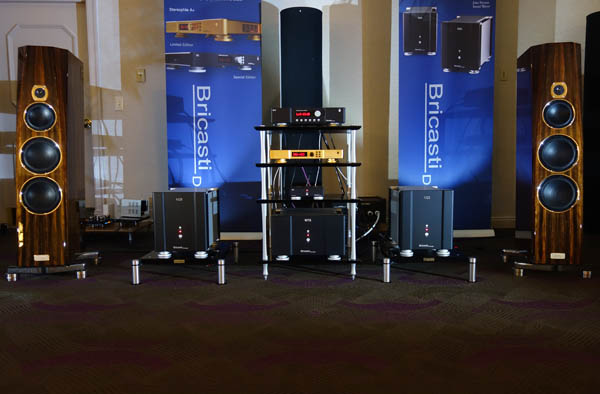
Brian and I had chatted about that prior to my arrival in the Bricasti room, and I already knew that he's especially fond of orchestral music—so when I arrived, I got what I expected: A/B comparisons between DSD and PCM files of the same orchestral recordings. Both sounded colorful and stirring through Tidal Contriva G2 speakers ($65,900/pair in veneer, as shown), driven, via Oyaide cables, by Bricasti's M28 monoblock power amplifiers ($30,000/pair) and M12 preamp/DAC, which is new. But while Brian consistently preferred the DSD files, which were inarguably better in their portrayal of room ambience, I found most of the PCM material to be more convincing in terms of momentum and drive, and thus musical involvement.
So it was with Massachusetts-based Bricasti Design, whose DACs have impressed John Marks, John Atkinson, and me, among others. Thankfully, Bricasti is easy to write about, in part because company co-founder Brian Zolner is a pleasant and intelligent human being and a man whose point of view makes an impression. And that point of view says: DSD is superior to PCM in playback quality.
Brian and I had chatted about that prior to my arrival in the Bricasti room, and I already knew that he's especially fond of orchestral music—so when I arrived, I got what I expected: A/B comparisons between DSD and PCM files of the same orchestral recordings. Both sounded colorful and stirring through Tidal Contriva G2 speakers ($65,900/pair in veneer, as shown), driven, via Oyaide cables, by Bricasti's M28 monoblock power amplifiers ($30,000/pair) and M12 preamp/DAC, which is new. But while Brian consistently preferred the DSD files, which were inarguably better in their portrayal of room ambience, I found most of the PCM material to be more convincing in terms of momentum and drive, and thus musical involvement.
 While continuing my rounds on the hotel's third floor, I entered the Lincoln Room—sponsored by Tenacious Sound—at a time when they were demonstrating with various Mobile Fidelity LPs titles, past and present. I confess to swimming against the stream when it comes to Tom Waits in general and the One from the Heart soundtrack in particular—their appeal is hidden from me—but the sound of MoFi's out-of-print LP of that recording sounded delightful, the singing voices of Waits and Crystal Gayle sounding especially real and present. Doing the honors were TAD's Evolution One Power loudspeakers ($29,995/pair), driven by their own M2500 power amp ($24,000) and C3000 preamp/DAC ($29,000), with Black Cat cables and power-conditioning products from Isotek. LPs were played on a Mobile Fidelity Ultradeck turntable with Ultradeck cartridge ($1999), feeding a Heed Quasar phono preamp ($1200).
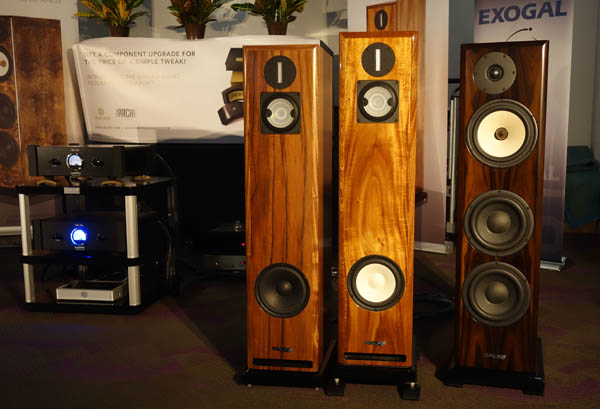 In the Monroe Room, where Salk Song 3A loudspeakers ($3900/pair) were driven by a Wells Majestic integrated amplifier ($3600), itself fed by a Salk streamer/player ($1700) and Exogal Comet DAC ($3000), Vinh Vu of Gingko Audio demonstrated his latest product: a curved, rigid isolation foot, sold in sets, called the ARCH. (The first three letters stand for Acoustic Resonance Clarifier; the H is left unexplained.) In fact, there were two pairs of those Salk speakers, and two Wells amplifiers, to facilitate comparison tests with a minimum of fiddly.
Used under the speakers, the large ARCHes ($400/set of 8) did seem to make the music sound richer and more present, and a little more dynamically nuanced; that said, I wasn't sure that the two setups were perfectly level-matched with one another, so I can't say for sure. (And in any event, while playing "Bird on the Wire" from Jennifer Warnes' Famous Blue Raincoat, that nice system sounded good both with and without the Gingko supports, the small version of which costs $300 for a set of 12.
In the Monroe Room, where Salk Song 3A loudspeakers ($3900/pair) were driven by a Wells Majestic integrated amplifier ($3600), itself fed by a Salk streamer/player ($1700) and Exogal Comet DAC ($3000), Vinh Vu of Gingko Audio demonstrated his latest product: a curved, rigid isolation foot, sold in sets, called the ARCH. (The first three letters stand for Acoustic Resonance Clarifier; the H is left unexplained.) In fact, there were two pairs of those Salk speakers, and two Wells amplifiers, to facilitate comparison tests with a minimum of fiddly.
Used under the speakers, the large ARCHes ($400/set of 8) did seem to make the music sound richer and more present, and a little more dynamically nuanced; that said, I wasn't sure that the two setups were perfectly level-matched with one another, so I can't say for sure. (And in any event, while playing "Bird on the Wire" from Jennifer Warnes' Famous Blue Raincoat, that nice system sounded good both with and without the Gingko supports, the small version of which costs $300 for a set of 12.
 Richmond, Virginia-based manufacturer Fern & Roby impressed me two years ago, when I first encountered them at Capital Audiofest 2015; from what I saw and heard at CAF 2017, they have more than lived up to my high expectations, continuing to combine innovative, one-of-a-kind design work with decidedly artisanal build quality. Chief designer Christopher Hildebrand doesn't make me-too products—but neither is he trying to be different for the sake of being different: to hear him explain his products is to know that every design decision, whether functional or aesthetic, is made for a reason. In that sense, his products are at once very progressive and very conservative.
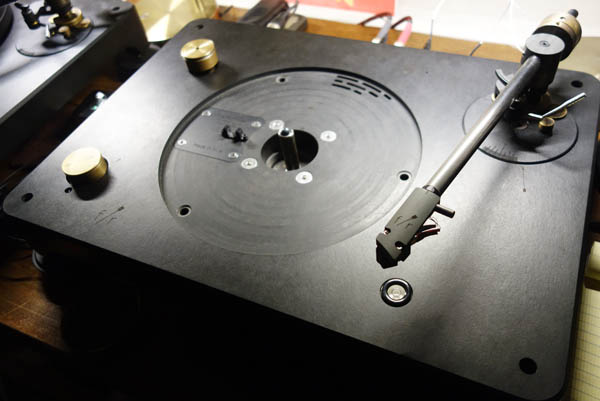
An example: Fern & Roby's tonearm, seen above on the company's recent Montrose turntable ($4950 for the combination—the tonearm is not sold separately) has now been updated with easily adjustable azimuth and spindle-to-pivot distance, and the female portion of its unipivot bearing has been refined to include a machined-in structure that prevents "wobble" during handling, and makes setup easier for the user. And because Fern & Roby offer a new phono preamp, which is available not only in its own casework but also as an onboard module for the company's turntable—it's priced at $650 for the former, $500 for the latter—Hildebrand made sure to add vents between the platter and the below-board preamp, so the former can create a Venturi effect that will cool the latter. Cool, indeed. (BTW, the Fern & Roby phono pre is on its way for review.)
Richmond, Virginia-based manufacturer Fern & Roby impressed me two years ago, when I first encountered them at Capital Audiofest 2015; from what I saw and heard at CAF 2017, they have more than lived up to my high expectations, continuing to combine innovative, one-of-a-kind design work with decidedly artisanal build quality. Chief designer Christopher Hildebrand doesn't make me-too products—but neither is he trying to be different for the sake of being different: to hear him explain his products is to know that every design decision, whether functional or aesthetic, is made for a reason. In that sense, his products are at once very progressive and very conservative.
An example: Fern & Roby's tonearm, seen above on the company's recent Montrose turntable ($4950 for the combination—the tonearm is not sold separately) has now been updated with easily adjustable azimuth and spindle-to-pivot distance, and the female portion of its unipivot bearing has been refined to include a machined-in structure that prevents "wobble" during handling, and makes setup easier for the user. And because Fern & Roby offer a new phono preamp, which is available not only in its own casework but also as an onboard module for the company's turntable—it's priced at $650 for the former, $500 for the latter—Hildebrand made sure to add vents between the platter and the below-board preamp, so the former can create a Venturi effect that will cool the latter. Cool, indeed. (BTW, the Fern & Roby phono pre is on its way for review.)
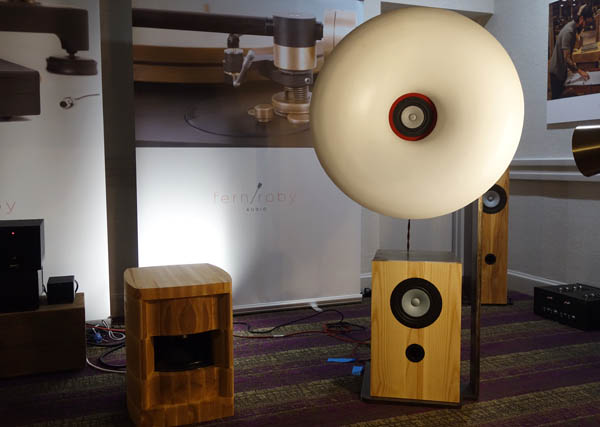 Also new from Fern & Roby is their forthcoming horn loudspeaker, comprising a Mark Audio driver in a fiberlass horn—designed by CAF founder Gary Gill, who fabricated the sample seen here—that reproduces frequencies from 1200Hz and up; a larger, reflex-loaded driver in a cabinet with brass veneer to its top and sides ("For performance, and because [wood]-veneered cabinets do not age gracefully," according to Hildebrand), for the range between 70 and 120Hz; and a self-powered sub containg two 15" woofers for frequencies below 70Hz, driven through an outboard electronic crossover with separate level controls for the three drivers/driver groups.
Although I couldn't listen for nearly as long as I wanted to, a quick listen to Cat Stevens' "Where Do the Children Play?" made it clear that the Fern & Roby horn is well-balanced, free from glaring tonal aberrations, and capable of the most important of all horn characteristics—the ability to make all instrumental sounds, and especially percussion, sound like they were produced by human force, as opposed to just appear, ether-like, between the speakers.
Also new from Fern & Roby is their forthcoming horn loudspeaker, comprising a Mark Audio driver in a fiberlass horn—designed by CAF founder Gary Gill, who fabricated the sample seen here—that reproduces frequencies from 1200Hz and up; a larger, reflex-loaded driver in a cabinet with brass veneer to its top and sides ("For performance, and because [wood]-veneered cabinets do not age gracefully," according to Hildebrand), for the range between 70 and 120Hz; and a self-powered sub containg two 15" woofers for frequencies below 70Hz, driven through an outboard electronic crossover with separate level controls for the three drivers/driver groups.
Although I couldn't listen for nearly as long as I wanted to, a quick listen to Cat Stevens' "Where Do the Children Play?" made it clear that the Fern & Roby horn is well-balanced, free from glaring tonal aberrations, and capable of the most important of all horn characteristics—the ability to make all instrumental sounds, and especially percussion, sound like they were produced by human force, as opposed to just appear, ether-like, between the speakers.
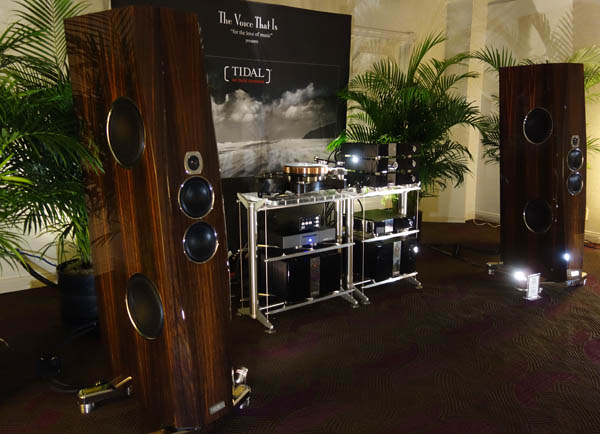 As I believe I have suggested before: There are good set-up people, there are great set-up people, and then there is Doug White, properietor of the Newtown Square, Pennsylvania-based salon The Voice That Is, who can make a playback system sing like no one else in my experience. So it was at CAF 2017, where Doug played music on a system comprising: a Transfiguration Proteus phono cartridge ($6000) in a TW-Acustic tonearm ($5490), mounted on a TW-Acustic Raven Anniversary turntable ($22,000); an Antipodes DX Gen 3 music server ($7750 and up, depending on onboard storage); Tidal Audio's Camira DMC D/A converter ($28,500), along with their Presencio Reference preamp ($77,900) and Ferios mono amplifiers ($67,900/pair; the Tidal Agoria loudspeaker ($109,000/pair in Midnight Black); and various Tidal power cords, interconnects, USB cables, and speaker cables, also new to the company's product line.
After listening to a couple of selections by the Ray Brown Trio, I scribbled in my listening notes: "Maybe the real thing would sound a little more rawboned, their timing a little more unpredictable, maybe even dangerous—maybe—but this system on this song captured the sound of a jazz piano as well as and probably better than any other playback I've heard." Breathtaking, if breathtakingly expensive.
As I believe I have suggested before: There are good set-up people, there are great set-up people, and then there is Doug White, properietor of the Newtown Square, Pennsylvania-based salon The Voice That Is, who can make a playback system sing like no one else in my experience. So it was at CAF 2017, where Doug played music on a system comprising: a Transfiguration Proteus phono cartridge ($6000) in a TW-Acustic tonearm ($5490), mounted on a TW-Acustic Raven Anniversary turntable ($22,000); an Antipodes DX Gen 3 music server ($7750 and up, depending on onboard storage); Tidal Audio's Camira DMC D/A converter ($28,500), along with their Presencio Reference preamp ($77,900) and Ferios mono amplifiers ($67,900/pair; the Tidal Agoria loudspeaker ($109,000/pair in Midnight Black); and various Tidal power cords, interconnects, USB cables, and speaker cables, also new to the company's product line.
After listening to a couple of selections by the Ray Brown Trio, I scribbled in my listening notes: "Maybe the real thing would sound a little more rawboned, their timing a little more unpredictable, maybe even dangerous—maybe—but this system on this song captured the sound of a jazz piano as well as and probably better than any other playback I've heard." Breathtaking, if breathtakingly expensive.
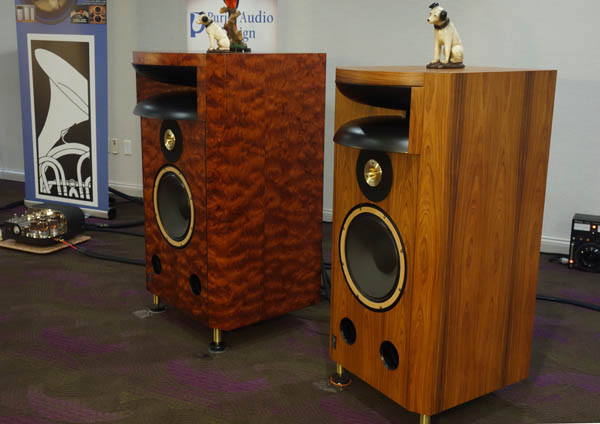 I always look forward to seeing John Wolff at Capital Audiofest and listening to his vintage-inspired Classic Audio loudspeakers. Unfortunately, throughout my visit to his demonstration room, John was busy with customers—so, barring input from John Wolff (which I welcome!), I can't tell you which models are shown here.
 But I can say that, driven by output-transformer-less monoblock amplifiers and a tubed preamplifier from Atma-Sphere, fed by a Kuzma turntable-tonearm combination, the system filled this enormous room with the sort of tactile-high-impact sound that only well-designed horns and field-coil-energized drivers seem capable of supplying
 In the Adams room was a system featuring electronics from Dynamic Sounds Associates, including their Phono II phono premplifier ($13,500), Pre I line-level preamplifier ($16,500), and Amp I monoblock power amplifiers ($25,000/pair). LPs were played on a VPI Avenger reference with Magnetic Drive and metal and 3D-printed arms ($30,000, including three arms), with Ortofon MC A95 ($6500), Ortofon Candenza Mono ($1280), Miyajima Madake (($5995), and Miyajima Zero-Mono ($1995) cartridges. Loudspeakers were Studio Electric's FSX three-way floorstanders ($11,500/pair), with cabling from Tweek Geek and a variety of accessories.
More important than bringing good gear, these guys brought to the show real records—the kind that normal people buy and play!—and I especially enjoyed the convincingly present and thoroughly righteous sound of an acoustic blues duet featuring Junior Wells and Keb' Mo'.
In the Adams room was a system featuring electronics from Dynamic Sounds Associates, including their Phono II phono premplifier ($13,500), Pre I line-level preamplifier ($16,500), and Amp I monoblock power amplifiers ($25,000/pair). LPs were played on a VPI Avenger reference with Magnetic Drive and metal and 3D-printed arms ($30,000, including three arms), with Ortofon MC A95 ($6500), Ortofon Candenza Mono ($1280), Miyajima Madake (($5995), and Miyajima Zero-Mono ($1995) cartridges. Loudspeakers were Studio Electric's FSX three-way floorstanders ($11,500/pair), with cabling from Tweek Geek and a variety of accessories.
More important than bringing good gear, these guys brought to the show real records—the kind that normal people buy and play!—and I especially enjoyed the convincingly present and thoroughly righteous sound of an acoustic blues duet featuring Junior Wells and Keb' Mo'.
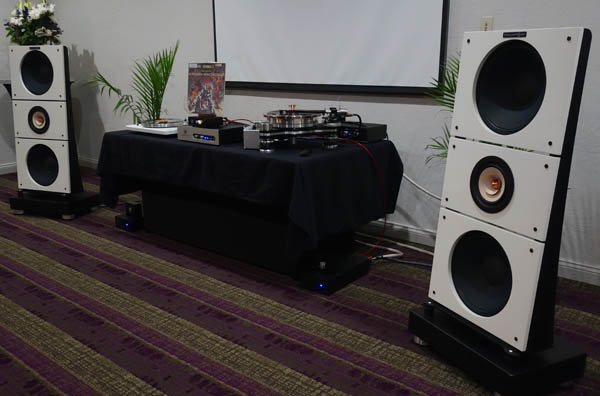 In another situation where, unfortunately, I wasn't able to speak with the manufacturers during my visit to their room—when I visited the VPI room, the father and son team of Harry and Mat Weisfeld were busy conducting a demonstration for a packed room, and my own time limitations, plus a healthy number of exhibitors, made it impossible to visit any rooms more than once—I had to let the music do all the talking. In this case, that was a pleasure. Selections from Joe Jackson's Summer in the City: Live in New York, including the title cover song, sounded great in the best possible way: I forgot to think about hi-fi, because the music was so much fun to listen to. (Well, I did catch myself admiring the clarity of the electric bass lines played by Graham Maby—a brilliant musician who I've also seen play live with Marshall Crenshaw and Chris Stamey—via this rig.)
The gear being demonstrated: a VPI Cliffwood record player with ($900 with a VPI Green cartridge—although an Ortofon Red was used for the demo); VPI's Avenger Reference turntable with their new JMW Fatboy ("Dad picked the name!" says Mat) tonearm ($20,000), with Ortofon Windfeld cartridsge; VPI's brands new Voyager phono preamp, which was designed by Mike Bettinger ($2500); Luminous Audio Axiom line stage; and PureAudioProject's Trio 15B open-baffle loudspeakers ($3500/pair).
In another situation where, unfortunately, I wasn't able to speak with the manufacturers during my visit to their room—when I visited the VPI room, the father and son team of Harry and Mat Weisfeld were busy conducting a demonstration for a packed room, and my own time limitations, plus a healthy number of exhibitors, made it impossible to visit any rooms more than once—I had to let the music do all the talking. In this case, that was a pleasure. Selections from Joe Jackson's Summer in the City: Live in New York, including the title cover song, sounded great in the best possible way: I forgot to think about hi-fi, because the music was so much fun to listen to. (Well, I did catch myself admiring the clarity of the electric bass lines played by Graham Maby—a brilliant musician who I've also seen play live with Marshall Crenshaw and Chris Stamey—via this rig.)
The gear being demonstrated: a VPI Cliffwood record player with ($900 with a VPI Green cartridge—although an Ortofon Red was used for the demo); VPI's Avenger Reference turntable with their new JMW Fatboy ("Dad picked the name!" says Mat) tonearm ($20,000), with Ortofon Windfeld cartridsge; VPI's brands new Voyager phono preamp, which was designed by Mike Bettinger ($2500); Luminous Audio Axiom line stage; and PureAudioProject's Trio 15B open-baffle loudspeakers ($3500/pair).
 My last room of the day was the smaller of two rooms sponsored by Deja Vu Audio, a retailer known for making and selling their own vintage-inspired gear, in addition to a selection of other brands. (Herb reports on the other Deja Vu room elsewhere in our CAF 2017 coverage.) This relatively compact system included an Acoustic Signature turntable/tonearm combination with an Ortofon Quartet Bronze cartridge; a Synthesis A100 integrated amp ($7995), plus a Synthesis phono preamp and CD player; and a pair of Harbeth 30.2 Anniversary loudspeakers, in their limited-edition Silver Eucalyptus finish ($6494).
The system—and the speakers in particular—provided for me a reality check that lasted for the rest of the show: As much as I love vintage gear, there remain those well-designed, well-made contemporary products that are unabashedly modern, yet bow to nothing in their ability to play music with warmth and humanness. These and other Harbeths are surely near the top of that list, and I left Deja Vu's musically sound demo thinking to myself: I could live with those, easily.
My last room of the day was the smaller of two rooms sponsored by Deja Vu Audio, a retailer known for making and selling their own vintage-inspired gear, in addition to a selection of other brands. (Herb reports on the other Deja Vu room elsewhere in our CAF 2017 coverage.) This relatively compact system included an Acoustic Signature turntable/tonearm combination with an Ortofon Quartet Bronze cartridge; a Synthesis A100 integrated amp ($7995), plus a Synthesis phono preamp and CD player; and a pair of Harbeth 30.2 Anniversary loudspeakers, in their limited-edition Silver Eucalyptus finish ($6494).
The system—and the speakers in particular—provided for me a reality check that lasted for the rest of the show: As much as I love vintage gear, there remain those well-designed, well-made contemporary products that are unabashedly modern, yet bow to nothing in their ability to play music with warmth and humanness. These and other Harbeths are surely near the top of that list, and I left Deja Vu's musically sound demo thinking to myself: I could live with those, easily.
So it was with Massachusetts-based Bricasti Design, whose DACs have impressed John Marks, John Atkinson, and me, among others. Thankfully, Bricasti is easy to write about, in part because company co-founder Brian Zolner is a pleasant and intelligent human being and a man whose point of view makes an impression. And that point of view says: DSD is superior to PCM in playback quality.
While continuing my rounds on the hotel's third floor, I entered the Lincoln Room—sponsored by Tenacious Sound—at a time when they were demonstrating with various Mobile Fidelity LPs titles, past and present. I confess to swimming against the stream when it comes to Tom Waits in general and the One from the Heart soundtrack in particular—their appeal is hidden from me—but the sound of MoFi's out-of-print LP of that recording sounded delightful, the singing voices of Waits and Crystal Gayle sounding especially real and present. Doing the honors were TAD's Evolution One Power loudspeakers ($29,995/pair), driven by their own M2500 power amp ($24,000) and C3000 preamp/DAC ($29,000), with Black Cat cables and power-conditioning products from Isotek. LPs were played on a Mobile Fidelity Ultradeck turntable with Ultradeck cartridge ($1999), feeding a Heed Quasar phono preamp ($1200).
In the Monroe Room, where Salk Song 3A loudspeakers ($3900/pair) were driven by a Wells Majestic integrated amplifier ($3600), itself fed by a Salk streamer/player ($1700) and Exogal Comet DAC ($3000), Vinh Vu of Gingko Audio demonstrated his latest product: a curved, rigid isolation foot, sold in sets, called the ARCH. (The first three letters stand for Acoustic Resonance Clarifier; the H is left unexplained.) In fact, there were two pairs of those Salk speakers, and two Wells amplifiers, to facilitate comparison tests with a minimum of fiddly.
Richmond, Virginia-based manufacturer Fern & Roby impressed me two years ago, when I first encountered them at Capital Audiofest 2015; from what I saw and heard at CAF 2017, they have more than lived up to my high expectations, continuing to combine innovative, one-of-a-kind design work with decidedly artisanal build quality. Chief designer Christopher Hildebrand doesn't make me-too products—but neither is he trying to be different for the sake of being different: to hear him explain his products is to know that every design decision, whether functional or aesthetic, is made for a reason. In that sense, his products are at once very progressive and very conservative.
An example: Fern & Roby's tonearm, seen above on the company's recent Montrose turntable ($4950 for the combination—the tonearm is not sold separately) has now been updated with easily adjustable azimuth and spindle-to-pivot distance, and the female portion of its unipivot bearing has been refined to include a machined-in structure that prevents "wobble" during handling, and makes setup easier for the user. And because Fern & Roby offer a new phono preamp, which is available not only in its own casework but also as an onboard module for the company's turntable—it's priced at $650 for the former, $500 for the latter—Hildebrand made sure to add vents between the platter and the below-board preamp, so the former can create a Venturi effect that will cool the latter. Cool, indeed. (BTW, the Fern & Roby phono pre is on its way for review.)
Also new from Fern & Roby is their forthcoming horn loudspeaker, comprising a Mark Audio driver in a fiberlass horn—designed by CAF founder Gary Gill, who fabricated the sample seen here—that reproduces frequencies from 1200Hz and up; a larger, reflex-loaded driver in a cabinet with brass veneer to its top and sides ("For performance, and because [wood]-veneered cabinets do not age gracefully," according to Hildebrand), for the range between 70 and 120Hz; and a self-powered sub containg two 15" woofers for frequencies below 70Hz, driven through an outboard electronic crossover with separate level controls for the three drivers/driver groups.
Although I couldn't listen for nearly as long as I wanted to, a quick listen to Cat Stevens' "Where Do the Children Play?" made it clear that the Fern & Roby horn is well-balanced, free from glaring tonal aberrations, and capable of the most important of all horn characteristics—the ability to make all instrumental sounds, and especially percussion, sound like they were produced by human force, as opposed to just appear, ether-like, between the speakers.
As I believe I have suggested before: There are good set-up people, there are great set-up people, and then there is Doug White, properietor of the Newtown Square, Pennsylvania-based salon The Voice That Is, who can make a playback system sing like no one else in my experience. So it was at CAF 2017, where Doug played music on a system comprising: a Transfiguration Proteus phono cartridge ($6000) in a TW-Acustic tonearm ($5490), mounted on a TW-Acustic Raven Anniversary turntable ($22,000); an Antipodes DX Gen 3 music server ($7750 and up, depending on onboard storage); Tidal Audio's Camira DMC D/A converter ($28,500), along with their Presencio Reference preamp ($77,900) and Ferios mono amplifiers ($67,900/pair; the Tidal Agoria loudspeaker ($109,000/pair in Midnight Black); and various Tidal power cords, interconnects, USB cables, and speaker cables, also new to the company's product line.
I always look forward to seeing John Wolff at Capital Audiofest and listening to his vintage-inspired Classic Audio loudspeakers. Unfortunately, throughout my visit to his demonstration room, John was busy with customers—so, barring input from John Wolff (which I welcome!), I can't tell you which models are shown here.
But I can say that, driven by output-transformer-less monoblock amplifiers and a tubed preamplifier from Atma-Sphere, fed by a Kuzma turntable-tonearm combination, the system filled this enormous room with the sort of tactile-high-impact sound that only well-designed horns and field-coil-energized drivers seem capable of supplying
In the Adams room was a system featuring electronics from Dynamic Sounds Associates, including their Phono II phono premplifier ($13,500), Pre I line-level preamplifier ($16,500), and Amp I monoblock power amplifiers ($25,000/pair). LPs were played on a VPI Avenger reference with Magnetic Drive and metal and 3D-printed arms ($30,000, including three arms), with Ortofon MC A95 ($6500), Ortofon Candenza Mono ($1280), Miyajima Madake (($5995), and Miyajima Zero-Mono ($1995) cartridges. Loudspeakers were Studio Electric's FSX three-way floorstanders ($11,500/pair), with cabling from Tweek Geek and a variety of accessories.
More important than bringing good gear, these guys brought to the show real records—the kind that normal people buy and play!—and I especially enjoyed the convincingly present and thoroughly righteous sound of an acoustic blues duet featuring Junior Wells and Keb' Mo'.
In another situation where, unfortunately, I wasn't able to speak with the manufacturers during my visit to their room—when I visited the VPI room, the father and son team of Harry and Mat Weisfeld were busy conducting a demonstration for a packed room, and my own time limitations, plus a healthy number of exhibitors, made it impossible to visit any rooms more than once—I had to let the music do all the talking. In this case, that was a pleasure. Selections from Joe Jackson's Summer in the City: Live in New York, including the title cover song, sounded great in the best possible way: I forgot to think about hi-fi, because the music was so much fun to listen to. (Well, I did catch myself admiring the clarity of the electric bass lines played by Graham Maby—a brilliant musician who I've also seen play live with Marshall Crenshaw and Chris Stamey—via this rig.)
My last room of the day was the smaller of two rooms sponsored by Deja Vu Audio, a retailer known for making and selling their own vintage-inspired gear, in addition to a selection of other brands. (Herb reports on the other Deja Vu room elsewhere in our CAF 2017 coverage.) This relatively compact system included an Acoustic Signature turntable/tonearm combination with an Ortofon Quartet Bronze cartridge; a Synthesis A100 integrated amp ($7995), plus a Synthesis phono preamp and CD player; and a pair of Harbeth 30.2 Anniversary loudspeakers, in their limited-edition Silver Eucalyptus finish ($6494).
The system—and the speakers in particular—provided for me a reality check that lasted for the rest of the show: As much as I love vintage gear, there remain those well-designed, well-made contemporary products that are unabashedly modern, yet bow to nothing in their ability to play music with warmth and humanness. These and other Harbeths are surely near the top of that list, and I left Deja Vu's musically sound demo thinking to myself: I could live with those, easily.














