

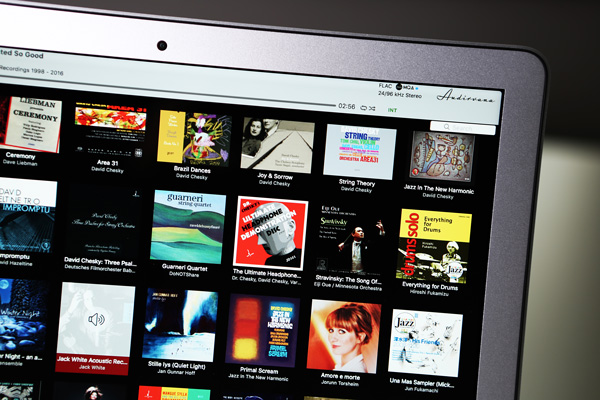
The recently-released Audirvana Plus 3 has become the first desktop music player for MacOS to include an integrated MQA Core decoder. To quote the press release, issued jointly by London-based MQA and Paris-based Audirvana, Audirvana's MQA Core decoder "enables the first origami 'unfold' and also authenticates the file using a blue or green light to confirm that the sound is identical to that of the source material."
In addition to optimizing sound quality and authenticating file provenance, Audirvana Plus 3 claims to include "a complete library management system with full metadata and cover art display" for music that is either stored locally or streamed, and integration with premium streaming services such as Tidal and Qobuz. Whether Audirvana's latest library management system etc. is anywhere near as extensive as what Roon currently offers is another matter.
The MQA Core decoder's initial file "unfold" is claimed to recover all direct music-related information and make it available for either analog or digital output at 88.2 or 96kHz. Thus, even without an MQA-enabled DAC, listeners can expect to hear enhanced sound. Optimal sound quality is achieved with an MQA-enabled DAC, which will continue to unfold the file "with precise file and platform-specific DAC compensation and management." Clarification on what all this means follows.
Audirvana offers a free 15-day trial version of Audirvana Plus 3. Cost for those wishing to purchase is $74 for new customers, $39 for upgrade from a previous version of Audirvana Plus, and gratis for those who have purchased Audirvana Plus 2 since December 25, 2016.
More Playback Software in the Pipeline
Audirvana will not be alone in offering MQA Core decoding. Amarra 4 Luxe, which is due in May 2017 from Sonic Studio, will support MQA decoding on OSX (10.8+) and Windows (8/10)-based computers for $99 pending final license agreement with MQA. The player will have an entirely new look, and include integrated artwork. Sonic Studio's Jon Reichbach reports, via email, "With MQA decode integration, Amarra 4 Luxe adds support for MQA playback of local MQA audio files and MQA Master files from Tidal HiFi streaming service. Amarra 4 Luxe's MQA decoding will allow playback of music up to 96kHz sample rates and, when combined with an MQA-enabled DAC, full unfolding to 4x rates as well as MQA rendering. The software will also include advanced equalization, headphone processing, optional iRC room correction, and support for native DSD (1x/2x). Future integrations will allow for MQA device management with integrated DSP processing."
Rob Darling of Roon Labs also reports that MQA decoding will come to the Roon music library/file player app, Stereophile's 2015 Joint Accessory of the Year, in a future update. Roon Core runs on Mac, PC, and Linux, with Room Remote available for Mac, PC, iOS, and Android. Tidal integration is part of the package.
Pure Music software, which is dedicated to MacOS, has not as yet finalized its plan for MQA decoding. As Rob Robinson explained by phone, "We expressed interest MQA at Rocky Mountain Audio Fest 2015, but they haven't followed up in a meaningful way."
As for JRiver playback software, CEO Jim Hillegass writes, "JRiver has no plans to support MQA. MQA is not a lossless or open format, and it offers no apparent benefit to consumers, in our opinion."
Because Bob Stuart of MQA was traveling at press time and unavailable for comment, I asked Darling if he could explain further how playback software that includes MQA Core decoding can improve sound, and how that improvement differs from what an MQA-enabled DAC can do. He replied:
"It helps to think of MQA as three things:
1. A lossless packing scheme.
2. A DSP technology for removing artifacts (de-ringing) both in the analog/digital converters used to capture the recording, as well as in the digital/analog converter you are listening through.
3. An authentication mechanism to show you are listening to a file in its full glory, with the right DSP applied for both ends of the digital process. If you play back through software that does the first decode, but with a standard DAC, you are unpacking a 24/48 losslessly encoded file and playing it back at 24/96, with the artifacts of the A/D removed.
If you play back through a full MQA DAC, that device has been tested and "profiled" by MQA, so that the DSP can be performed that will compensate for its artifacts. Thus, you get the full benefit of the DSP technology in MQA, where "de-ringing" has been applied with knowledge of both the A/D and D/A."
Audirvana will not be alone in offering MQA Core decoding. Amarra 4 Luxe, which is due in May 2017 from Sonic Studio, will support MQA decoding on OSX (10.8+) and Windows (8/10)-based computers for $99 pending final license agreement with MQA. The player will have an entirely new look, and include integrated artwork. Sonic Studio's Jon Reichbach reports, via email, "With MQA decode integration, Amarra 4 Luxe adds support for MQA playback of local MQA audio files and MQA Master files from Tidal HiFi streaming service. Amarra 4 Luxe's MQA decoding will allow playback of music up to 96kHz sample rates and, when combined with an MQA-enabled DAC, full unfolding to 4x rates as well as MQA rendering. The software will also include advanced equalization, headphone processing, optional iRC room correction, and support for native DSD (1x/2x). Future integrations will allow for MQA device management with integrated DSP processing."
2. A DSP technology for removing artifacts (de-ringing) both in the analog/digital converters used to capture the recording, as well as in the digital/analog converter you are listening through.
3. An authentication mechanism to show you are listening to a file in its full glory, with the right DSP applied for both ends of the digital process. If you play back through software that does the first decode, but with a standard DAC, you are unpacking a 24/48 losslessly encoded file and playing it back at 24/96, with the artifacts of the A/D removed.















