

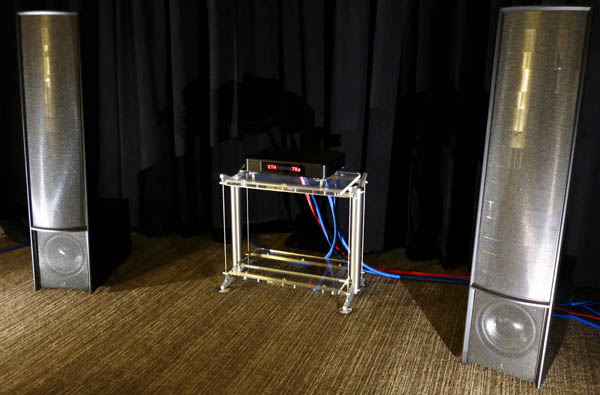
Never have I had to work so hard to convince someone that a product that first surfaced at CES 2017, just started shipping, and was just awarded MQA certification belonged in a new-product show report. Finally, after several minutes of what was beginning to look like a Socratic dialogue, Michael McCormick, President of Minneapolis-based Bel Canto Design, acknowledged that the single-box Bel Canto Black Box ACI 600 ($25,000) was indeed deserving of coverage by the publication that awarded the three-box Bel Canto Black system "Best Amplification Product of 2015."
Billed as the "Ultimate Integrated"—"It's essentially an app-controlled server/streamer that manages a library," said McCormick—the ACI 600 decodes MQA, up to DSD 128, and up to PCM 24/384. Roon-ready, it features Bel Canto's "tilt control," which compensates for room anomalies by adjusting treble and bass while holding the middle at a constant level. It also includes a programmable phono stage, selectable headphone output, 1 TB drive, and various remote-control apps. The ACI 600 outputs 300Wpc into 8 ohms, and 600 into 4.
Paired, by Chicago's Precision Audio & Video, with MartinLogan Expression ESL 13A loudspeakers and Cardas Clear Beyond cabling, the ACI 600 was handicapped by heavy drapes that impacted the speakers' rear-firing musicality. Despite the draping and the Expression ESL 13A's touted Anthem Room Correction, I found it impossible to fairly evaluate the Bel Canto unit in its echo chamber of a room. Nonetheless, when the Agathe Jazz Quartet performed "I've Got a Crush on You," MQA's ability to make voices sound real was clearly in evidence.
 Applause is due the US premiere of the Clearaudio Charisma phono cartridge ($2000). The cartridge was part of a Clearaudio Performance DC Wood turntable with TT-5 tonearm/swing base ($6500) that was exhibited by Quintessence Audio. Equal applause goes to the new Dynaudio Contour 60 loudspeaker ($10,000/pair) and to the Simaudio Moon 850P preamp ($30,000), 810LP phono preamp ($13,000), 650D CD player/DAC ($9000), 780D streaming DSD DAC ($30,000), and 880M amplifier ($45,000/pair). On Marian Hill's "Down," the lovely vocals were enhanced by impressive, well-controlled bass and various effects. On this and other tracks that were playing when I entered the room, the sound was excellent.
 It was excellent sound all the way at MoFi Distribution's world premiere of the TAD Laboratories Micro Evolution One loudspeaker ($12,495/pair). Paired with a Dr. Feickert Analogue Blackbird Deluxe 12 turntable with second-tonearm package ($9485) that was outfitted with Koetsu Urushi Sky Blue MC ($5995) and Urushi Vermillion mono MC cartridges ($6495), Balanced Audio Technology VK-P12-SE phono stage ($9995), TAD D1000 SACD player/DAC ($15,000), TAD C2000 preamp ($29,000), TAD M2500 amp ($24,000), Isotek power products and cables, Solid Steel racks, TAD speaker stands, and Nordost Valhalla 2 cabling, the speakers delivered a gorgeous midrange over a silent backdrop.
StillPoints Aperture panels, rather than heavy draping, certainly figured in the system's success. "Analog sounds extremely clear and quiet, with gorgeous timbres," I wrote in my notes before a 16/44.1 file of Victor Wooten and Marcus Miller's "Miller Time" was conveyed with ideal speed and beautiful timbres.
After the show, when I emailed Andrew Jones, formerly of TAD, to explain the evolution of the Micro Evolution One, he responded, "The Chief Engineer for TAD, Toru (Tad) Nagatani, worked with me all through my period of designing TAD speakers. Tohru Nakamura did a lot of the driver engineering. Both are brilliant engineers.
"The project concept started while I was there, but became stalled. It was picked up again after I left. The speaker uses a concentric driver that had been developed with TAD engineers for another project, and that I thought would be the perfect driver around which to base a new compact speaker design. As I left before the project re-started, I give all credit to Nagatani-san for its development and sound tuning. They have developed a stunning speaker."
While it will take a full review to confirm Andrew's assessment, a short listen under far less than ideal conditions suggested that the TAD Evolution One could join the short list of outstanding diminutive speakers that have caused people to re-evaluate the need for large floorstanders.
It was excellent sound all the way at MoFi Distribution's world premiere of the TAD Laboratories Micro Evolution One loudspeaker ($12,495/pair). Paired with a Dr. Feickert Analogue Blackbird Deluxe 12 turntable with second-tonearm package ($9485) that was outfitted with Koetsu Urushi Sky Blue MC ($5995) and Urushi Vermillion mono MC cartridges ($6495), Balanced Audio Technology VK-P12-SE phono stage ($9995), TAD D1000 SACD player/DAC ($15,000), TAD C2000 preamp ($29,000), TAD M2500 amp ($24,000), Isotek power products and cables, Solid Steel racks, TAD speaker stands, and Nordost Valhalla 2 cabling, the speakers delivered a gorgeous midrange over a silent backdrop.
StillPoints Aperture panels, rather than heavy draping, certainly figured in the system's success. "Analog sounds extremely clear and quiet, with gorgeous timbres," I wrote in my notes before a 16/44.1 file of Victor Wooten and Marcus Miller's "Miller Time" was conveyed with ideal speed and beautiful timbres.
After the show, when I emailed Andrew Jones, formerly of TAD, to explain the evolution of the Micro Evolution One, he responded, "The Chief Engineer for TAD, Toru (Tad) Nagatani, worked with me all through my period of designing TAD speakers. Tohru Nakamura did a lot of the driver engineering. Both are brilliant engineers.
"The project concept started while I was there, but became stalled. It was picked up again after I left. The speaker uses a concentric driver that had been developed with TAD engineers for another project, and that I thought would be the perfect driver around which to base a new compact speaker design. As I left before the project re-started, I give all credit to Nagatani-san for its development and sound tuning. They have developed a stunning speaker."
While it will take a full review to confirm Andrew's assessment, a short listen under far less than ideal conditions suggested that the TAD Evolution One could join the short list of outstanding diminutive speakers that have caused people to re-evaluate the need for large floorstanders.
 The all-new MSB Select DAC ($84,500) with Femto 33 clock and mono power-base options ($9950 and $19,950, respectively) contains a new 16/44.1 digital filter and in-home-upgradable firmware claimed to raise CD sound to hi-rez levels "without oversampling or other processing tricks." Though it can play DSD natively, the MSB Select DAC offers a new "DSD Optimized Mode" firmware upgrade that addresses DSD out-of-band artifacts in a new way. MSB claims the Select DAC is future-proof, in that new DAC ladders and clocks can be installed in its modular architecture whenever they are developed.
Joining the DAC were the MSB Universal MSB Universal Media Transport V with Dual Signature Transport Power Base ($11,990), M204 monoblocks ($39,950/pair), YG Acoustics Sonja 1.2 loudspeakers ($72,800/pair), and Analysis Plus cabling.
First up was Dean Martin's "I'm Confessing that I Love You" on SACD. One of those close-recorded, intimate tracks that, like many of Ella Fitzgerald's recordings from the 1950s, invariably makes a system sound good, it was beautifully quiet, intimate, and smooth. However, when I was played a blues track to demonstrate how the DAC made a piano sound like a "real piano," it failed to convince.
Asking to hear my oft-cited Murray Perahia CD of Handel and Scarlatti, I discovered that the system over-emphasized the lower parts (undertones) of individual notes, and lower-pitched tones over higher ones. As smooth and lovely as the sound was, the system's lower midrange imbalance put too much emphasis on the notes in Perahia's left hand, and highlighted the piano's percussive plunk while diminishing its sustain.
The all-new MSB Select DAC ($84,500) with Femto 33 clock and mono power-base options ($9950 and $19,950, respectively) contains a new 16/44.1 digital filter and in-home-upgradable firmware claimed to raise CD sound to hi-rez levels "without oversampling or other processing tricks." Though it can play DSD natively, the MSB Select DAC offers a new "DSD Optimized Mode" firmware upgrade that addresses DSD out-of-band artifacts in a new way. MSB claims the Select DAC is future-proof, in that new DAC ladders and clocks can be installed in its modular architecture whenever they are developed.
Joining the DAC were the MSB Universal MSB Universal Media Transport V with Dual Signature Transport Power Base ($11,990), M204 monoblocks ($39,950/pair), YG Acoustics Sonja 1.2 loudspeakers ($72,800/pair), and Analysis Plus cabling.
First up was Dean Martin's "I'm Confessing that I Love You" on SACD. One of those close-recorded, intimate tracks that, like many of Ella Fitzgerald's recordings from the 1950s, invariably makes a system sound good, it was beautifully quiet, intimate, and smooth. However, when I was played a blues track to demonstrate how the DAC made a piano sound like a "real piano," it failed to convince.
Asking to hear my oft-cited Murray Perahia CD of Handel and Scarlatti, I discovered that the system over-emphasized the lower parts (undertones) of individual notes, and lower-pitched tones over higher ones. As smooth and lovely as the sound was, the system's lower midrange imbalance put too much emphasis on the notes in Perahia's left hand, and highlighted the piano's percussive plunk while diminishing its sustain.
 Linear Tube Audio's new ZOTL40 Mk.II power amplifier ($5800) contains different tubes, caps, and internal wiring than its predecessor. It shares with its companion, the LTA Micro ZOTL preamp ($2100), circuitry designed to provide the detail of solid-state and warmth of tubes.
Equally new in the room were Spatial Audio's M3 Triode Master speakers ($4000/pair), which were designed to be tube-friendly. With an in-room frequency response of 32Hz–18kHz, ±3dB, the speakers claim 95dB efficiency.
The rest of the system included Lampizator's Komputer server (3900), which contains a Linux-based computer that, I was told, is "really tricked out" and offers Roon, HQ Player, upsampling to DSD, and the ability to play DSD512, and Lampizator's Golden Atlantic DAC (9000). The DC uses directly heated Russian 4P1L tubes and a ladder digital engine, plays all forms of PCM and up to DSD256, and doesn't upsample.
On music that contained, at most, one vocalist and two instruments, the system made some enticingly beautiful, warm sounds with a very smooth finish. The noise floor seemed low, and the presentation clear. However, when the presenters were asked to play something complex that would reveal the extents of the system's abilities, they could find nothing on their server that would suffice. Consider this a disappointingly hung jury of one, with no verdict possible.
Linear Tube Audio's new ZOTL40 Mk.II power amplifier ($5800) contains different tubes, caps, and internal wiring than its predecessor. It shares with its companion, the LTA Micro ZOTL preamp ($2100), circuitry designed to provide the detail of solid-state and warmth of tubes.
Equally new in the room were Spatial Audio's M3 Triode Master speakers ($4000/pair), which were designed to be tube-friendly. With an in-room frequency response of 32Hz–18kHz, ±3dB, the speakers claim 95dB efficiency.
The rest of the system included Lampizator's Komputer server (3900), which contains a Linux-based computer that, I was told, is "really tricked out" and offers Roon, HQ Player, upsampling to DSD, and the ability to play DSD512, and Lampizator's Golden Atlantic DAC (9000). The DC uses directly heated Russian 4P1L tubes and a ladder digital engine, plays all forms of PCM and up to DSD256, and doesn't upsample.
On music that contained, at most, one vocalist and two instruments, the system made some enticingly beautiful, warm sounds with a very smooth finish. The noise floor seemed low, and the presentation clear. However, when the presenters were asked to play something complex that would reveal the extents of the system's abilities, they could find nothing on their server that would suffice. Consider this a disappointingly hung jury of one, with no verdict possible.
 I prefer not to end on a down note, but the sound in the room put together by Saturn and Harold of TuneLand Vegas was as incomprehensible as the system and setup. (Several conversations were going on while music was playing.) You can only see part of it—the Audio Note AN-E loudspeakers, Audolici all-tube electronics from Portugal, a $30 Magnavox DVD player, ca 2002, used as a source, Audio Note and Transparent cabling, and some of the Michael Green Audio devices—but not the equally unattractive Michael Green room treatment that was positioned at a 90º angle to the system beyond the picture boundaries.
Applause is due the US premiere of the Clearaudio Charisma phono cartridge ($2000). The cartridge was part of a Clearaudio Performance DC Wood turntable with TT-5 tonearm/swing base ($6500) that was exhibited by Quintessence Audio. Equal applause goes to the new Dynaudio Contour 60 loudspeaker ($10,000/pair) and to the Simaudio Moon 850P preamp ($30,000), 810LP phono preamp ($13,000), 650D CD player/DAC ($9000), 780D streaming DSD DAC ($30,000), and 880M amplifier ($45,000/pair). On Marian Hill's "Down," the lovely vocals were enhanced by impressive, well-controlled bass and various effects. On this and other tracks that were playing when I entered the room, the sound was excellent.
It was excellent sound all the way at MoFi Distribution's world premiere of the TAD Laboratories Micro Evolution One loudspeaker ($12,495/pair). Paired with a Dr. Feickert Analogue Blackbird Deluxe 12 turntable with second-tonearm package ($9485) that was outfitted with Koetsu Urushi Sky Blue MC ($5995) and Urushi Vermillion mono MC cartridges ($6495), Balanced Audio Technology VK-P12-SE phono stage ($9995), TAD D1000 SACD player/DAC ($15,000), TAD C2000 preamp ($29,000), TAD M2500 amp ($24,000), Isotek power products and cables, Solid Steel racks, TAD speaker stands, and Nordost Valhalla 2 cabling, the speakers delivered a gorgeous midrange over a silent backdrop.
StillPoints Aperture panels, rather than heavy draping, certainly figured in the system's success. "Analog sounds extremely clear and quiet, with gorgeous timbres," I wrote in my notes before a 16/44.1 file of Victor Wooten and Marcus Miller's "Miller Time" was conveyed with ideal speed and beautiful timbres.
The all-new MSB Select DAC ($84,500) with Femto 33 clock and mono power-base options ($9950 and $19,950, respectively) contains a new 16/44.1 digital filter and in-home-upgradable firmware claimed to raise CD sound to hi-rez levels "without oversampling or other processing tricks." Though it can play DSD natively, the MSB Select DAC offers a new "DSD Optimized Mode" firmware upgrade that addresses DSD out-of-band artifacts in a new way. MSB claims the Select DAC is future-proof, in that new DAC ladders and clocks can be installed in its modular architecture whenever they are developed.
Joining the DAC were the MSB Universal MSB Universal Media Transport V with Dual Signature Transport Power Base ($11,990), M204 monoblocks ($39,950/pair), YG Acoustics Sonja 1.2 loudspeakers ($72,800/pair), and Analysis Plus cabling.
First up was Dean Martin's "I'm Confessing that I Love You" on SACD. One of those close-recorded, intimate tracks that, like many of Ella Fitzgerald's recordings from the 1950s, invariably makes a system sound good, it was beautifully quiet, intimate, and smooth. However, when I was played a blues track to demonstrate how the DAC made a piano sound like a "real piano," it failed to convince.
Linear Tube Audio's new ZOTL40 Mk.II power amplifier ($5800) contains different tubes, caps, and internal wiring than its predecessor. It shares with its companion, the LTA Micro ZOTL preamp ($2100), circuitry designed to provide the detail of solid-state and warmth of tubes.
Equally new in the room were Spatial Audio's M3 Triode Master speakers ($4000/pair), which were designed to be tube-friendly. With an in-room frequency response of 32Hz–18kHz, ±3dB, the speakers claim 95dB efficiency.
I prefer not to end on a down note, but the sound in the room put together by Saturn and Harold of TuneLand Vegas was as incomprehensible as the system and setup. (Several conversations were going on while music was playing.) You can only see part of it—the Audio Note AN-E loudspeakers, Audolici all-tube electronics from Portugal, a $30 Magnavox DVD player, ca 2002, used as a source, Audio Note and Transparent cabling, and some of the Michael Green Audio devices—but not the equally unattractive Michael Green room treatment that was positioned at a 90º angle to the system beyond the picture boundaries.















